Construction, packaging, or agriculture works are not new to most of us. And the question is, what kind of plastic do you think the thing you stumbled upon is? A thin, flexible, and shiny plastic layer used for covering, sealing, or protecting is what you most likely have in your hands. That’s LDPE sheet – short for Low-Density Polyethylene sheet – and it’s far more powerful than it looks. The irony is that most of us take it for granted, assuming it is merely another plastic sheet. However, LDPE is the one saving the day silently.
I can recall a day I went to visit a local construction site, where I found workers engrossed in the task of spreading black LDPE sheets in preparation for the concrete pouring. Out of my inquisitiveness, I asked the site engineer the reason for using these sheets. Just a simple explanation coming from him, “If not for these, water would flow freely and we would lose strength in the foundation.” The interaction I had with him made me see how something so common can have a huge impact.
What Are LDPE Sheets?
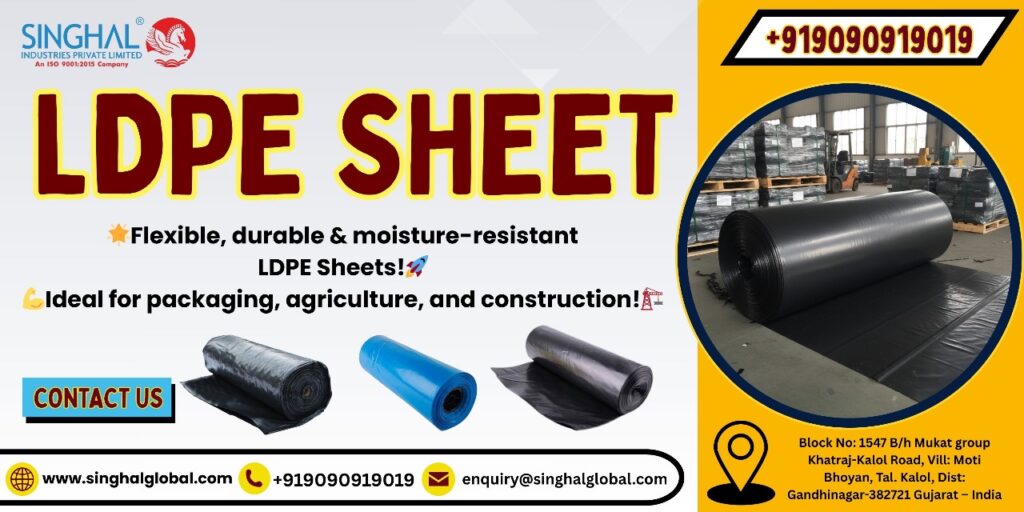
LDPE is an acronym for low-density polyethylene. It is a type of thermoplastic that is created from the monomer ethylene under high pressure. The final product is a flexible, semi-transparent sheet that is tough, weatherproof, and chemically stable. Many people confuse LDPE with HDPE; however, LDPE is a softer and more flexible material.
Thinking of an LDPE plastic sheets, consider one that can be somewhat stretched, be resistant to tears, and can handle moisture without getting spoiled. It does not rust, rot, or crack easily. These features make it a perfect fit for industries that are in heavy use for protection, insulation, and water resistance.
Why LDPE Sheets Are Cost-Effective
The most common first question most buyers ask is — what is the LDPE sheet Price? It is an entirely reasonable question since the budget plays a major part in the decision of industrial material selection. What is surprising is that even though LDPE is very durable and performs well, it is mostly cheaper than those materials that provide the same properties.
From the viewpoint of production, LDPE is obtained by high-pressure polymerization, which is a well-known and quite affordable process today because of its scalable technologies. Also, the manufacturing process does not include a port of complex additives or reinforcements for the general applications, thus the cost per kilo is lowered.
LDPE Sheets in Construction
Construction sites are full of surprises — influenced by rain, sun, dust, and inevitable wear. This is the exact place where LDPE sheets come into their own. A lot of engineers would use an LDPE sheet for construction for the achievement of some of the following objectives:
- As a moisture barrier under concrete slabs
- For waterproofing foundations and basements
- To cover building materials on-site
- Temporary roofing during repairs
- Road construction for preventing soil-water mixing
One of the most significant advantages of LDPE sheets is their behavior towards fluctuating temperature. For a country like India, where temperatures can vary from 5°C to 45°C, materials are often subjected to expansion and contraction. LDPE silently takes its part without breaking or separating.
LDPE in Packaging and Manufacturing
What if I told you that the thin plastic layer that you take off your new furniture or electronics is probably LDPE? This material’s transparency, flexibility, and sealing ability are what attract the packaging industries the most.
A manufacturer uses it in the production of stretch wraps, lining material, and container covers. In this way, the products are protected from moisture and dust, the addition of which is almost negligible in terms of weight. Moreover, LDPE is recyclable, which makes it compatible with the current plastic waste mitigation trend.
LDPE Sheets in Agriculture
LDPE plays a major role in agriculture, which is something that you wouldn’t have thought of. Farmers utilize it in mulching, as greenhouse covers, and for water storage linings. By using the sheet, the soil retains its moisture, weeds are kept at bay, and the crops get protection from overly strong solar rays.
In locations where the weather is hard to predict, such as parts of Rajasthan or Maharashtra, LDPE sheets have brought stability to farming. The farmers have also disclosed that mulching with LDPE has elevated their crop yield. Technology empowering grassroots agriculture is definitely a win-win scenario, and seeing it is both uplifting and encouraging.
A Cost-Saving Case
There was a story of a small construction firm in Gujarat that told that by switching to LDPE, they have saved waterproofing costs by 30% annually. They used a bitumen-based sheet which they claimed that due to the high temperatures of the summer would crack and peel quite fast. Detachment of the bitumen-based sheet was thereby the cause of the usual waterproof layer failure. Transition to LDPE not only lengthened the material life but also decreased the labor cost as the installation was relatively simple, according to them.
Meanwhile, a Mysore entrepreneur thought to use the remnants of packaging-grade LDPE sheets as liners for their bio-compost pits. And they recognized that the sheets were durable enough to resist moisture and microbial action. They said, “It was a low-cost solution that has developed into a permanent one.”
What-did-they-mean moments like these really make us understand the material as not just a simple one but rather an enabler of cost control, innovation, sustainability, and more.
Market Trends and Global Manufacturers
The worldwide LDPE market keeps expanding due to the material’s requirement from various industries. In India, companies like Singhal Industries, Reliance Industries, GAIL, and Sabic are major contributors to this segment. In the same way, ExxonMobil Chemical, Dow Chemical, and LyondellBasell are the topmost global players in the production of LDPE sheets.
Working on making the product more durable, environmentally friendly, and adaptable for highly specific applications such as solar panel back sheets or advanced geomembranes, LMN are the chief contributors of LDPE innovation that rely heavily on research and development.
Common Applications at a Glance
- Construction moisture and vapor barriers
- Agricultural mulch films and pond liners
- Packaging protection wraps
- Chemical storage tank lining
- Temporary roofing and insulation
- Floor protection in renovation projects
The underlying concept of each of these is the same — dependable function without unnecessary costs.
Conclusion
The fact is LDPE sheets do so much to quietly revolutionize the industries by providing a cheap yet efficient alternative the more you look at them. Using them as crop covers, waterproofing buildings, or furniture wrapping are just a few of the ways in which LDPE does its job without attracting attention or making demands.
Their reliability coupled with their low price is what makes LDPE sheets one of the most feasible industrial materials around. Therefore, the next time you go by a construction site or a farm and see those translucent or black sheets, think again – they are doing a lot more than what you see.
Frequently Asked Questions (FAQs)
Q1. In what manner are LDPE sheets different from HDPE sheets?
LDPE (Low-Density Polyethylene) is a softer and more flexible material and has a lower melting point than HDPE (High-Density Polyethylene). On the other hand, HDPE is less flexible but more rigid and stronger. While LDPE is generally more suitable for application as a stretch and moisture-resistant material.
Q2. Are LDPE sheets safe for food contact?
Under certified and controlled production conditions, LDPE sheets are safe to be in direct contact with food. They are made of inert and non-toxic materials, so they are widely used in the food industry as packaging films and containers.
Q3. How long do LDPE sheets last outdoors?
The duration of LDPE sheets when exposed to outdoor conditions is usually between 3 to 5 years. Those with a UV stabilizer could live 7 years depending on the weather and the amount of their exposure.
Q4. Are LDPE sheets suitable for agricultural applications?
Sure! LDPE sheets are very widely used in mulching, soil covering, irrigation canals, and greenhouses, and these are owing to their properties like being flexible, weather-resistant, and able to retain soil moisture.
Q5. Who is the largest manufacturer of LDPE sheets?
Leading producers of LDPE sheets are a few major global conglomerates like Singhal Industries, LyondellBasell, and ExxonMobil. Top players in the Indian market for LDPE are Reliance Industries Limited, GAIL, and Sabic India.