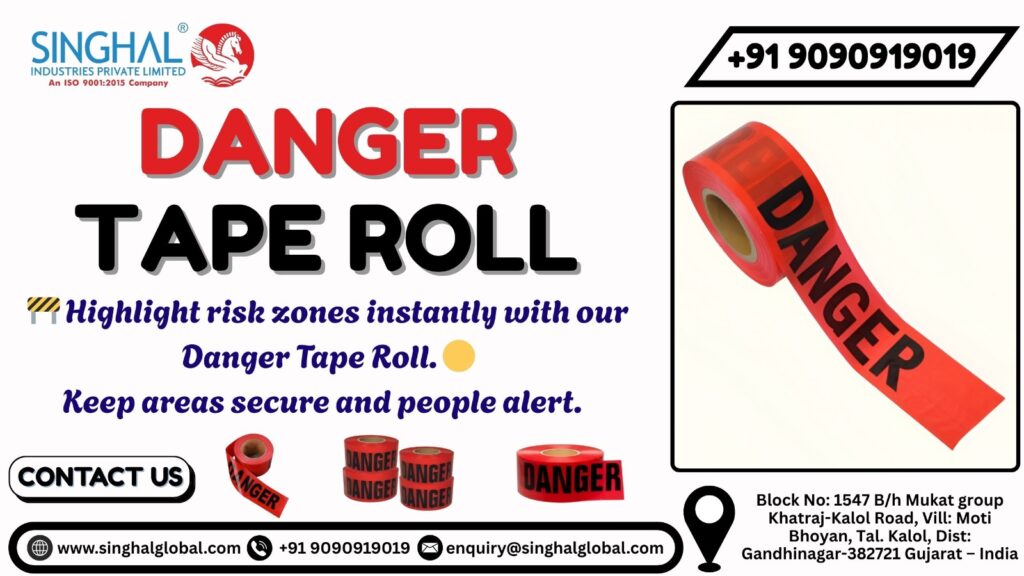
What is a Danger Tape Roll?
It shouldn’t be overly complicated to make a safe area. Just one roll of caution tape is enough to make a previously confusing and dangerous situation understandable at once.
It is a brightly colored, non-adhesive plastic tape utilized to identify the area of danger or the portion of a place restricted to the public that is commonly referred to as a Danger tape roll. The tape is typically constructed of sturdy polyethylene or the equivalent plastic, and the most commonly used graphics are “DANGER – DO NOT ENTER” printed in big dark letters.
Such tapes are placed around holes, installations with heavy machinery, electrical works, road repairs, places where an accident has happened, and a number of other areas that can be potentially harmful to people. Besides that, it is very convenient in terms of its features – it is light, can withstand the rain, and is very easy to fix – and therefore it has become one of the safest on-the-spot management instruments.
Why These Simple Tapes Matter
One can easily overlook the importance of a mere strip of plastic; however, a danger tape is what actually prevents a person from taking that one wrong step. In fact, when an area has been properly cordoned off, people instinctively slow down, observe their surroundings, and make safer choices.
It provides a visual barrier that even a passer-by can recognize without the need to consult a safety guide.
First of all, the use of the tapes correlates to legal and safety regulations since many of these require the existence of visible barricades at areas of hazardous work.
Moreover, the tapes clarify the situation for the workers, visitors, and drivers, by informing them of the places that are either allowed or forbidden to them.
Very often the least expensive safety products are those which people turn to each and every day. A danger tape roll is one of such items.
Where Danger Tape Rolls Are Used
Danger tape rolls have an extensive list of uses, and as a result, they are present not only in the different industry sectors but also in the urban spaces.
Some of the common uses are:
- Construction and civil work: Marking open trenches, scaffolding zones, crane operating areas, demolition sites, and concrete pouring zones.
- Road and infrastructure maintenance: Barricading pothole repair areas, manhole work, bridge maintenance, and traffic diversions.
- Industrial plants and warehouses: Marking high-risk zones around machines, electrical rooms, chemical storage, or maintenance work.
- Events and crowd control: Using the tapes to separate the audience from the areas where the shows or concerts are prepared, temporary structures, or unsafe stages and platforms.
- Emergency and accident scenes: Holding the public away from fire, collapse, spill, or accident investigation zones.
At all of these locations, a roll of danger tape serves as a temporary, adaptable barrier that may be taken down or moved when the work is relocated.
How Good Manufacturers Make a Difference
Not all tapes are the same, and that is why quality danger tape producers are important. Quality producers utilize high-strength polyethylene or a similar fabric that can endure tearing, UV exposure, and harsh outdoor conditions. The color (usually red with black lettering for danger) needs to be bright enough to be seen even in dim light or dusty conditions.
Good danger tape roll manufacturers also:
- Provide your company with the pressing products containing your brand and the warnings of your choice.
- Different thicknesses are provided by them for use that is light, standard, or heavy-duty.
- They ship their products to a lot of different countries and are familiar with the safety regulations in each locality.
Singhal Industries Pvt Ltd, for instance, is recognized as a top danger tape roll manufacturer and exporter, providing durable products to markets such as the USA, UK, UAE, Australia, and Gulf countries. By cooperating with the experienced Danger tape manufacturers, companies can escape the production of the cheap rolls that deteriorate quickly and tear even if the wind is only a bit stronger.
Choosing the Right Danger Tape Roll
It is beneficial that the person choosing a danger tape roll considers other aspects rather than just the price and color.
Key points to consider:
- Material and thickness: The material should be a strong polyethylene or the like plastic with a suitable thickness that is weather-resistant and fits the conditions of the site.
- Colour and message: What safety managers mostly recommend is that the red “DANGER” tape is used for high-risk zones, while the yellow “CAUTION” ones are for lower-risk and warning areas.
- Visibility: The whole idea of the tape was to be recognized from afar and under various lightings, so the tape should have a bright mixture of light and dark color, and be bold-printed.
- Roll length: Longer rolls would be good for bigger areas and projects with the short ones for small projects and works indoors.
- Supplier reliability: A long-performed Danger tape roll manufacturer with consistent quality and a non-stop supply is the point to pay attention to.
Consumers might sometimes be attracted by very low prices, but a small saving per roll is of no use if a tape that breaks, sags, or fades is being used while work is still going on.
Using Danger Tape Safely and Effectively
Putting up a danger tape is pretty easy, but the right way is the point.
Basic good practices include:
- Mark clear boundaries: Before unrolling the tape, you have to figure out not only the area that is dangerous but also how far people must stay back from such an area. Use poles, cones, fencing, scaffolding, or existing structures to make a continuous fence that people cannot pass through.
- Keep it tight and visible: Danger tape roll should be done at a certain height so that it does not touch the ground and it is easy to spot. Where most people will approach from, the message side should be facing that direction.
- Check and maintain: Changes in worksites occur every day. Along with the wind, vehicles, or even curious kids can dislocate tape. Therefore, supervisors should regularly walk the boundary to see if there are any sections that need tightening and if there are any that have been damaged and thus should be replaced.
- Remove after use: After a risk has been removed, the tape should be taken away so as not to confuse people and avoid useless plastic waste. Leaving old and faded tapes hanging is giving a wrong sign that safety is not as important as before.
Here we have this tiny inconsistency: the tape is made to be durable and long-lasting, but often it is used only once and then thrown away. That is a starting point for environmental questions.
Can Danger Tape Be Eco-Friendly?
Commonly, the production of dangerous tapes involves non-biodegradable plastic films that are generally not recycled. After using such tapes, they are thrown away as plastic waste. If the tapes were to be only paper-based, then the production process could be recyclable, but most barricades or danger tapes are plastics, and they are not allowed in usual recycling streams.
Although the changes are happening slowly:
- Some of the suppliers have started to offer barrier tapes that are partly made of recycled plastic or more environmentally friendly material.
- There is a small number of manufacturers and safety advisors who suggest the reuse of the tape if it is still good rather than treating every roll as single-use.
- Certain areas have provisions for recycling plastic films. However, you have to check the local regulations before deciding to do that.
Is it possible for a danger tape to be really “green”? Perhaps not yet; however, people are very much into looking for better alternatives, and the markets are responding with recycled and sustainable options.
Conclusion
In fact, a single roll of danger tape is something that goes beyond writing plastic. It is a tiny but potent indication of the care that the workers, visitors, and the public are given. The results can be the everyday reality of “easy safe zones” coming from a slogan if decisions about the right danger tape manufacturers, usage of the tape properly, and the consideration of its environmental impact are made collectively.
Frequently Asked Questions (FAQs)
Q1. Can I use Danger Tape Roll on construction sites safely?
Yes, the danger tape roll is a common sight on construction sites, where it serves the purpose of fencing off the areas that pose danger like open trench, overhead lifting area, and demolition zone. Red “DANGER” tapes are highly recommended in safety guidelines and are the ones mostly used when the risk is high and it is necessary to have entry strictly controlled.
Q2. Is the tape still visible from a long distance?
Good quality danger tapes are manufactured with very bright colors and the letters are in bold pressing with contrasting colors, thus the tapes are very visible even from a safe distance during the day and under some artificial lighting as well. Regulations and best practices normally require that the sources of danger must be clearly visible to a person long before they reach the site of the danger, especially in the case of heavy industries and traffic.
Q3. What is the proper storage of a Danger Tape Roll?
If you want to keep the danger tape roll in good condition for a long time then you need to store it in a cool, dry place where it is not subjected to direct sunlight and is distant from any extreme heat. It is also good to store the rolls in their original packaging or in a closed container so that they are not exposed to dust and can be protected from unintentional damage, thus they will always be ready for use whether planned or an emergency.
Q4. Is Danger Tape recyclable?
The majority of plastic danger tapes that are commonly used are not that recyclable and are treated as plastic waste after being used. There may be some paper-based or special eco barrier tapes which can be recyclable or made from recycled material, but you should adhere to the local recycling regulations or consult your supplier for proper guidance.
Q5.Who is the largest exporter of danger tape roll?
China is currently the leading exporter of danger tapes globally and holds a substantial share of global export volumes, according to trade data and recent market analyses. The international buyers often choose the Singhal indutries manufacturers and the other significant exporting regions to fulfill their demands, subject to quality, certification, and logistics needs.