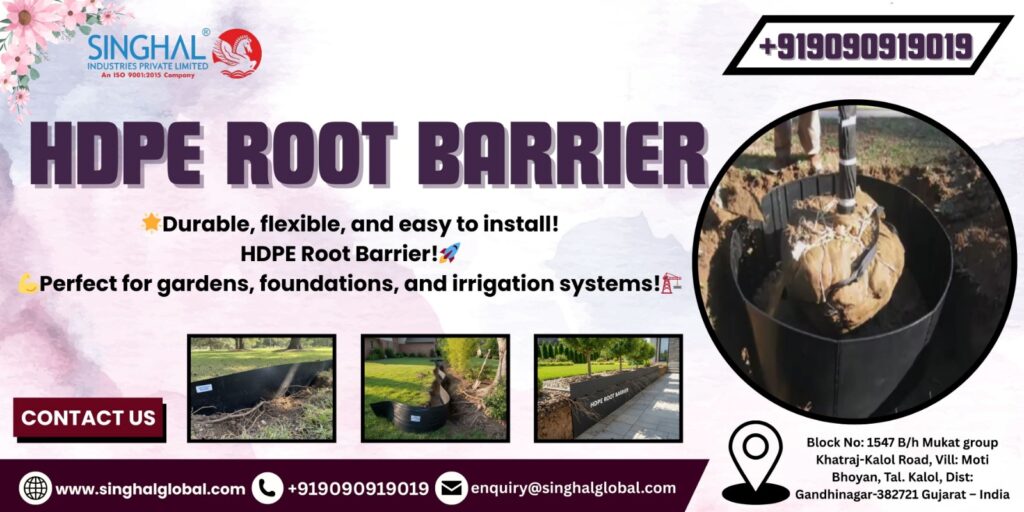
It is very important to increase the health and safety of trees in urban landscaping, residential gardening, and commercial planting projects with the help of HDPE root barriers. These Plastic root barriers help in controlling the growth of roots, protecting the underground utilities, and preventing the pavements, pipes, and foundations from getting expensive damages. These plastic root barriers can help roots grow downwards thus if trees are grown hygienically and safely with the help of these barriers which are properly installed and maintained.
What is an HDPE Root Barrier?
An HDPE root barrier is essentially a sturdy and pliable panel fabricated from high-density polyethylene plastic and used for limiting and rerouting the roots’ growth. The product is fully sealed against roots and, therefore, the roots try to find a deeper way into the soil instead of spreading on the surface, and thus, they do not damage the sidewalks, driveways, foundations, and underground utilities. The Root barrier for trees is a physical barrier placed vertically in the soil around the root zone. It is very durable as it is not easy for the soil microbe to take moisture, chemical, or microbial attack from it.
Singhal Industries Pvt. Ltd. is known for a long time as an HDPE root barrier manufacturer, which is a company focused on quality and produces plastic root barriers that are durable and are used throughout India and exported to various countries. Their items vary in thickness, width, and length to meet different project needs.
Benefits of Using HDPE Root Barriers
- Durability and Flexibility: HDPE root barriers can endure different types of weather conditions; they do not break and are able to uphold their shape and function when submerged in water or covered with soil for a long time without wear and tear.
- Effective Root Growth Control: They nip in the bud surface destruction by creepers of the kind like pavement push or foundation crack, thus stopping roots at the source of recourse and making them go downwards again.
- Protect Underground Utilities: The impermeable barrier shields water pipes, sewage lines, cables, and other utilities from invasive root damage.
- Environmental Friendliness: The utilization of recycled or reprocessed material comprises the major part of many barrier productions; thereby, their carbon footprints are very minimal. Besides that, they are non-toxic and safe for soil fauna.
- Cost Savings: While the initial cost may be deemed quite high, the long-term costs saved from pavement repairs, plumbing fixes, and tree loss that can occur due to root growth are significant.
Installation Insights for Root Barrier for Trees
There is a need for proper planning and the right technique when putting in an HDPE root barrier if one wants to get the greatest advantages from the work. The steps normally include:
- Placement of the marking materials along the circle of the tree or its root system that is going to be sheltered.
- Digging around the root zone. The depth to which one digs depends on the tree species. In most cases, it is about 30 inches.
- Inserting the root barrier piece vertically into the trench and making sure that it shows a little above ground level to stop roots from overrunning it.
- Filling the excavated hole with earth and pressing it down firmly around the barrier to keep it immobile.
- If it’s required, you can also place the edges of other sheets over each other and fix joints properly so that roots can’t get access to them.
Certain professional landscapers and homeowners who have installed this have expressed their emotional relief through stories, such as the prevention of destruction to their cherished home gardens or city pavement, which would have otherwise cost them thousands of dollars and brought them great distress.
Contradictions and Opinions
However, despite the benefits of the HDPE root barriers, the use of plastic underground, the cause of microplastic pollution, is, according to some, what the barriers contribute to, and that is a problem that will take decades to solve. Meanwhile, the advantages that come from the use of recycled HDPE and the constituent part of the infrequent infrastructural maintenance rather than the removal of damaged concrete or digging of pipes are more significant, supporting the argument.
Also, some argue that proper care and knowledge must accompany the installation of root barriers. If, for instance, a person installs the barrier too shallowly, leaves holes, and so on, then the roots will find their way around the barrier, and the problem will not be solved although the barrier has been installed. This submission underlines that one should either take a professional’s advice or strictly follow the provided guidelines when planning the installation.
Conclusion
To sum up, the use of HDPE root barriers can significantly help the balance between trees and the urban infrastructure, enabling cohabitation in cities and rural areas. This, of course, depends on taking the barriers from trustworthy factories and vendors, the correct placing, and later maintenance of the pads. In case you are aiming at prolonged and efficient protection of your trees, landscapes, and infrastructures, purchasing plastic root barriers such as those by Singhal Industries will undoubtedly be a wise and money-saving decision.
Frequently Asked Questions (FAQs)
Q1. Is HDPE Root Barrier a good choice for various trees and plants?
With the help of a root barrier HDPE, any wood or plant species is normally compatible. The exception is the root systems of decorative plants such as bamboo and wild poplar, which will inevitably have to be thicker and deeper. Also, it is always good practice to check the different plant requirements for installation.
Q2. Can HDPE Root Barrier be harmful to underground facilities?
No, HDPE root barriers do not pose a threat to underground facilities such as water pipes, sewage, or electrical lines. The protective layer required for breaking the roots of the tree does not hamper the facility’s functionality, and the barrier itself is totally safe (chemically inert and non-toxic).
Q3. Are HDPE Root Barriers sustainable products?
Considering that waste materials have been transformed responsibly into finished materials, HDPE is a great solution for panel production from an environmental perspective. In addition, they refrain from huge damages on the ground caused by frequent repair and replacement of infrastructures and thus save natural resources. Furthermore, the products are free of contaminants and odors, making them safe for the soil ecosystem.
Q4. Is the barrier available only in rolls or also in other formats?
The general cases of HDPE root barriers are available in rolls, yet one can come across pieces of the barrier tailored to size projects and requirements which can be cut from the roll. Width and thickness of the rolls can be adjusted accordingly to certain standard units that either small residential gardens or large commercial landscapes can use.
Q5. Who is the largest supplier of HDPE Root Barrier?
Singhal Industries Pvt. Ltd., Mumbai, is among the top producers and exporters of HDPE root barriers in India and ranks high regarding both comprehensive production and exports globally, with quality and adaptability being the main characteristics.