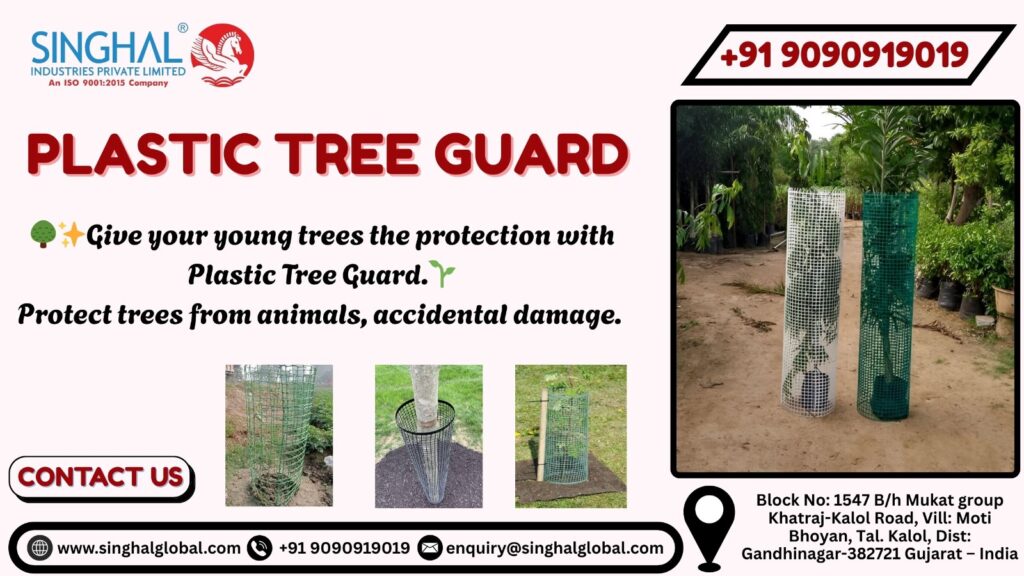
Without a doubt, healthy trees are the result of good Plastic tree guard care, which can significantly improve tree health, their survival, and even quicken the growth rate, particularly in the 3–5 years period of the first life. Essentially, by selecting the best guard, placing it properly, and keeping it with some affection and attention, you are transforming a little vulnerable sapling into a robust, self-assured tree that will still be able to resist weather, animals, and city life without any problem.
The Main Reason Why Tree Guard Care Should Be Considered a Priority
Basically, young trees could be likened to children in a densely populated playground – they can be hurt by anything that is around them – goats, cows, bikes, lawn mowers, even strong wind or unmindful people. In effect, a plastic tree guard acts as a kind of safety shield that is placed tightly around the trunk and which prevents bites to the bark by animals, damage caused by the use of machines, and extreme sun so that the tree can use energy for growth rather than repair work.
Proper care means not only purchasing a guard and then forgetting about it, but rather it implies taking care of the guard by ensuring that it is kept upright, ventilated, clean, and that it is changed for a bigger size as the tree grows. Thus, the guard is not only there to “stay” – it becomes a single element of the overall tree care system that provides water retention, lessens the tree’s stress, and in general adds to the tree’s good condition.
How to Find the Best Plastic Tree Guard?
The first major step in tree guard care is to figure out the kind of tree plastic guard that would suit your climate, animals living in the area, and your budget before going further with regards to taking care of them. Most buyers nowadays mostly go for HDPE or PVC-based guards because these materials are light in weight, are UV stabilized, and are durable enough to be left in the field for a few years without breaking due to sun or rain.
- HDPE guards: The best HDPE tree guard manufacturers provide the customers with such guards that are not only flexible but also impact resistant, and therefore, can endure both the bite of animals and rough treatment at farms or roadside plantations. They are chosen for big projects because of their qualities that make them light, easy to carry, and fast to put on, even by people without the necessary skills.
- PVC guards: Usually, PVC units are a more rigid design or a net and are utilized when a firmer frame is necessary, or when one compares the Pvc tree guard price with metal or RCC and finds plastic to be more cost-effective per year of life.
- Mesh vs. solid: Mesh products provide the user with more air circulation and light, whereas semi-solid products offer extra protection from sand, dust, or chemical spraying; the “right” choice simply depends on the conditions of your site and the type of tree.
In India, the company Singhal Industries Pvt. Ltd. is considered one of the most reputable HDPE tree guard manufacturers that provides different-sized and patterned plastic nets and tree protective material for landscaping, agriculture, and city projects.
Daily and Seasonal Care Practices
The installation of the guard is just the beginning, as regular maintenance is not very different from looking after a child’s school bag – small checks prevent big problems. A kind, everyday check-up will keep not only the tree but also the guard healthy throughout the year.
Some of the most crucial care habits are:
- Check for Damage: After encountering strong winds, a storm, or animal movement, if you see cracks in the plastic, broken ties, or tilted guards that may press the stem, then it is time to repair the damaged parts.
- Adjust Ties: As the tree grows thicker, take off the ties or move them so that they will not bind to the bark and limit the growth of the tree, especially if it is a fast-growing one.
One such shared emotional moment that is quite common among people is when a little sapling that was planted for a loved one – perhaps for the birth of a child or in the memory of someone cherished – suddenly looks suffocated because the guard is too tight. Usually, the tiny alteration that offers the tree “space to breathe” brings not only relief but also simultaneously a weird feeling of guilt and joy.
Preventing Animal and Mechanical Damage
Mostly, people put plastic tree guards around trees to avoid animals and machines from damaging trees. A proper guard is the thing that keeps the tree safe from bites, rubbing, and unintentional “assaults” by mowers, bikes, or walkers.
- Animal Browsing: Among the many things that deer, goats, cows, and rabbits love to eat are the soft bark and leaves of young trees; however, plastic tree guards prevent them from eating the parts that are closest to the trunk and lower branches.
- Bark Rubbing: Animals sometimes may rub their horns or bodies against the tree trunks, resulting in the removal of the bark and the exposure of wood; however, guards prevent this from happening by stopping the direct contact.
- Mechanical Damage: In urban areas, the use of trimmers, brush cutters, and even construction activities can lead to the easy removal of the bark; thus, the presence of the guard acts as a visible and physical boundary among the workers who are operating their machines and are unwilling to cross it.
Most of the time, one story is enough where a single guard “rescued” a little tree from a bike crash or a cow’s horn, and that one small win is often what convinces a whole neighborhood or panchayat to cover all newly planted trees.
Ventilation, Light, and Tree Growth
Well-made plastic tree guards deliver safety without depriving trees of necessary air.
Contemporary tree guards employ a perforated or mesh design, thereby allowing air to flow unimpeded and light to come in contact with the bark and the lower portion of the stem. Correct ventilation deters the development of fungi and prevents the trunk from getting too hot on warm days.
Moreover, these guards help the trees by creating a slightly milder microclimate around them – less direct wind, lower evaporation, and some shade – thus they can not only reduce the stress of the saplings but also potentially enable them to root faster, especially in arid or windy regions. Numerous specialists are therefore of the opinion that trees equipped with well-constructed guards usually grow more rapidly and may reach a stable height sooner than those without protection.
Conclusion
Besides that, large B2B marketplaces have listings of the various plastic tree guard producers from which one can find a trusted supplier such as Singhal Industries that stands out. If you use the correct plastic tree guard and install it properly, and keep taking care of the tree after that, then your young trees aren’t just “protected” – they get the real opportunity to mature into strong, lovely trees that make the environment better, the farms healthier, and give you a treasure trove of memories that last for quite a while.
Frequently Asked Questions (FAQs)
Q1. Are Plastic Tree Guards capable of providing sufficient air circulation?
Indeed, the majority of contemporary plastic tree guards are constructed with perforations or mesh-style openings that facilitate air circulation, hence the bark is ventilated and does not overheat or remain damp for extended periods. It is particularly beneficial to use a mesh HDPE or PVC design in a hot or humid area where the occurrence of mildew and heat stress are likely.
Q2. Could the guard impede the tree’s growth?
An ideally chosen and properly mounted guard normally results in the tree’s growth becoming healthier since it lessens the stress from animals, wind, and mechanical injuries, thus more energy can be used for height and trunk development. On the other hand, if the guard is too tight, too short, or never changed as the trunk is growing, it may hinder growth or even cause injury to the bark; therefore, it is very important to make regular checks and adjust the guard in due time.
Q3. Are Plastic Tree Guards able to stop animal-caused damages?
Certainly, plastic tree guards are among the frequently employed means to prohibit animals’ access to cutting, biting, and rubbing of the plant stem, mainly due to animals such as goats, cattle, deer, and rabbits, by creating a physical fence around the tree trunk. When done at the proper height and with a secure attachment, they greatly diminish the early-stage losses of plantations, farms, and urban roads, thus paving the way for sustainability.
Q4. What is the duration of a Plastic Tree Guard?
Tree guards made out of top-notch HDPE and PVC along with UV-stabilized material can stay in good condition for years outdoors; however, this still depends on the amount of sun exposure, the way the item is handled, and the climate of the area. The majority of plantation managers carry out this practice over numerous planting seasons, thus the per tree cost becomes very low with the passage of time.
Q5. Who is the largest supplier of Plastic Tree Guards?
Though there are numerous suppliers all over the world, Singhal Industries Pvt. Ltd., in the Indian scenario, is considered one of the top-notch manufacturers and suppliers of HDPE plastic tree guard nets as well as other tree protective products.