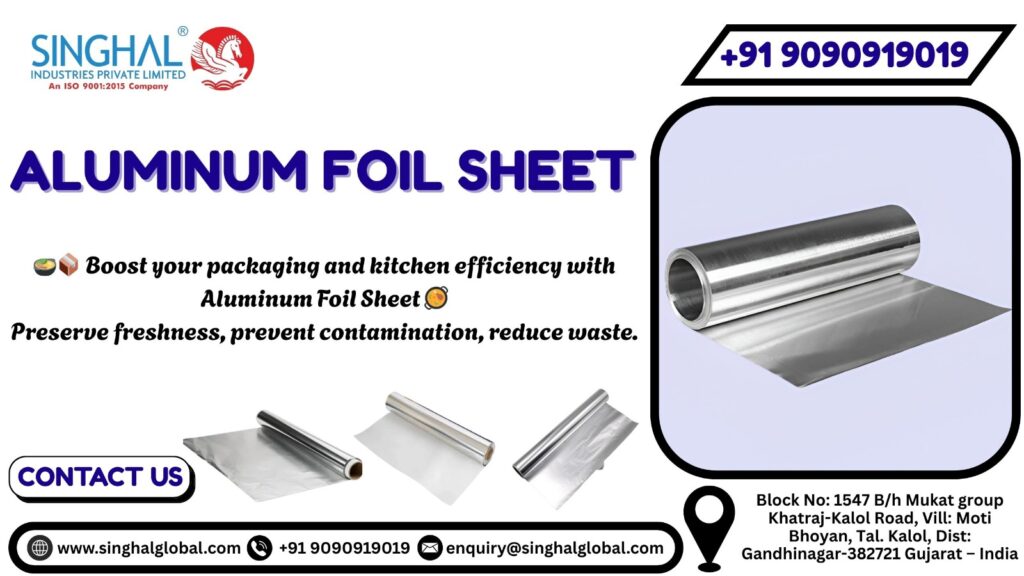
If you look around any industry plant or packaging facility, or even a construction site, there is one material which you can almost be sure of finding there – the Aluminum foil sheet. It is thin, bright, light in weight, and almost endlessly versatile; it is one of those silent helpers which are indispensable in the industrial worlds. We tend to think of aluminum foil as a food wrapping or baking tool, but the reality is, it hardly gets utilized in the kitchen for what it is made. As a matter of fact, it penetrates deeply into manufacturing, energy, transportation industries, and even in advanced technology!
That is why it makes sense to pause for a second and take a trip through the industrial world of aluminum foil sheets. A surprise awaits you in the fact of how a minor metal piece can be so instrumental in our daily lives – the times when we don’t even acknowledge it.
What Exactly Is Aluminum Foil?
Basically, aluminum foil is very thin aluminum – it is rolled to a thickness of less than 0.2 millimeters. It is a pretty simple thing, but that’s where its magical powers lie. The foil is a good reflector, durable, and quite resistant to moisture, light, bacteria, and air. These features have made it a favorite in different industrial sectors.
The majority of foil sheet producers make the foil through a process of multiple rolling, in which aluminum slabs are brought to the required thinness by continuous rolling, then the foil is annealed (heat-treated) to increase its flexibility and luster.
Once upon a time, tin foil was in vogue, but the taste it imparted to food made the people shift to aluminum foil. Since then, aluminum foil has been the one to lead the way in all the industries worldwide – mainly because it is less expensive, safer, and recyclable.
Why Industries Love Aluminum Foil Sheets
The question that arises is why most factories and engineering departments seem to be so fond of foil sheets. The main qualities which make it an absolute must-have are:
- Light in weight but strong: The addition of unneeded weight to machines or products is out of the question by it.
- Reflective and heat-resistant: Emits heat, thus can be used for insulation and packaging purposes.
- Non-toxic and food-safe: Safe for food applications and does not react with most substances.
- Corrosion-resistant: Doesn’t corrode or break down easily, even under humid or high-temperature conditions.
- Recyclable: Aluminum is a material that can be reused an infinite number of times without a loss in quality.
Every one of those features leads the way to a certain industrial application of the material. We can find out what those applications are if we think through the points one by one.
Aluminum Foil in the Packaging Industry
One could argue that there is no other industry that so heavily relies on aluminum foil as the packaging one. Whatever the case with the first and the third of the examples listed above may be, this material is ubiquitous in the pharmaceutical industry as well.
Take the case of a chocolate bar. Who doesn’t love a good chocolate bar wrapped in a shiny wrapper? The look gives the product double its value of goodness, but the main function of the wrapper is to keep the food fresh by keeping out water, air, and light. So the packaging of pharmaceutical products is equally dependent on foil sheets. The push-through packaging (also called blister packs) is the way used to keep drugs dry and safe from pollutants.
In addition, food processing plants buy in bulk from Foil sheet manufacturers who provide them with aluminum foil in large quantities because they are using it to wrap ready-to-eat meals, dairy products, and snacks. The barrier properties of foil are what make it a perfect preservative to extend shelf life without the addition of harmful preservatives.
Aluminum Foil in the Construction Industry
What is it that the majority of people most likely don’t realize is that the metal foil doesn’t only serve food. It’s an indispensable building material.
In construction projects, aluminum foil sheets are being utilized as the sources of insulation. They prevent the solar heat from coming through the surface as it reflects it back, thus keeping the rooms cool in summer and warm in winter. For example, foil sheets installed under the roof or on the walls act as a heat-reflecting layer; hence, the usage of air conditioners and heaters is greatly decreased.
An instance where the usage of reflective insulation made of foil sheets has been employed for temperature control is commercial warehouses situated in hot places like Rajasthan or Dubai. Not only does this help them cut down on energy usage, but it also brings down the total of operational costs for the facility.
Quite a number of foil sheet manufacturers have nowadays been adding polymer coatings or laminations to their products so that the sheets can be more durable and have longer fire resistance when used in the construction industry.
Healthcare and Pharmaceutical Uses
The healthcare industry may be the biggest consumer of aluminum foil than what most people think. It is not only medicine packaging but also sterilization, storage, and hygiene.
Hospitals employ sterile aluminum wraps with medical tools as the foil keeps out the pollutants while being sterile. Besides, bandages and ointment tubes are also made to depend on aluminum films to be their bridesmaids in terms of integrity and shelf life.
Being a nontoxic product, foil turns out to be a dream one for the pharmaceutical unit – bacterium-resistant, odorless, tasteless, and safe. So long as the packing is done in a proper way, medicine can be good for years without a single trace of degradation.
Cost and Market Trends
The prices are not fixed and vary with the worldwide demand for aluminum, the prices of energy, and the quantity of recycling. Materials are mostly charged according to their thickness and coating, where the price is also changed if the manufacturer offers custom laminations. The aluminum foils price is higher than that of household foil due to quality specifications and protective treatments.
Nevertheless, a good number of industries still opt for it because of its long life, recyclability, and overall good performance. In case the initial Aluminum foil price is quite high, the money will be paid back quickly by means of efficiency and less maintenance.
Conclusion
Aluminum foil sheets may appear fragile, but their use in the industry is of great magnitude. They are everywhere – from packaging the food that we eat to cooling our vehicles, insulating our homes, and supporting renewable energy. Regardless of whether you are a small manufacturer or a large global corporation, aluminum foil is still the silent, unsung hero – shapeless, silent, and endlessly useful.
Frequently Asked Questions (FAQs)
Q1. How long does aluminum foil last?
Aluminum foil is not something that will “expire.” It is capable of lasting forever provided that it is correctly stored in a place where there is no moisture or chemicals. Under industrial applications, it may still be in good working condition for up to several decades depending on the environment such as temperature and exposure.
Q2. Can aluminum foil be used for baking?
Definitely! It is one of the best materials for baking. Because it is a heat-resistant and non-sticky (if properly oiled) material, bakers turn to it when they need to line trays, wrap dough, or cover dishes to help retain the moisture.
Q3. Are aluminum sheets waterproof?
Practically, yes. Aluminum sheets are water-resistant and do not corrode like steel. What they do is to form a very thin oxide layer that acts as a shield against moisture.
Q4. Can aluminum foil sheets be used for insulation?
Yes, surely! They are the top most common pieces of the industry. You can find them everywhere, even in houses, industrial plants, and different modes of transport, where they are mounted for the purpose of heat reflection, which is leading to cooler interiors and energy-saving.
Q5. Who is the largest manufacturer of aluminum foil sheets?
There are a few big players in the industry. Big companies such as Singhal Industries Pvt Ltd (India), Norsk Hydro (Norway), and Alcoa Corporation (USA) are considered to be the leading ones in the global market. Besides, there are numerous regional manufacturers of aluminum foil sheets that produce the specialized or eco-friendly variants which are customized for specific industries.