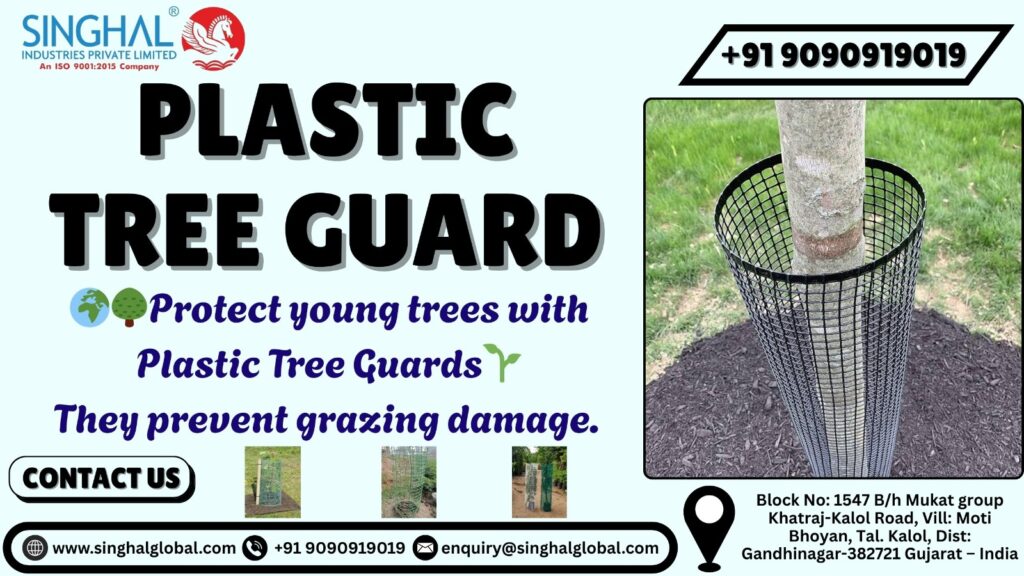
Hey, everyone! Have you ever planted a tiny sapling only to see it devoured by rabbits and snapped off by hefty wind? Sure, I’ve been there. This is where plastic tree guards can be found as superheroes for your trees. These easy-to-use, yet brilliant devices protect young plants in landscape drives and planting projects. They’re made of durable PVC and similar materials, creating an enclosure over the root. In India, where we love our trees, but are battling unpredictable weather and pests, tree guard India alternatives are growing. No matter if you’re putting in a greener urban park or a huge farming operation, the guards will keep trees safe until they grow high in their individuality.
But, wait, do you think they’re truly that good? Sometimes I question if they’re just another issue with plastic within our ecological world. Nah, let’s dive deeper. This blog will break down the entire subject matter of plastic tree guards, from how they function in real-world projects to choosing the perfect PVC tree guard cost that won’t cost you a fortune. We’ll discuss Tree guard manufacturers, throw in some frequently asked questions, and maybe even ask several aspects in the process. Keep coming; it’s going to be a great trip through the trees.
How do Plastic Tree Guards Fit into Big Plantation Projects?
Plantations aren’t just a small garden thing. Think of government schemes such as those of the Green India Mission or corporate CSR tree drives. Here, Tree guard India demand explodes. Manufacturing companies produce millions each year and deliver to states ranging from Kerala to Kashmir.
Imagine a typical construction project that involves 10,000 trees along an expressway. Without guards, the survival rate? Perhaps 40 percent. If you have plastic guards? It can reach 80-90 percent. They allow water and air to pass through, but they block dangers. Installation is simple: just dig a little, place the guard on top of the ground, and then stake it. There are no fancy tools required.
Landscape professionals love them for campuses and parks. You can imagine IIT campuses or luxurious hotels – neat rows of protected trees that are in a uniform, beautiful, and attractive. However, here’s a question: What do they do everywhere? In the super-hot Rajasthan deserts, perhaps not on their own; pair them with stakes. The flexibility of the stakes is crucial.
I’ve seen some projects where the guards double as mini greenhouses, capturing humidity in dry regions. Cool hack! But, is it a problem with forests? Debatable. More on that later.
Distinguishing the Types and Features of Plastic Tree Guards
Guards are not all created identical. The most basic ones are straight tubes that measure about 3 feet high. More expensive models vent at the top to allow airflow and prevent the growth of mold. Colors? Green blends with white, while the heat reflects off of it.
PVC tree guard cost varies dramatically. Entry-level? The price is 20-40 for smaller sizes. Premium, UV-stabilized ones? Up to 100 rupees. Bulk purchases will drop to around 15 Rs. Buy wisely. Local Tree guard manufacturers in India offer discounts.
Materials matter. Virgin PVC lasts longer than recycled plastic; however, recycled is greener. Thickness? 1-2mm standard. Some are slits that allow for easy development of the trunk. For a more attractive landscaping look, spiral guards encircle the tree in a natural way. Straight ones are ideal for mass plantings. Tips: Select an item that is UV-resistant for India’s sun; they’re less yellow.
However, prices can fluctuate. Fuel costs up? Tree guard price rises. Visit the internet or contact the manufacturer directly.
Highlight on the Tree Guard Industry from India
There’s a vibrant scene in India for tree-protection producers. The major players from Gujarat, Maharashtra, and UP produce high-quality products. Names such as those from Ahmedabad produce eco-friendly PVC guards and even export.
Why should you choose local? Faster delivery, custom sizes, better tree guard price. They adjust to suit Indian conditions, monsoon-proof and pest-proof.
Have you ever been to a factory? Machines are able to extrude plastic tubes continuously. Quality checks assure that there are no cracks. Top manufacturers are certified by ISO to prove their products’ durability.
The time to compare: A few claim Chinese imports are less expensive. But customs fees and shipping cost them more in the long term. Also, you can support local employment, right?
To help you with your project, search for the Tree guard India suppliers through the IndiaMART website or Alibaba. Request samples. The largest ones provide lakhs of dollars per month to government tenders.
Instructions for Installation – Do Not Mistake This!
Alright, hands-on time. Step 1: Choose a spot, dig a hole for the sapling. Step 2: Remove the guard when spiral, then slide it over the trunk. Leave a 2-inch gap at the base to allow water. Make sure you stake it down deep, 1 foot deep underground. Ties loosely, chokes tightly restrict growth. It’s done! Two minutes for each tree!
Common mistake? Forgetting vents. Trapped moisture rots bark. In monsoons, raise your base a bit. A twist on landscaping: Add decorative stones to create the appearance of bling. In the case of plantations, align guards in the same direction to prevent wind.
Benefits that Will Blow Your Mind (And Some Negatives)
Pros first: Cost-effective. One guard is able to protect for many years while avoiding the expense of replanting. It’s portable and stacks on trucks easily. Eco-angle: Use fewer pesticides with no weeds. Trees are growing faster, absorbing more CO2. They also accelerate maturation, reducing water consumption. Stats? Studies show 70% greater survival in plots with guards. In the arid regions of India, the survival rate is 85 percent.
Downsides? The pollution from plastic is not averted if recycled. Animals might chew ’em (rare). In forests, they appear sloppy. There are some contradictions! Certain forests prohibit them for natural appearance, but roadsides require. It makes sense? Debatable. Overall, the benefits outweigh the costs for the majority of projects.
A Real-World Example: Studies from India
Let’s get real. By 2023, Uttar Pradesh planted 35 million trees. Tree guards India make use of technology to boost survival rates to 75 percent. Varanasi ghats project guards have protected 90 percent of the peepal saplings they saved from goats. Karnataka highways Tree guard Manufacturers sold 5,000 units. Result? Greener roads, less erosion. The winning landscaping project, Mumbai’s Aarey Colony revamp, used spiral guards. Trees flourished in a city of chaos. A failure story? One Rajasthan project lacked stakes; winds fell half. Leaps to be learned. These stories prove that the right application is the best way to ensure success.
Cost Analysis – Budgeting Smartly for Your Project
PVC tree guard prices are crucial. If you have 1,000 trees: Basic: Rs 25k total. Premium: Rs. 60k. Include stakes (Rs 5k). Add labour (Rs 10k). ROI? Replants saved worth a few lakhs. Tree guard manufacturer’s bulk purchase reduces costs. Govt subsidies help too. Comparing: Bamboo guards will rot in a year and are more expensive long-term. Question: Budget tight? Start small, scale up.
The Future of Tree Guards: What’s Next in the Field of Tree Guards?
Biodegradable plastics are coming! The last 3-5 years will vanish naturally. It’s expensive now, but it’s dropping. Smart guards that have sensors? Monitor moisture via app. This app is great for large-scale projects. India’s drive: more trees, security, India R&D to develop models that are climate-proof. It’s exciting times!
Conclusion
In conclusion, PVC tree guards may not be perfect, but they’re a game changer for landscaping and planting. From PVC tree guard cost steals to the top tree guard India selections, we’ve been informed.
Frequently asked question (FAQs)
Q1. What sizes are there for plastic tree guards?
Sizes galore! For saplings: small (1-2 feet), medium (3-4 feet), gigantic (up to 6 feet) for large trees. Diameters from 5 to 20 centimeters. Custom made by manufacturers.
Q2. Are plastic tree guards used to plant roadside plants?
Absolutely! They can handle traffic noise and exhaust, and wind. UV versions work best. Make sure you stake well.
Q3. Are plastic tree guards appropriate for plantations in forests?
Mixed bag. Excellent for protection at first, but removed later to get a natural appearance. Certain forests do not like them; it’s dependent on the rules.
Q4. What is the average time that plastic tree guards last?
3-10 years easily. UV-stabilized? 7+ hours in the sunlight. Recycle post-use.
Q5. Who is the largest supplier of plastic tree guard ?
A tough choice; however, Gujarat-based giants are like Singhal Industries Pvt Ltd those who supply national projects. Look up tree guard companies for the numbers – thousands of dollars per month!