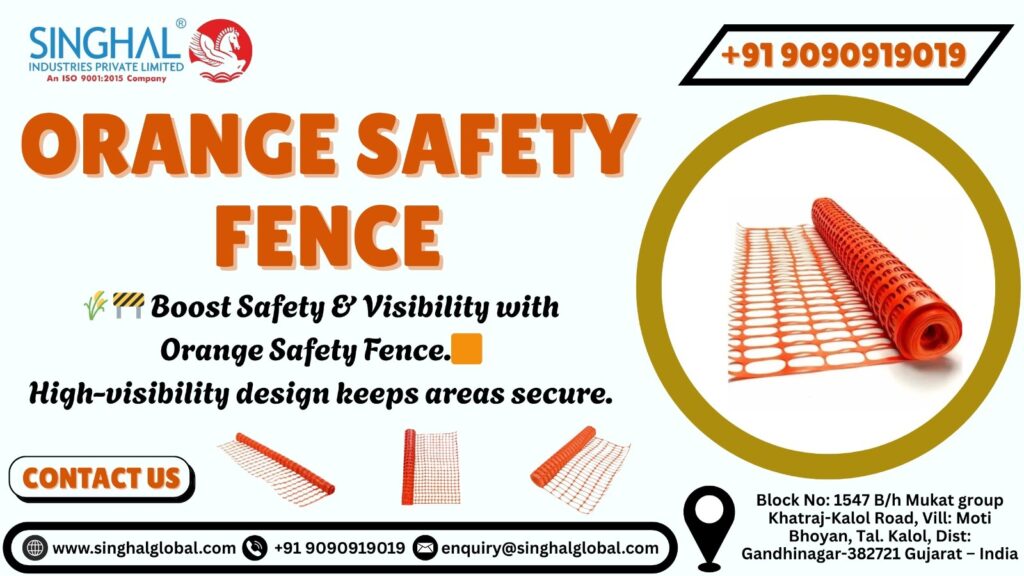
Everyone in the road construction and construction world—have you noticed those striking orange fences that are popping up in construction sites all over India? They’re more than just pretty; they’re lifesavers. Orange safety fence identify dangerous zones, keep unauthorized individuals out, and ensure that operations are smooth amid construction, digging, and heavy equipment. In a nation like India, with mega-projects such as Bharatmala and smart cities all around, they are indispensable.
Why do they have to be orange The bright hue can cut through fog, dust, and twilight, making it impossible to ignore. Today, we’re breaking down everything from their cosmetics to the real-world application, including the best Orange safety fence supplier India, as well as Orange safety fence exporter India and the orange safety fence manufacturing facility in India. At the end of this article, you’ll understand why avoiding these is a risk you shouldn’t take. However, before that, let’s get to the fundamentals.
The fences are usually made out of high-density polyethylene (HDPE) mesh, which is tough and flexible. It weighs between 150 and 300 grams per square meter. The mesh dimensions? Usually fifty millimeters x 50 millimeters aperture, permitting wind to whistle through without transforming into a kite. Rolls typically measure 1.5m to 2m in height and 25-50m in length; they weigh between 10 and 20kg to allow for simple handling by two people. Installation? Hammer on metal or plastic ground stakes every 2-3m, then tension by bungees. All done in just a few minutes. There is no welding, and there is no heavy lifting as with steel barricades. And durability? UV-stabilized for 12+ years in the harsh Indian sun, impervious to chemicals, and fire retardant according to guidelines.
Why Orange Safety Fences Dominate Construction Sites
Construction sites are hazardous playgrounds—trenches deeper than 1.2m demand barriers per Indian Factories Act rules. Orange safety fences do well here. They secure the excavations, scaffold base, and stockpiles of material. In the event of a crash, visibility can reduce trips by 30-40% according to safety audits. Go to a high-rise building in Gurgaon; the fences stopped the risk of falling during crane operations. Also reusable—roll into place, then store and redeploy. Cost? About Rs40-100 per meter, as opposed to more than Rs200 for metal. Eco-friendly recyclable HDPE reduces waste.
They aren’t, but can they be guaranteed to be reliable? Sometimes, a nudge from a forklift tears them, a valid gripe. Solution: double layer or reinforced edges. When monsoons are on, they drain quickly, unlike fabric that is sagging. Do they conform to NBC 2016? Yes, if they are from certified manufacturers.
Perfect Fit for Road Projects
Roadwork’s a different beast: NH expansions, urban pothole repairs, and toll plazas. Orange fences are shining for detours, lane closures, and asphalt safety. India’s MoRTH has them as a requirement to provide temporary control of traffic. On NH-44, they’ve managed the traffic safely amid continuous pours. They can withstand winds up to 120km/h, stackable for transport. Contrary to what people say: they’re too heavy for the highways. The reinforced models that use fiberglass rods prove that they can withstand the ravages of cyclones.
Customized rocks: print “Road Work Ahead” or reflective strips for nighttime. For Kerala rainfalls, they stayed in place while wood was washed away. Stats? IRC reports reveal 25% less run-offs when there are visual barriers.
Key Features and Material Breakdown
What is the source of these fences? HDPE’s tensile strength is about 15-20kN/m². Colors? Pure orange or black to provide contrast. Accessories: grommets to tie spiked bases to create soft ground. Tests include drop tests, abrasion, and colorfastness. Indian factories employ blow-film extrusion to create uniform mesh. It is superior to Chinese weaves, which fray quickly. Lifespan? 1 to 2 years outdoors, more indoors. Maintenance: wash mud and look for tears. Tips for storage of bulk: hang vertically to prevent wrinkles.
Leading Suppliers and Exporters in India
India is the world’s hub. As the most renowned Orange safety fence supplier India, Gujarat and TN companies are the most dominant. Orange safety fence exporter India? Exports grew by 35% between now and the year 2025. They are heading to UAE and Africa. One Orange safety fence factory India, close to Coimbatore, produces 20,000 rolls per month and exports 60%. What’s the reason? BIS/IS 17319-certified, competitive with $0.5/meter FOB. Vs imports: faster delivery, no duties. Example: Dubai Expo used Indian fences and was praised for their strength. Local edge: customize fast, like adding Hindi warnings.
Installation Guide and Best Practices
- Survey site, mark hazards.
- Cut the fence to size.
- Drive stakes 30cm deep, 2m apart.
- Clamp on the top and bottom of it, and pull it even.
- Light up signs, lights and other lighting to make the night.
- For roads: pair with cones. Utilize A-frames.
Training teams: poor setups cause 10% of failures. First, safety first: wear gloves, and check the wind.
Applications Across Industries
Beyond roads and construction: events (Diwali fairs), farms (pesticide zones), warehouses (aisle barriers), airports (tarmac work), and mines (stockpiles). Versatility? Even shipyards for gangway edges. Question: snow-prone? Consider a treatment to prevent hair loss.
Challenges and Solutions
Issues: fading in Rajasthan sun—pick UV20+. Trends: IoT integrated for alerts, biodegradable blends. Market growth in 2028: Rs600cr, according to FICCI.
Real-World Success Stories
Hyderabad Metro: 10km fenced, zero breaches. Rajasthan highway: cut delays 20%. Varanasi ghats rehab: crowd control magic.
Conclusion
Rs1,500-4,000 per 50m roll. Factors to consider: thickness, UV rating. Get it from Orange safety fence supplier India for warranty Smart fences equipped with GPS and auto-tension. The Atmanirbhar push in India will lead to more factories. Go orange—or regret it?
Frequently Asked Questions (FAQs)
Q1. Do you think orange safety fencing is suitable in construction areas?
Absolutely, it’s made specifically for this purpose. Its high visibility, light installation, and weatherproofing are ideal for marking perimeters, hazards, and digging on busy construction sites.
Q2. What are the heights of orange security fences?
The usual heights are 1 meters, 1.2 meters and 1.5 meters, and the highest height is 2 meters. Reputable suppliers offer custom heights that can be used to suit the project requirements.
Q3. What are the industries that use orange fences to prevent accidents?
They are relied on in ensuring safety zones in roadworks, construction, events, warehouses, agriculture, airports as well as oil fields.
Q4. Is orange fencing cuttable to the size required?
It’s a breeze to cut using knives or scissors. The majority of suppliers offer cut-to-size panels, while roll-cuts can be customized on the spot.
Q5. Who is the largest exporter of Orange Safety Fence?
India is a leader in the world and is the world’s top safety fence exporter. Indian companies, particularly Singhal Industries Pvt Ltd in Gujarat, export millions of meters annually to more than 50 countries.