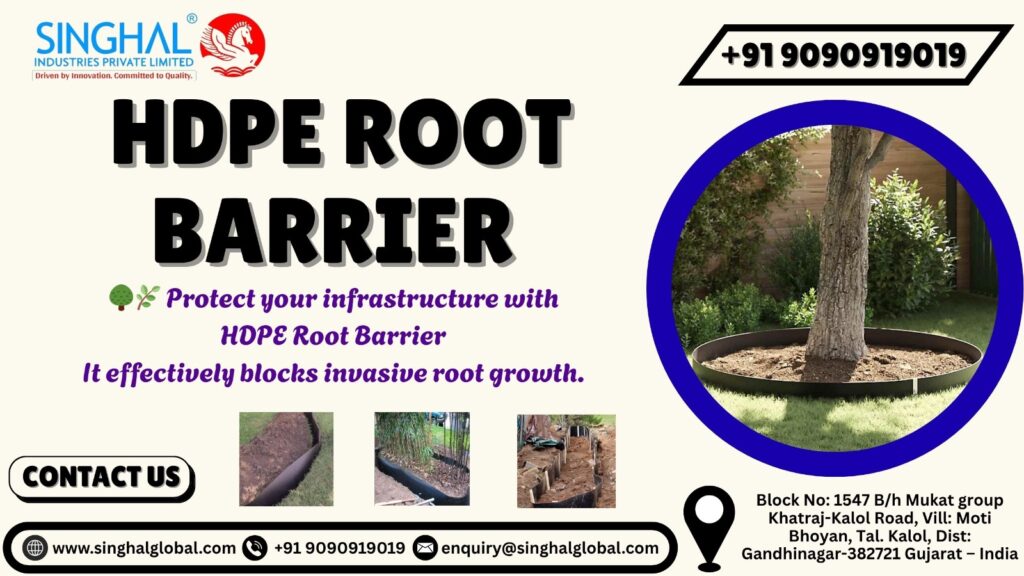
Roots, whether found in cities or even within garden plots, bring both advantages and annoyances. The benefits are clear, providing trees to shade the city, improve soil quality, and enhance aesthetic appeal. Unfortunately, roots can cause problems by gradually cracking pavements, lifting tiles, weakening foundations, and even rupturing underground pipelines. In such cases, one solution to consider is the use of HDPE root barriers.
This blog post will provide you with information about Root barrier HDPE, including how they protect infrastructure; what factors impact the root barrier price; the application areas of the products known as root barrier sheets; and some common FAQs. We aim to give you practical information that will make the reading more interesting than a standard academic article.
How HDPE Root Barriers Protect Infrastructure
The roots do not suddenly decide to damage your drainage system; rather, their natural tendency is to look for water, oxygen, and nutrients. Sadly, these are often available close to the foundation, drainage, or water supply line. Given enough time, the roots from the huge trees such as banyan, ficus, eucalyptus, or bamboo will exert pressure resulting in:
- Structural damages on buildings’ foundations and retaining walls.
- Raised pavements and driveways.
- Water leakage in water supply or sewer pipes.
- Degradation of waterproofing material in planter or podium gardens.
Installing a Root barrier sheet using HDPE in between the tree and the infrastructure allows you to control the situation. The barrier:
- Prevents the roots from penetrating directly into the protected area.
- Guides the aggressive roots downwards and reduces surface lifting.
- Prevents aggressive roots from damaging the waterproofing membrane.
- Avoids expensive repair costs in the future.
For large infrastructures, it is not only financial issues that come into play. Sewage contamination of the soil is possible, not to mention the damage to footpaths resulting in accidents.
Another paradox related to roots is that while we talk about the beauty of strong roots, which we appreciate, no one will be singing their praises when they damage newly-laid pavements. Therefore, HDPE walls ensure that we benefit from the shade and vegetation without any costly damage to infrastructure underneath.
HDPE Root Barrier Sheet Key Features
Let’s highlight some important characteristics that distinguish an HDPE root barrier sheet from ordinary plastic sheets.
- High mechanical strength and toughness
An HDPE root barrier sheet is strong enough to prevent roots from penetrating the area covered by this film. For example, the roots of bamboo plants are not able to penetrate HDPE films since they have high tensile strength and puncture resistance.
- Resistance to chemicals and moisture
Since the soil may be acidic or alkaline, the underground space remains moist. It means that HDPE materials cannot get corroded or damaged when coming into contact with moisture and soil chemicals.
- Durability
Under appropriate conditions, HDPE sheets can remain durable and usable for decades. Their durability is one of the major reasons why HDPE materials are widely used in various construction projects.
- Easily bendable enough to fit in
Even though HDPE barriers have strength, they can be bendable and flexible around trees and building corners or other uneven terrains. This property makes installation easier in tight locations.
- Different thickness and height
The barrier of roots using HDPE is provided in rolls with varying levels of thickness (generally in mills or mm) and height. In the case of small landscape plants, the smaller height will do. However, for deeper rooted plants and bamboo, the height of the barrier should be higher.
But does that make HDPE the best choice always? The answer may not always be in favor of HDPE. Some special situations may demand metal or concrete barriers. In many cases, however, HDPE is better than its competition.
Cost of Root Barrier Sheets: Factors Determining its Price
Typically, the first question asked by most buyers is: “How much is a Root barrier price per meter?” And here goes another cliche: “It depends.”
The following aspects can determine the root barrier sheets cost:
- Sheet thickness
A thicker HDPE is expensive due to the extra materials used in production. In addition, a thick barrier is stronger and more resistant to root invasion and mechanical damage but is not always necessary for a flower garden.
- Sheet height (depth)
A deeper barrier means that a buyer should purchase a longer sheet. In other words, a 1-foot root barrier and a 3-foot barrier cannot cost the same per roll.
- Sheet quality and UV stabilization
UV stabilized sheets cost more since they have additives which prevent the sheeting from degrading under the influence of sunlight on its top surface.
- Brand and certification
Popular brands and certified products (e.g., for construction of public facilities) are typically somewhat more expensive, but also more reliable.
- Sheet quantity
One roll of a sheet purchased to protect plants in your garden and several hundred meters of sheeting purchased for constructing highway barriers will naturally cost differently. Discounts can be expected for bulk purchases.
Therefore, while you may find a vendor selling you a cheap “root barrier” which looks like a thin plastic sheet, do you think this will withstand root pressure for two decades? I doubt it. Often, even paying a little extra for high-quality HDPE is justified since it will save you much money by preventing structural problems and repairs.
Applications Where HDPE Root Barriers Used
The uses of HDPE root barriers are numerous and quite surprising in terms of versatility. They are found in almost all industries and even those you would never think of.
- Urban landscapes and streetscapes
In sidewalk, footpath, and curb areas to prevent lifting or cracking. By tree pits that are next to roads, buildings, and parking spaces.
- Residential and commercial buildings
Around foundations, compound walls, basements, and underground water storage tanks. In podiums, terraces, green roof gardens, and planters to safeguard the waterproofing membrane.
- Infrastructure projects
Around pipelines and trenches. Next to rail tracks and metro tunnels, as well as retaining walls by planted areas.
- Agriculture and horticulture
For segregating the aggressive plants from normal plantation. Within orchards, nurseries, and polyhouse areas.
- Special containment areas
As a measure for preventing invasive plants from entering a specific area such as swimming pool enclosures and underground storage tanks.
It is interesting to note that in some small gardens, an attempt is made by some individuals to manage root growth through pruning or trial-and-error plantings. However, at the same time, the very same individual would ask for the installation of the high-quality Root barrier HDPE for their building or factory.
Conclusion
Although Root barrier HDPE may seem unimportant due to being underground, they are key in providing protection for the roads, buildings, and utilities from underground threats. In case your project involves trees in close proximity, some additional questions regarding root barrier sheets’ type and depth could help avoid problems later on.
Frequently Asked Questions (FAQs)
Q1. Are root barriers able to be reused?
Occasionally, this might occur depending on the condition of the sheet and whether the removal process has been carried out properly. However, in large-scale operations, root barriers are considered non-reusable.
Q2. What kinds of root barriers exist?
Some common varieties include HDPE barrier sheets (both LDPE and PVC varieties), metal root barriers, concrete root barriers, as well as geocomposite root barriers with specialized coatings.
Q3. How resilient are HDPE root barriers?
HDPE root barriers are very resilient and able to withstand tearing and puncturing. These barriers have been developed to resist tree roots over long periods of time.
Q4. In which industries can root barriers be found?
Root barriers are typically used in landscaping, building construction, road/highway construction, railway/metro systems, water/drainage utilities, and agriculture/horticulture.
Q5. Who is the largest manufacturer of Hdpe root barriers?
There isn’t any one company recognized around the world as the most dominant producer; companies vary by region, thus it would be best to compare the quality of products based on regional manufacturers.