Suppose a reader was at a busy Indian construction site. Moaning, the dust is lifting, and then – everything comes to a halt. Someone’s dug too deep. The site manager is churning. Do we run into a power cable? Or, perhaps, a gas pipeline? These and various other cases had been common in the past, which resulted in risky leakages, expensive repairs and most frequently, heart-wrenching injuries.
However, there’s a hidden hero operating beneath the ground: the underground warning net. It’s often overlooked, but it’s vital. This simple, yet highly technical mesh is changing the way construction is done not only in India, but all over the world. What exactly is it? Why is it important, and how can it improve the safety of construction, timelines for projects, and even the profits of the industry? Let’s walk (or perhaps, more appropriately, dig) through the world below our feet.
What Is Underground Warning Mesh?
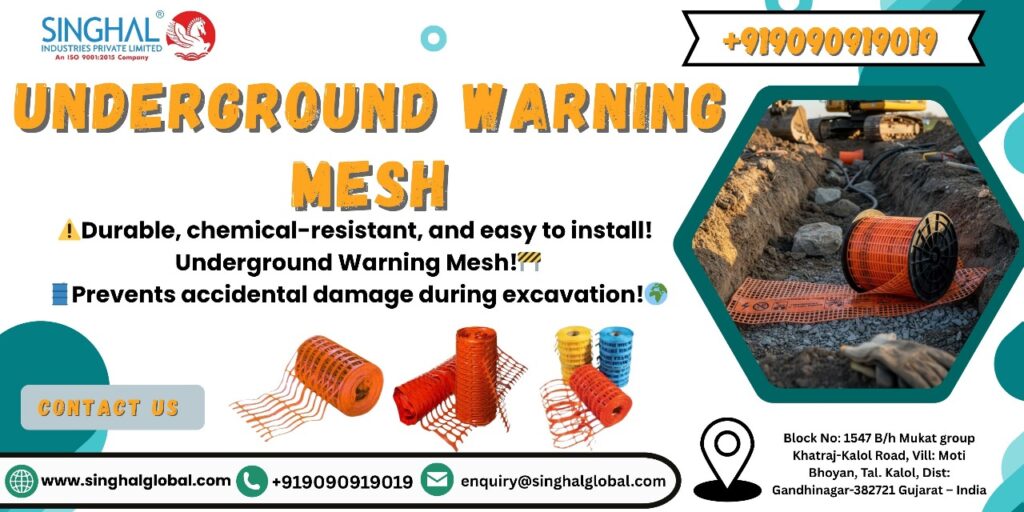
The Underground warning mesh is vibrantly colored plastic mesh that is designed to be submerged above utility lines such as pipelines for gas, mains water, and electrical wires. When digging is underway into the ground, the mesh is their first sight—a strong signal to stop, take a look at the situation, and reconsider before it occurs. There’s a chance you’ve seen the red mesh to indicate electrical and gas, yellow for water, and blue for water. Colors aren’t just decorative; they also can save lives by providing immediate visual signals.
Real-life example? Some time ago, in a township on the outskirts of Mumbai, the workers struck the mesh when digging, but not the fiber optic cables that it protected. The construction stopped for about half an hour while they reviewed their records and shifted the trench, which saved the day and a lot of rupees.
In India, the demand for underground safety meshes is growing quickly due to urbanization and more stringent safety regulations. This mesh, typically constructed of UV-resistant polypropylene or polyethylene, is resistant to moisture and microorganisms. It’s more than just a barrier; it’s security for workers, engineers, and anyone who lives or works above the ground.
Why Do We Need It?
Construction doesn’t have to be just about concrete and cranes; it’s about reputation, safety, and, frankly, sleeping at night. Do you ever wake up and wonder whether your project could be an imminent danger because you missed a cable that was buried? That feeling of fear is the reason the warning mesh is designed to eradicate.
Mistakes do happen. Maps can be inaccurate, markings can fade, maps aren’t as clear, and even the most successful teams can have down days. Site managers have shared their stories of “close calls”—the vibrant orange mesh could be the crucial difference between an easy repair and a hospital trip. It’s a feeling of relief that comes from seeing your team safe from harm with this basic plastic mesh. It’s a profound feeling knowing that the entire power or water supply, or even safety, is yours each time you dig.
Underground Warning Mesh in India: Local Growth and Solutions
India’s rapid growth in infrastructure has seen millions of kilometers of cables and pipes snaking beneath the surface. Cities such as Delhi, Bangalore, and Chennai depend on utility networks that are so dense that one dig could disrupt entire communities.
The positive side? Underground warning mesh in india now becoming a common practice as state agencies and private contractors insist on it for every new construction project. The top manufacturers provide mesh in a variety of sizes, colors, and with company logos, translations, or markings that are printed directly onto the mesh.
Also, since the Indian climates may be extreme, consider heavy monsoons, sweaty summers, and microorganisms everywhere, the mesh in this case is tough. Good products correspond to the world standards of longevity, UV protection, and soil-based chemicals resistance. Some models even contain detectable wires so that the workers can find out the position of the mesh with specially designed detectors before the shovels strike the soil.
How Much Does Underground Warning Mesh Cost?
Let’s discuss budgeting. Depending on the thickness, the width, detectability, and whether it can be custom printed or not, the Underground warning mesh price may be between approximately 4 and 40 rupees per meter. This is one temporary cost although it is not the most costly line item, as compared to the cost of repairing a ruptured water main or a gas explosion.
There are also numerous Indian sellers with large price reductions and options of eco-friendly or recycled mesh. Certification and testing are also included in the price and therefore, one should always ask about testing reports and durability information. Being ready and preventing huge losses, injuries, or even litigations in future is a good idea.
How Does Warning Mesh Protect Projects and People?
It also factors into the way that people feel too. Workers are more confident in the knowledge that dangers are clearly identified. Supervisors can rest better. Insurance claims go down, not up. Clients receive their projects completed on time, without ugly, unavoidable headlines.
The mesh isn’t only for megacities either. I recently learned about a village school project in which the warning mesh saved volunteers from damage to newly constructed water lines. The satisfaction that they expressed when their children had clean water without delays or accidents speaks more than any manual on technical issues could.
Beyond Tape: Why Mesh Wins for Safety
Certain contractors still employ caution tape; however, mesh can offer several benefits:
- Strength and durability: Mesh is stronger, more durable, less prone to tear, and will not degrade rapidly. In soils that are rocky or backfill that is heavy, this is crucial.
- Perception: Mesh is more visible in excavations; even when partly covered by soil, the mesh will not lose its shape.
- Advanced features: The advanced mesh has metallic wires to detect before digging. This is an important benefit for the more difficult urban locations.
- Customization: You are able to get mesh in various sizes, colors, and languages. This is essential for multilingual teams as well as varying utilitarian types.
Conclusion
Innovation continues. RFID tags are also embedded in some new meshes to make the process of asset management smarter. The new frontier in research is sustainability and so is the biodegradable mesh which is safe as well as environmentally sustainable.
The fact that a small product can transform the lives of people is what excites me the most. It does not matter whether you are a project manager in Delhi or a small contractor in Kerala, the inclusion of underground warning mesh is a continuation of an age-old culture of accountability and nurturing. In some cases, the bottom part is an assurance that the rest of it is strong and firm.
Frequently Asked Questions (F&Q)
Q1. What is an underground safety mesh distinct from tape for warning?
Mesh is stronger, more durable, and less likely to tear or weaken. It’s visible in trenches and may include detector wires, in contrast to the standard warning tape. While tape is more effective than nothing, mesh is the ultimate standard in terms of safety.
Q2. How deep is the warning mesh to be buried?
The standard practice is to place the mesh 30 to 45 cm above the utility line, but beneath the surface. In this way, it’s viewed in the excavation process first, and not the cable or pipe! Always adhere to the specific codes for your project and utility guidelines for precise depths.
Q3. What mesh lengths and widths are available?
The most common widths in India vary from 150 millimeters up to 1,200 millimeters, with standard rolls ranging from 50 to 500 meters. Prints and sizes customized to your specifications are possible—just ask suppliers.
Q4. How long will the underground mesh for warning last?
Mesh that is of high quality, particularly ones made of UV-stabilized polypropylene and polyethylene, can last at least 30 years underground. The mesh is resistant to rot, chemicals, and, most importantly, the hungry microorganisms that prosper within Indian soil.
Q5. Who is the largest manufacturer of Underground Warning Mesh?
In India, the top names are Singhal Industries and Stalwart Wartape, along with major international companies such as WarnMat, which export and tailor products for Indian conditions. The market all over the world is expanding and the demand is rising due to urbanization and infrastructure developments.