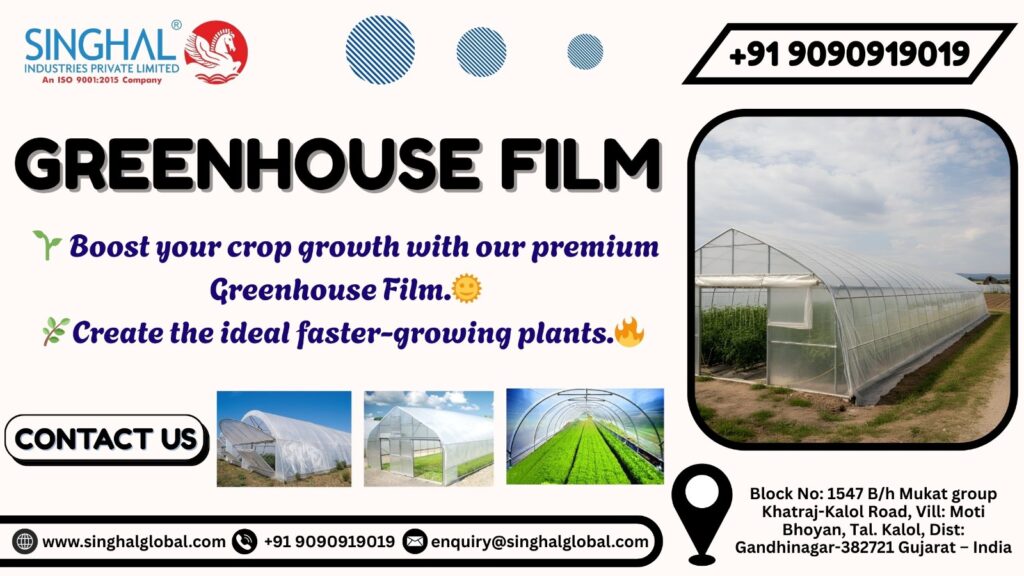
Greenhouse farming is not merely a fashionable way to farm. It’s a crucial global requirement that’s rapidly changing as the planet’s population increases while the available resources diminish. So, what is at the center of this change? Greenhouse plastic film – those pretty handy plastic wraps that protect the environment while keeping the inside of the greenhouse bright and beautiful.
From afar, they may appear to be nothing but a plastic cover over metal, but if you look closer, you will notice how these covers preserve the heat on a cold day or how they diffuse the light almost as if by a trick. It would not be far from the truth to say that these plastic films are the ones which are totally and quietly reshaping the agriculture sector worldwide, thereby changing the world in fact, one field at a time.
Why Should We Talk About Greenhouse Films?
A glance at any farm of today would almost certainly present you with greenhouses covered with plastic films. Perhaps you were questioning the point of using only plastic in farming practices even when it comes to highly technological greenhouses full of sensors and pipes. The answer? Those films are doing so much more than just providing shelter from the rain.
The films used for greenhouses are the nearest things to perfect barriers that allow certain types and quantities of sunlight to pass through, keep the heat of the day enclosed, and protect the plants from natural disasters, diseases, and even birds that are looking for food. Without them, the transition to sustainable agriculture might not have happened so far. Nevertheless, just like in any other sector of farming, the one-answer-fits-all solution is non-existent. Some of the plastic films are strongly built to withstand all kinds of bad weather, while some are designed to be light and are only used for covering short-seasoned crops in this way, which can later be easily disassembled again.
The Green Revolution, Reinvented with Plastic Films
Remember the time twenty years ago? Greenhouses were mostly built in glass—strong, yes, but costly and not flexible. Everything was changed by the coming of Greenhouse plastic films. The doors of greenhouses with high-yield, intensive farming that was only for the affluent were now open to anyone, and as a result, the smallholder farmers were able to construct their own greenhouses too.
But, why is this important for sustainability? The main reason is that food safety and taking good care of the environment are two different things which have to be balanced very carefully. Greenhouse plastic films empower growers to produce more food with lesser use of water, land, and other resources, and also the use of pesticides can be minimized. These points are in line with the requirements for sustainability.
Imagine a situation in which new strawberries are planted in Maharashtra, India, where the rain keeps pouring throughout the summer and the strawberries get spoiled if exposed to too much moisture. The greenhouse films which are properly fitted over the seedlings will provide them with the needed shelter from the wetness. Sunita, a local farmer, said to me that she would never have thought that by “wrapping” her crop in plastic she would be able to see her children eating strawberries in July, i.e., months ahead of the usual harvest.
How Do Greenhouse Plastic Films Actually Work?
Simply putting a shield between your plants and the rain or sun can’t be the whole story. What’s really going on with these films is their interaction with light, heat, humidity, and even bugs.
Okay, so what are we going to do with light? Well, various plant species have different requirements. For instance, tomatoes need a lot of direct sunlight, while lettuce, on the other hand, gets wilted under the same condition. Luckily, the makers of greenhouse plastic have come a long way in solving this problem. These days, you can have films which are capable of blocking the harmful UV rays that are responsible for sunburn or scatter the sunlight so that it is evenly distributed even in the farthest parts of the greenhouse. Consequently, plants grow in a more uniform manner, lessened chances of leaves being sunburned, and – nice to know – the vegetables being tastier.
Choosing the Right Film: It’s Complicated
This is the point at which farmers, suppliers, and local Greenhouse plastic manufacturers, who might be spectating this conversation, get riled up and start discussing this matter fervently. There are several norms in terms of thickness, in which one can buy a greenhouse film: from an ultra-light 80-micron sheet up to a very strong 200-micron sheet. The price is not always the same. Quality even more so.
I had an opportunity to witness two farms that were near each other in Punjab. One farm had invested in a costly, high-diffusion film while the other farm had gone for a less expensive, clear plastic roll. After six months, the difference between the two was quite visible. The first farm had the spinach that was green, leafy, and even looked like it had grown in the corners of the house. The second farm had an unbalanced growth of vegetables with certain areas turning yellow.
Conclusion
After weighing all their advantages and disadvantages, greenhouse films are still one of the quiet yet most potent sustainability tools in agriculture. What is going to follow? Maybe films that are plant-based and decompose naturally or smart films that automatically regulate the amount of light they let through. Perhaps shortly, every farmer, be it large or small, will be able to afford the best films and there will be recycling programs in the countryside to complement it.
Will that answer all the questions? Most probably not. Yet, more and more each year, farmers are trying, adjusting, and revealing the effectiveness of different methods. From green and controlled environment farms in the Netherlands to high-altitude polyhouses in the Himalayas, the use of plastic films for greenhouses is still gaining ground. Whether you consider them as heroes of the environment or necessary evils, there is one thing that is sure: at the moment, they are vital connections between farming traditions and our sustainable future.
Frequently Asked Questions (F&Q)
Q1. What thickness of greenhouse film is best for farming use?
The ‘best’ thickness is largely influenced by your local climate, crop, and budget. The majority of farms have films of 120 to 200 microns thickness. The thicker ones (180+ microns) are more durable and can offer better protection in windy or stormy areas, whereas thinner ones can be used for short-term or low-cost purposes.
Q2. Can greenhouse film be used in all climates?
Yes, but there is a catch! Greenhouse plastic films are designed to withstand a wide range of conditions such as freezing and hot weather; however, you need to select the correct one for your climate. If you live in extreme heat areas, your choice should be the film with UV protection and good ventilation. If you are in the cold region, then thermal films which trap heat are the best choice.
Q3. What is the difference between clear and diffused greenhouse film?
Clear films are those that allow all the sunlight to reach the plant directly, so they are excellent for plants that need a lot of direct sun. However, they may cause overheating and sunburn in plants that are sensitive. Diffused films scatter the rays so that the light is evenly distributed and the crops are less stressed.
Q4. Does greenhouse film help control temperature and humidity?
Yes, those films are designed to trap heat within the growing area, and also they can regulate humidity since they prevent water loss. The installation of special components thus water droplets formation and dripping are stopped—which keeps plants healthier by lessening the occurrence of diseases.
Q5. Who is largest exporter of greenhouse plastic film?
China is currently the largest exporter of greenhouse plastic film. Global manufacturers from Israel, Spain, and other European countries follow closely. Quality can be quite different, so always verify the standards and, if possible, get feedback from other farmers before big purchasing.