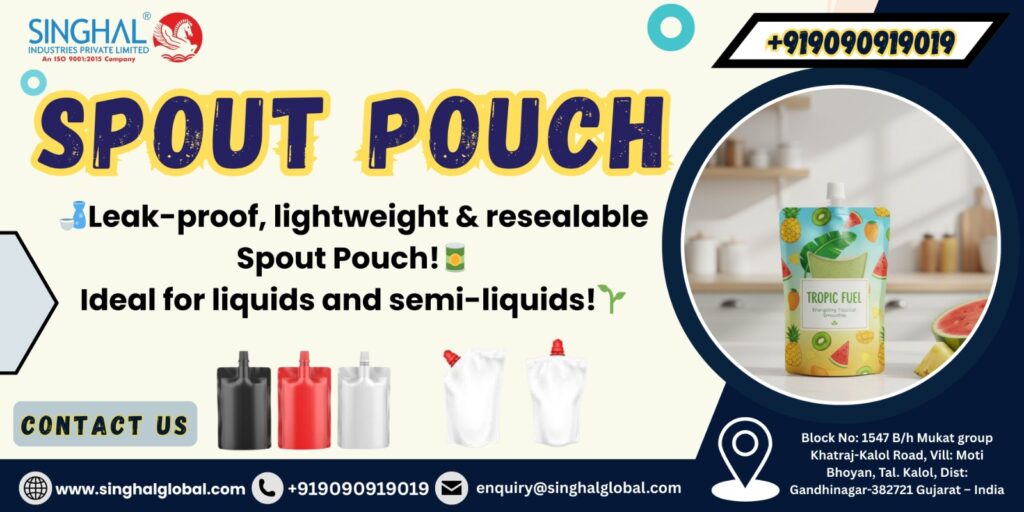
Spout pouches have turned out to be a significant factor in the ready-to-drink (RTD) product market, thus changing the way liquids are packaged and consumed on the go. They are an indispensable element of the system operating because they connect convenience, safety, sustainability, and branding possibilities in one small, consumer-friendly package. If you are taking a juice to a child’s lunchbox or providing a protein shake after a workout, in both cases the answer is more than likely that a spout pouch was the one that made the work easy and clean.
What Makes Spout Pouches Ideal for Ready-to-Drink Products?
Spout pouches come with an integrated spout and resealable cap that allows for pouring or sipping in a non-messy way that is usually done from bottles or cartons of the same content. These pouches, though flexible, are strong enough and commonly have a base that enables them to stand, thus making both storage and display easy and efficient. This packaging style is great for liquids and semi-liquids such as juices, smoothies, sauces, baby food, and many others.
That are foremost conveniences which make spout pouches the best choice for RTD products as follows:
- Convenience: They are easy to tear open, drink from, and close again. This is the perfect type of packaging for those who lead a busy life and thus want a drink that they can take with them wherever they go, drink from without the risk of spillage and without the need for other cups.
- Longer Shelf Life: Because of the multi-layered barrier films, the contents of the packages are safe from air, light, and moisture thus the drinks are kept fresh for a long time without the producers having to add a lot of preservatives.
- Lightweight & Space-Saving: Spout pouches are more material efficient, they are less heavy and occupy less space during the time they are transported and are on the shelves in comparison to glass or plastic bottles.
Also, the customizable option is available for brands to print their bright graphics and logos on the large flat surfaces making the Customized spout pouch that not only get on with their unique story but also attract attention.
Why They Suit Ready-to-Drink Products
Ready-to-drink (RTD) products are all about at-handness: open, consume, close, and do it again. Spout pouches go well with that way of life as they are simple to open, reclose, and carry without the concern of spilling. The addition of a spout and a cap allows consumers to “unscrew and sip” in a jiffy, something that would be very helpful for busy commuters, children going to school, and people who go to gyms. The flexible nature of the material and the strong layers of the barricade make it possible for the freshness of the beverages to be preserved over a longer period of time, even if very few preservatives are added, and this is very important for juices, health drinks, and functional beverages. Let us think of the situation where a juice pouch is handed over by a parent to the child in the car: if the kid squeezes the bottle, a spill might occur; however, a properly constructed Spout pouch India is able to withstand that squeezing and at the same time, it is still possible to close it again later.
Spout Pouch Manufacturing and Customization in India
India is shifting to be a major center where spout pouches are made. Food-grade, leak-proof pouches that are specifically designed for various Spout pouches for liquid products – from beverages to sauces, are the specialties of numerous manufacturers. They present innumerable sizes and permit graphics, spout location, and material changes for the purpose of meeting brand requirements.
A decision to buy spout pouches from a supplier based in India is likely to be advantageous in terms of costs and flexibility, particularly for the new brands that are willing to test the market with their products or flavors. These manufacturers have capacity for a quick turnaround of small orders and at the same time can accept large-scale orders, thus they have become the first choice of many companies.
The Contradictions and Challenges
Although spout pouches claim to produce less packaging waste and are highly convenient, there is still the issue of recycling due to the multi-layer laminates that are usually used. Nonetheless, the industry is moving quickly to resolve this by launching recyclable and compostable films. Therefore, while some consumers are concerned about the ecological impact, the fact that the packaging is lighter and uses fewer materials makes it a positive overall.
Certain buyers might think that glass bottles are more high-end; however, spout pouches are advancing in design complexity, thus being able to feature matte or metallic finishes and eye-catching graphics which, in most cases, are more liked by the younger or eco-friendly consumers.
In short, the advantages of spout pouches, such as convenience, style, and future sustainable solutions, are combined together in ready-to-drink segments, thereby changing the ways in which we consume liquids daily. Mainly, they are not only packaging—the consumer gets a lifestyle upgrade and the brands worldwide gain a strategic edge.
Conclusion
This detailed look at spout pouches in RTD products explains their ease of use, safety, branding, and the fast-growing manufacturing industry in India giving both the consumers and the brands a compelling option for the present and future beverage market.
If you are contemplating using spout pouches to package your liquid products, then give the nod to their adaptability, innovation, and consumer attraction which is inherently associated with this packaging method—the customized spout pouches are not just carriers; they are experience enhancers.
Frequently Asked Questions (FAQs)
Q1. Are spout pouches safe for food and beverages?
Yes, if spout pouches are made by a good manufacturer, they use only food-grade materials. The spouts are made of materials that can come in direct contact with drinks and liquid foods. The products are sealed in a controlled manner and are mostly checked for leakage, migration, and barrier performance to confirm safety during storage and transportation.
Q2. What sizes are available for spout pouches?
The sizes for spout pouches vary enormously, starting with very small single-serve versions which are less than 100 ml, then the normal-sized drinks which are from 200 to 500 ml, and finally, the large multi-serve packages which are several liters. Numerous suppliers will also allow you to specify the exact dimensions if you want your brand to have the perfect size of the pack and the right price for your product.
Q3. Can spout pouches be customized with branding?
Yes, one of their major areas of customization is what makes them so powerful: the brands can pick the colors, graphics, logos, finishes, spout styles, and shapes to put together an absolutely personalized spout pouch. The quality of the print on the big pouch panels permits a brand to communicate its story straightforwardly via the packaging itself.
Q4. What industries commonly use spout pouches?
Spout pouches are open to use in food and beverages for the likes of juices, smoothies, sauces, baby food, and spout pouches for liquid milk. Also, there are no limitations for their use in personal care, home care, and automotive products. Industries that package liquids or semi-liquids requiring safe, convenient, and portable solutions can mostly take advantage of this type of packaging.
Q5. Who is the largest manufacturers of spout pouches?
The market is complex, and different leaders are located in different regions, e.g., in India, companies like Singhal Industries are often mentioned among the top and most stable producers of stand-up and spout pouches. On a worldwide scale, many big flexible packaging groups are the major players manufacturing spout pouches in large quantities. Therefore, brands make their decisions of potential partners not only based on company size but also on capabilities, sustainability options, and service quality.