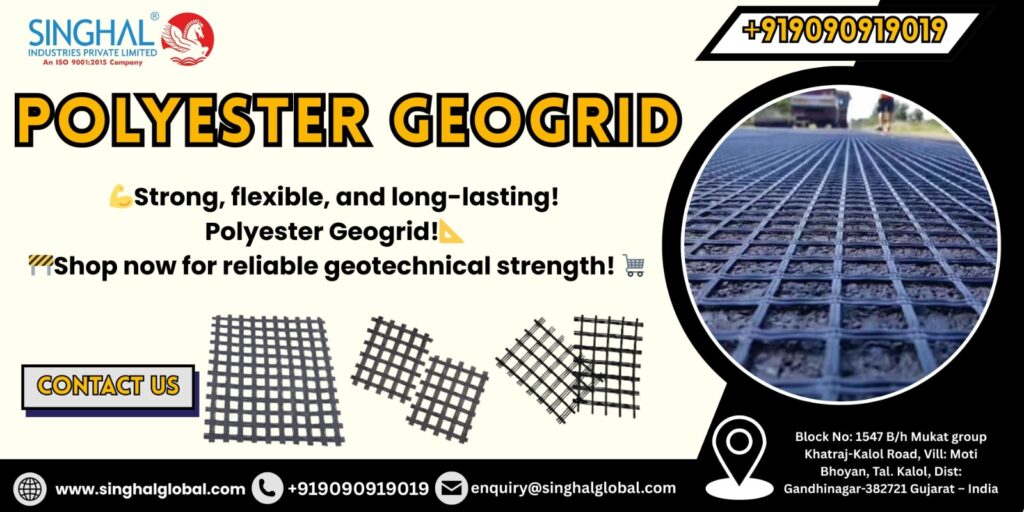
Hi friends! Suppose you want to construct a huge highway across soggy, unstable ground that seems to want to devour your project. This is the place where polyester geogrid comes pretty much like a superhero, silently maintaining the overall integrity. The grids fabricated from the strongest polyester yarns are changing the face of construction by soil reinforcement, erosion prevention, and enhancing the lifespan of the structures by far.
However, don’t get me wrong; it is not only about the fundamentals anymore. The most recent changes in polyester geogrid technology are so impressive that I could not stop saying that they are more intelligent, more eco-friendly, and more resistant than ever before. We mean here products that competently resist UV radiation and chemical attacks, hybrid designs that combine materials for great performance, and even an embedded sensor that sends a message to your mobile phone in case of any irregularity. I can recall my visit to the construction site in Polyester geogrid India India last year, where the engineers were extremely enthusiastic about how these new grids helped them to shorten construction time by several days. Isn’t it great to see technology solving real-world problems?
What Makes Polyester Geogrid Tick?
Essentially, polyester geogrid is either woven or knitted from long-lasting polyester fibers that are usually protected with PVC or bitumen. That results in a flexible framework that fits into the soil and ensures that the weights are split allowing for no collapse of the soil. The material composed of modern ones have a very low creep characteristic, which means that their elongation capability over time is very low and high tensile strength of up to 1600 km is possible.
Why not use polypropylene instead of polyester? For example, polyester is more suitable for application under bridges or on steep slopes because it is less sensitive to hydrolysis in wet conditions. However, I still find it contradictory that polypropylene geogrid price is usually lower (approximately 40-110 INR per sqm in India) and hence a good choice for budget projects.
But the point goes to polyester in terms of durability for long-term projects. From my experience, I have seen that polypropylene deteriorates quicker in acidic soils which is rather annoying when you have tight deadlines. Polyester geogrid manufacturers are intensively working on uniaxial variants for one-way force (e.g., walls) and biaxial for the even distribution of forces. Techfab India and Strata are producing warp-knitted grids which are better interlocking with gravel or sand because of the greater contact area. Also, the work can be done fast and easily—you can wrap a lightweight roll to look like a carpet and it is ready without the use of a heavy machine. You save on the labor costs and have more time for yourself.
Game-Changing Innovations Pushing Boundaries
What are the coolest things that happened? First of all, there are smart sensors that can be integrated right into the grid. This sensor-enabled geogrid is employing fiber Bragg grating (FBG) technology or IoT nodes that can continuously observe strain, soil moisture, and temperature, respectively. Envision a situation where a bridge is going to collapse on you but your app warns you of the danger several days beforehand. The patents from 2021 that are coming to the market in 2025 are especially effective in earthquake areas.
Moreover, here are hybrid designs. You may consider polyester combined with HDPE for producing very thin mesh layers or even geocells for soft soil. ARTER® GTM Italy combines the warp-knitting method with the weft-inserted fibers for the two meshes: large for coarse soil, small for fine. This also increases the firmness of the asphalt bond – ideal for roads. Besides that, how about recycled polyester geogrids? Researchers have found that they can increase the CBR bearing capacity 2-5 times if recycled PET bottles are used. They are both environmentally friendly and inexpensive – so why isn’t everyone on board?
Besides this, coatings are getting better very quickly. The new PVC/Bitumen/SBR mix is more resistant to installation damage as well as to chemicals. The 3D printed prototypes made from recycled plastics that connect the laboratory with the field are thinner pavements that last for decades. Countries like India and China, which are still developing, can reduce their material consumption by 40% with these products, thus directly combating global warming. However, in my opinion, we might be too eager to adopt sustainable solutions without having enough long-term testing. I find it exciting yet a little bit scary.
Polyester Geogrid India: Local Heroes Enjoy Their Boom Time
One of the most significant effects of India’s infrastructural projects (that include highways, railways, airports, etc.) is the soaring demand for geogrids. This has meant good news especially for Polyester geogrid India suppliers such as GeoSys, Techfab, and Ocean Nonwovens, who are considered the leaders in this field with their warp-knitted grids going to various applications from NHAI roads to embankments that are flood-prone. Thus, the producers are targeting different markets, from 20 km for stabilizing slopes to 1000 km for heavy-raising dams.
The prices? They are quite competitive and sometimes the local products even price imports. The Polypropylene geogrid price varies between 25 and 115 INR/sqm, but the polyester has a higher value because of a better finish, which is a common practice. I had a conversation with a supplier from Jaipur; he was talking about how great it was to use these products in the deserts of Rajasthan where they are not only stabilizing the dunes but also helping the villages that have been buried by them. It is impressive to see how technology can help communities.
The industry is not without its problems. The soft soils in the coastal areas put the products under a lot of pressure, but solving issues with such hybrids is a total revolution. Here is a question for you: As the monsoons become harsher and harsher, why don’t the mandates provide for the use of geogrids everywhere?
Conclusion
Summing it up: These decisions are not just talk, they’re actually changing the way we go about making the world stable and lasting. From the cleverness of the sensor to the recycled magic, the future for polyester geogrids looks very promising. But, at the same time, let’s not forget the workers who are out there on the field, putting in their sweat to make tomorrow safe. What do you think about it? Are you willing to use a geogrid for your next project? Do it, the earth is not going to support itself!
Frequently Asked Questions (FAQs)
Q1. Are they effective in soft ground?
Yes, without a doubt! Polyester geogrids are extremely efficient in peat or clay areas due to the fact that they firmly unite aggregates and thus significantly increase the bearing capacity 4-5 times. Both laboratory and field tests confirm this practice for highways over the soft ground. The only condition is to do it properly.
Q2: Do polyester geogrids need maintenance?
Very little, actually. The protective layers keep the product safe from UV, chemicals, and microbes – hence no decay or deformation. Checking the overlaps once a year is a good idea, but, in general, they are very robust and can be referred to as set-it-and-forget-it. Which is much better than having to take concrete repair works.
Q3: Are they environmentally friendly?
They are moving toward that goal! The recycled PET variants help reduce solid waste and thinner products mean less gravel is needed from the quarries. Some of the finishing layers biodegrade slowly; however, their overall impact is still more ecological than the deep excavation. The better option would be if the industry was more open to recycling. I say push for it!
Q4: Can they be customized?
Absolutely! Opening sizes, strength, finish—these can all be chosen based on the soil or the load. Indian polyester geogrid manufacturers can quickly produce uniaxial/biaxial hybrids for use. There is no such thing as one-size-fits-all.
Q5: Who is the largest supplier of polyester geogrid?
It is a rather difficult decision to make – Singhal Industries India and Strata are leading the way in India with their vast production for infra giants. On a worldwide scale, the market is fragmented; however, these two companies are the biggest players in Asia-Pacific. You should have a look at the volumes because they are shipping quite a few tons.