Our planet is rapidly transforming. Everywhere you go, from small local stores and neighborhood grocery shops to big supermarkets, you will meet people who discuss extensively one topic: environmentally friendly solutions. The plastic waste, pollution of the oceans, as well as garbage dumps overflowing, have become part of our everyday news that we can’t escape. Nevertheless, behind the facade of these troubles, there is a silent hero, PP spunbond non woven fabric, a material that almost nobody sees, but which is already the main game changer.
Next time you take a bag from the supermarket, why don’t you think about what it is made of? That fabric which is quite hard, yet still has a nice touch, and is also of good wear resistance, yes, that would be polypropylene spunbond nonwoven fabric. It is less or more of everything we know, not paper, not cotton, and surely not the type of plastic that we are used to. Still, it might very well be one of the smartest inventions in the green revolution.
Why Do We Need to Change: The Plastic Pollution
Do you still remember the plastic bags of the past? The thin ones that always tore at the most inconvenient times? They were handy, cheap, and literally, you could find them everywhere. But here is the ugly side of the story—these bags take 500 to 1000 years to decompose. Just imagine a plastic bag of yours from last week living on in the year 3025. Uncomfortable, isn’t it?
Different countries, e.g., India and the UK, have already started to ban single-use plastic bags. People had to find substitutes. Cotton bags were all right but too costly and too thirsty in terms of production. Paper bags were not durable. It was the moment when PP nonwoven fabric grabbed the attention of the crowd.
What Is PP Spunbond Nonwoven Fabric?
Spunbond is a method where the material, i.e., polypropylene, is converted into one long fiber from its molten state.
Nonwoven refers to the fact that these are not fabrics from weaving or knitting (like cotton or polyester), but the fibers are joined together by molten plastic or by applying pressure.
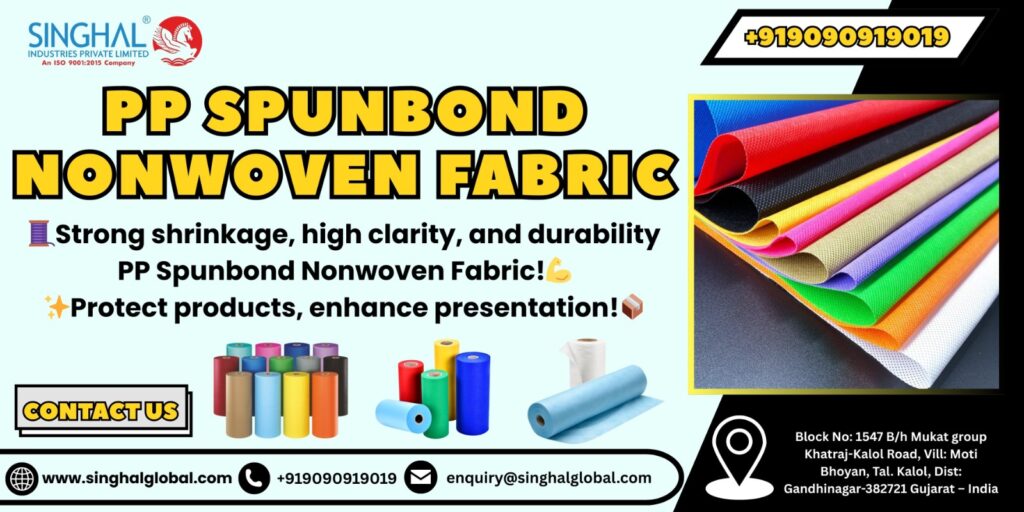
Visualize that the strands of the fabric are like spaghetti and that they are being wrapped together to form a strong, yet breathable and flexible fabric—this is basically what this fabric is.
Sure, it does sound like a scientific explanation, but in real life, it is quite simple. A local bag manufacturer I interviewed once said, “We prefer using spunbond fabric because it’s light, sturdy, and we can print attractive designs without any problem.” That is why you can frequently observe those colorful reusable bags with a shiny surface, which is due to the same fabric!
The Environmental Side of Spunbond Fabric
This is the point where things become interesting. It is not similar to thin plastic films that degrade into microplastics easily, and the way a single sack can be used over a hundred times before it is discarded.
As a matter of fact, I am guilty of revealing this personal story—The same green PP nonwoven shopping bag that I am using is almost a year old. It has been loaded with groceries, clothes, and bartenders’ supplies, yes even a few beach items. I have stained it, I have folded it a hundred times, and it is still in a condition that I can take it to the market again. No doubt, it may not be as nice as a cotton tote, but it is functional, long-lasting, and it empowers you with a feeling that you are doing something good for the earth.
From an environmental perspective, the carbon footprint of a PP non woven fabric bag is many times less than that of a single-use plastic bag. Moreover, when you decide to offer it to the garbage bin, it can be recycled into a wide range of products—from flower pots to storage boxes. In a way, it is like giving waste a second chance to live.
Apart from the Use of PP Fabric as Shopping Bags
One thing that might surprise you is that spunbond fabric is not only used for making shopping bags. Actually, it is used in making various products like hospital gowns, face masks, agriculture covers, furniture lining, shoe covers, and even tea bags in some industries.
A friend of mine, who works in a rural healthcare unit, told me, “Without spunbond nonwoven fabric, many small clinics wouldn’t be able to afford disposable equipment.” That’s how far its reach and impact is going. The very same material which is wrapping your groceries can also be the hero that saves lives in hospitals.
How PP Spunbond Bags Are Made
Do you recall seeing videos of cotton weaving on massive looms? The method of producing a PP spunbond nonwoven fabric is totally different. To make the PP non woven fabric manufacturers melt polypropylene granules and pass the molten polymer through a spinneret, resulting in the formation of long and thin fibers. These fibers are spread out on the conveyor in a random manner and are then bonded by heat. There is no stitch, and no weave.
The product at the end of the line can be different in terms of its thickness, softness, as well as flexibility based on the GSM (grams per square meter) used. Lower GSM fabrics (such as 10-25 GSM) can be used for the production of masks for medical purposes or covers for the agricultural sector, whereas higher GSM (80-150 GSM) can be utilized for making bags and upholstery.
Conclusion
Thinking of the next time you will be at the checkout counter and you will have to decide between ‘paper or plastic,’ maybe you should consider a more sensible option—neither one of those. What about using a PP spunbond nonwoven fabric bag? They are fashionable, durable, printable with your desired pattern, and really eco-friendly.
The next time you are out shopping for groceries or clothes, try to pay attention to how the fabric of that nonwoven bag touches your fingers. This is a tangible way to remember that your decisions have an impact.
Frequently Asked Questions (FAQ)
Q1. What are the GSM ranges of the spunbond fabric?
GSM of the fabrics made of spunbond usually spans from 10 to 150 grams per square meter. Low GSM material is light in weight and allows air to pass through it, meanwhile high GSM is strong and hardwearing, making it perfect for the likes of shopping bags or furniture covers.
Q2. Are medical instruments made from spunbond fabric safe?
Without a doubt, the answer is yes. The material is non-toxic, hypoallergenic, and breathable. In addition, PP spunbond nonwoven fabric is very popular in single-use gowns, surgical caps, and masks because it does not release fibers or other harmful chemicals.
Q3. Is it possible to produce facemasks from spunbond fabric?
Yes. As a matter of fact, organizers use this material as both inner and outer layers of medical and N95 masks because it is one of the most dependable materials available. Its filtration efficiency and comfort make it perfect for long-term wear.
Q4. Can a spunbond nonwoven fabric be cleaned by washing?
Sure, one can wash it softly. However, just like cotton, too much washing or exposure to heat may cause the fibers to become weak. The preferred method of cleaning for reusable bags is to occasionally wipe your bag with a damp cloth. It is made in such a way that it requires less maintenance and will last for a long time.
Q5. Who is the largest supplier of PP Spunbond Nonwoven Fabric ?
There are quite a few companies supplying spunbond fabric around the world, and with that said, some of the big names are the companies located in China, India, and Korea. The big market players like Singhal Industries Pvt Ltd, Fiberweb, and Rely Industries in India lead the market through the production of high-quality PP spunbond nonwoven fabric not only for the local market but also for the international one.