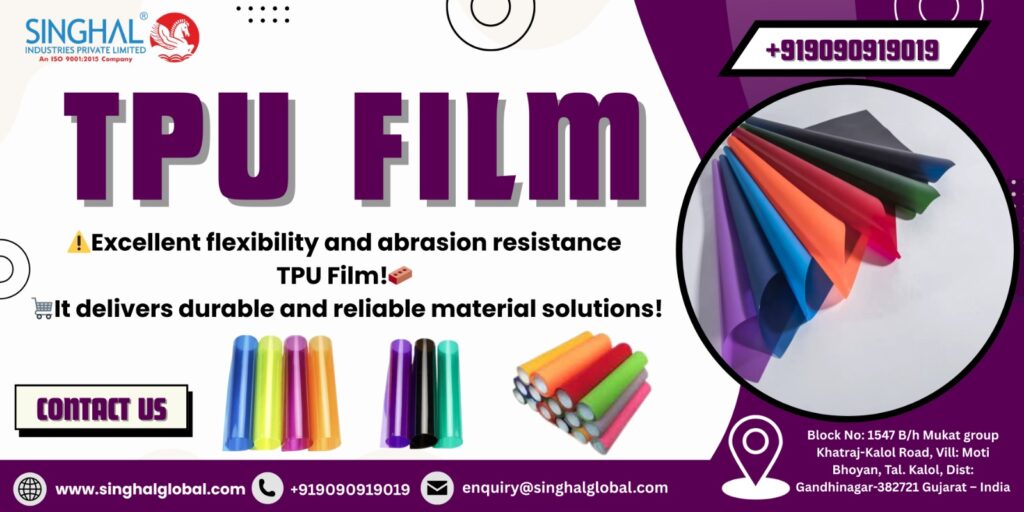
The TPU film can be described as a tough, flexible clear plastic that’s slowly become a hero for both the electronics and automotive industries, specifically in India’s growing manufacturing industry. It is a hybrid of rubber-like elasticity and plastic-like strength. That’s the reason why designers, engineers, as well as procurement teams continue to return to it when other options are not able to meet the demands of real-world environments.
Is TPU film a type of plastic?
Thermoplastic Polyurethane (TPU) film is a thin layer composed of TPU resin with a unique mix of abrasion resistance, flexibility, and weather resistance. In contrast to brittle plastics, TPU film remains flexible even at lower temperatures, but maintains its shape and strength even under heat, impact, and repeated bending. It could be translucent, transparent, or opaque, depending on the ingredients and the process.
TPU films are available in polyester and polyether grades, which are each designed for various uses, including moisture resistance, chemical resistance, or the ability to soften. From a practical perspective, TPU film is a bridge material. Not like rubber but not as hard, and not as strong as conventional plastic, but somewhere in between. And that “in-between” area is where many of the real-world applications are.
The role of the automotive industry
In modern automobiles, TPU film is used in places where people can view it, and also in places where they don’t. It promotes safety, comfort, and appearance in ways that automobile owners don’t even know about.
Interior protection and comfort
TPU films can be used to protect the dashboards, door panels, central consoles, as well as trimmings to protect against damage, UV fading, and everyday wear. The owner of a taxi fleet is a good example. They could opt for TPU-laminated interior components so that the surfaces appear new even after years of passengers moving bags and keys along the surfaces.
Controlling vibration and sound
Because it is a thin layer of sound insulation, TPU can dampen vibration and cut down on noise, making the cabin feel more luxurious even in mid-segment vehicles.
Safety and airbags
TPU films are commonly used for airbag coatings, hoses, and flexible connectors due to the fact that they can withstand high temperatures, rapid inflation, and aging for a long time without cracking. It’s a real-life story that usually occurs in automotive factories: a team may begin with a less expensive film for interior laminate, but then discover it cracks during hot summer days or gets yellow under sunlight. After a couple of warranties, the team changes to TPU. Suddenly, complaints decrease and, yes, that TPU film roll price feels justified as the brand’s reputation remains intact, and rework is down.
Electronics industry
Electronics is a different area in which TPU film quietly handles heavy lifting, particularly when devices become thinner, lighter, and more flexible.
Layers for protection of devices
TPU films are utilized in screen protection as well as flexible cover layers and inner films that absorb impact for tablets, smartphones, and wearables. The slightly “soft” sensation that the screen protectors have typically comes from a TPU-based design.
Flexible membranes and circuits
TPU is utilized as the insulation or carrier film for keypad membranes that are flexible, circuits, and sensor layers due to the fact that it is able to bend repeatedly without cracking.
Cable jackets and wire
For cables pulled or twisted and placed on (think charging cables, robotics, or wearable electronics), TPU jackets provide excellent abrasion resistance as well as good performance in cold and hot conditions. Imagine the wearable fitness tracker worn at the gym, during rain, or even while showering. A rigid plastic material could break or become brittle over time. TPU film, however, can stretch a little using straps, can withstand movement and sweat, and is soft on the skin. This means the item is “premium” instead of disposable.
TPU film producers in India and the sourcing reality
India is rapidly becoming an important center to source TPU films, fueled by the rapid growth of automobiles, technical textiles, and electronics. A mixture of local TPU film manufacturers in India as well as international brands meet this demand, frequently working with local converters and distributors.
Indian producers and converters make TPU films to be used in automotive interiors and packaging, textiles, as well as general laminate. They mainly focus on polyester-based films as well as standard lamination types used for clothing, rainwear, and industrial covers.
In addition, Indian buyers often import special films – medical quality, high-breathable, anti-bacterial, or extremely strict-tolerance electronic films from international suppliers, which include well-established Asian and European producers.
If someone is looking for the market for a TPU film manufacturers in India, the conversation is almost always more than the price. An average purchasing supervisor would inquire about consistent thickness, bonding temperatures, yellowing resistance, as well as tests and odor, as the failure of a film in the production line could end up wasting entire batches of components.
The understanding of TPU film roll cost and cost in relation to value
TPU film roll prices can vary significantly based on thickness, grade, specialty additives, and the volume of orders. Customers are often shocked when they compare TPU with other films such as PVC or PE; however, the price structure is more logical when you consider the performance and lifecycle.
Price influencing factors
- Grade and application: Medical-grade, flame-retardant, or UV-stable TPU film costs more than the general-purpose grade because of the more stringent raw material and quality control.
- The thickness and the width of the roll: Wider or thicker rolls require more materials and more precise control, increasing production costs.
- Customization and quantity of orders: Customized colors, textures, and mechanical properties usually result in higher minimum order amounts and support for engineering, which is reflected in the pricing.
In the real world, engineers often experience some internal conflicts. In the abstract, a less expensive film may appear “good enough.” But when you consider the longer-lasting durability, lower warranty claims, and less downtime, TPU starts to look like a better option regardless of whether the initial roll cost is more expensive.
Conclusion
TPU film is one of those materials which seem ordinary on paper but has already proved its value in actual, difficult conditions such as cars dashboards which roast in the sun to gadgets that can bend and spring back. In the case of the electronics and automotive companies that are interested in designing their products with a balance between the aesthetics, performance, and long-term durability, the issue of collaboration with a proper TPU film suppliers and the close consideration of the actual value without focusing on the TPU film prices can be the difference between a product that performs and a product that lasts.
Frequently Asked Questions (FAQs )
Q1. Typical uses of TPU film by industry?
TPU film is used in various markets, which are automotive, electronics, textiles, footwear, medical, and packaging. It is applied in car interiors, device screen protectors, waterproof clothing, sports footwear, inflatable structures and protective covers to mention a few.
Q2. Is it possible to customize TPU film in terms of thickness and color?
Certainly, TPU films can be customized in regard to the thickness, width, hardness, color, and even the surface texture to meet the needs of the particular application. There are numerous suppliers of Tpu film both in India and around the world who will offer tailored solutions after getting familiar with bonding techniques and aesthetics goals and performance goals.
Q3. How is TPU film manufactured?
The TPU films are commonly manufactured by extrusion, where the melted resin is forced through a flat die, and then allowed to cool before being rolled up into form. Some manufacturers achieve control of the thickness of their films by the use of calendering or other special casting techniques to ensure they have a precise and more optical clarity of the surface or even special finishes.
Q4. Is TPU film appropriate for electronic or medical uses?
Some forms of TPU films are designed to be worn in surgical equipment, wound dressing, and protective drapes as they are sterilized and biocompatible. TPU films are used in electronics in flexible circuitry, device protection layers, cables, cable jackets, and sensor membrane as well because of its flexibility, toughness and good dielectric characteristics.
Q5. Who is the largest supplier of TPU film?
The TPU film market is highly fragmented with numerous major global producers as well as significant regional players, which means there isn’t a single widely accepted “largest” producer. In India and other nearby markets, buyers generally evaluate several TPU film supplier in India as well as international brands via trade directories, industry directories, and direct partnerships to identify the most appropriate one for their needs and the volume they require.