Geomembranes are synthetic barriers which quietly address some of the most difficult engineering issues of today, including leaking landfills and risky mining sites. They may appear to be large sheets of plastic, but to many contractors, engineers, as well as farmers, the sheets appear to be a sort of security net that protects groundwater, soils, budgets, and even reputations simultaneously.
Geomembranes: What Do They Mean?
Geomembranes are flexible, thin sheets of waterproof material made of polymers such as HDPE, LLDPE, LDPE, PVC, as well as other materials, that are designed to prevent gases or liquids from going through. They are employed when there is a requirement to confine or isolate water and chemicals, waste, or any other fluids to ensure they don’t escape into the surrounding environment. In simple terms, it is a human-made barrier that separates “what is kept in check” and “what should be secured,” like soil or groundwater.
The most commonly used materials are HDPE geomembrane sheets, LLDPE, PVC, and occasionally, other specialty materials like EPDM as well as reinforced polypropylene for particular applications. A lot of engineers are initially skeptical; they think, “it’s simply plastic.” They then realize that just a few millimeters of selected material can prevent years of contamination. Their respect for this substance increases dramatically.
The Use of Geomembranes Today
Modern technology relies on geomembranes that we rarely visit but depend on each day. From mining firms to city corporations, these lines are a quiet way to reduce risk and enhance long-term performance. Applications that are essential include:
- Waste facilities and landfills: Geomembranes line the bottom of landfills. They also cover the very top in order to prevent leachate and other gases from contaminating groundwater and soil.
- Mining and tailings: These ponds line the tailings as well as heap leach pads, aiding in the containment of the toxic process fluids and solutions loaded with metal.
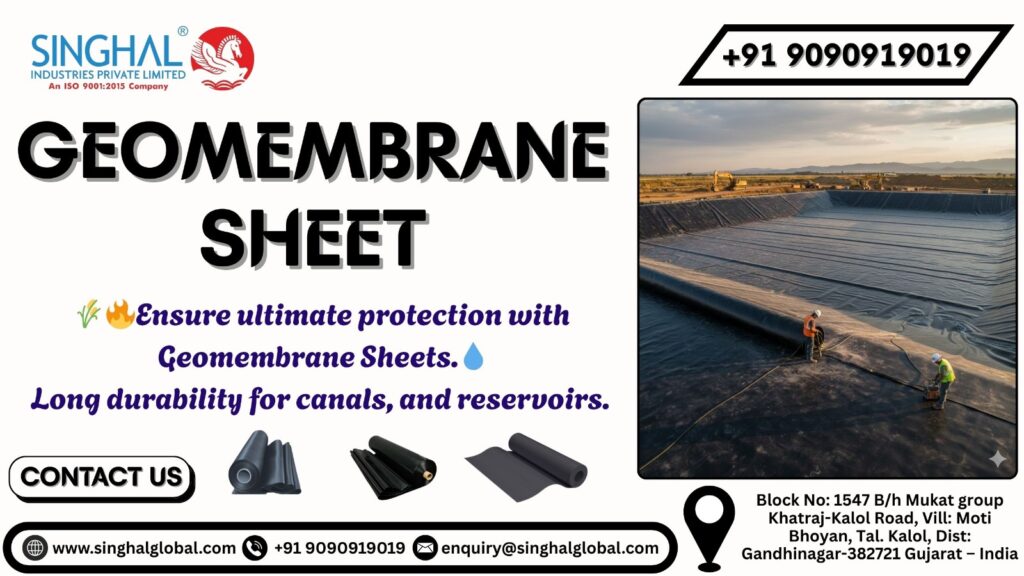
- Ponds, reservoirs, canals, and water storage: Ponds, canals, farms, and industrial lagoons typically employ geomembrane liners to limit the amount of water that seeps in and to conserve it.
- Industrial and wastewater containment: Effluent lagoons, sludge lagoons, and secondary containments are a second common place of operation.
A farmer who has an earthen pond that is leaking could observe water disappearing over the course of a few days. If a liner made of geomembrane is put in place, the same pond could keep water in place for months, and the feeling of relief from not seeing precious water disappear into the earth is truly huge.
What Is the Reason Why HDPE Geomembrane Sheet Is Sought-After?
In all forms, HDPE geomembrane sheet has become the mainstay material for a variety of large environmental and infrastructure projects. Engineers prefer it due to the fact that it is able to balance cost, durability, and chemical resistance with other alternatives.
Some defining traits include:
- Chemical resistance and low permeability: HDPE offers strong resistance to a broad range of chemicals. It also has very little seepage. This is vital for mining sites, landfills, or industrial ponds.
- Temperature and UV resistance: HDPE geomembranes can handle intense sunlight and large temperature swings, which makes them ideal for outdoor projects.
- Cost efficiency: For large-scale lines, HDPE generally provides the best price per square inch in comparison to performance. This is the reason why most big contractors choose to go to it, unless there’s a compelling reason not to.
There’s a downside, however. HDPE can be stiffer than, for instance, LLDPE, so installers often complain that it is more difficult to maneuver on curving curves or on very uneven ground. But, despite that, many teams continue to use HDPE for larger jobs due to the long-term performance being the main debate.
Geomembrane Producer from India and Market Reality
India has become an important center for geomembranes. They supply not just local projects but also international markets. A Geomembrane manufacturer in India can serve industries such as irrigation, industry containment, management of solid waste, and mining, frequently modifying products to suit the local climate and soil conditions.
Indian producers typically create HDPE, LLDPE, and occasionally LDPE geomembranes, in sheets or rolls with the thickness tailored to ponds, landfills, as well as canal-related projects. Many exports to Africa, the Middle East, and other Asian countries, which has led to the quality standards and testing procedures aligning with global standards.
It’s not unusual to see a project initially bid with a thinner or cheaper liner; then, after site visits and risk reviews, the team upgrades to a more robust HDPE geomembrane sheet because the cost of failure feels unbearable especially when livelihoods, drinking water, or reputations are on the line.
Understanding the Price of Geomembrane Sheets and Trade-Offs
The Geomembrane sheet Price is not a single figure that is simple and one-time. Actually, it is conditional upon the numerous moving elements such as thickness, material additions, level of certification, and size of the project.
Key price drivers include:
- Grade/type of material: HDPE can be more affordable per pound than other specialized materials, however, high-performance or UV-specific package or potable-water certifications can make it more expensive.
- Roll size and thickness: The bigger and thicker roll needs more materials and needs greater accuracy in production and quality control which also makes it more expensive.
- Test and certification: The facilities, which have extreme quality demands (e.g. large landfills and hazardous waste locations), must pay additional fees in testing, third party inspection, and traceability.
This is the cause of most clients being reluctant in terms of emotions. A certified liner is very costly in the spreadsheet and particularly when dealing with limited budgets. Nevertheless, with the prospect of a liner failure in mind, i.e., leachate into groundwater and PR disaster and litigation potentially costing something, the slightly higher Geomembrane sheet Price can be viewed as a cheap insurance policy, not an unnecessary enhancement.
Conclusion
Geomembranes are more than just sheets of plastic laid out on dirt. They are also quiet protectors of soil, water, and the trust of the public in modern-day infrastructure. If it’s an HDPE geomembrane layer under the landfill or a thoughtfully chosen liner in a pond for the village, picking the appropriate material, the best installer, and settling on the fair price for geomembrane sheets could turn a risky undertaking into a long-lasting, durable solution.
Frequently Asked Questions (FAQ)
Q1. Are geomembranes customizable for specific projects?
Geomembranes can be adapted to specific projects in regards to size, thickness of the polymer, width, color, as well as surface texture. There are even prefabricated sizes. A Geomembrane manufacturer in India or overseas can customize the UV stability, resistance to chemicals, and mechanical strength based on the type of project, like the construction of a landfill, fish lake, and an acidic dam.
Q2. Are geomembranes safe for the environment?
When they are properly chosen and installed, geomembranes can be considered eco-friendly since they block pollutants from entering the soil and the water. A lot of new HDPE and LLDPE liner materials are composed of chemically stable, non-toxic polymers. This means that they are more protective barriers than pollutant sources in sensitive environments.
Q3. What is the main difference between HDPE and LDPE geomembranes?
HDPE geomembranes are more rigid, stronger, more durable, and UV and chemically resistant, which makes them perfect for mining, landfills, as well as large-sized ponds. Depending on their formulation, LDPE (and mostly LLDPE) geomembranes are more likely to be flexible and can be shaped to complex shapes, although they can be a bit less stiff and sometimes less resistant to both temperature and chemicals than HDPE.
Q4. Are geomembranes able to survive extreme weather conditions?
Yes, properly designed geomembranes are able to stand up to extreme temperatures, high UV radiation, as well as freeze-thaw cycles, provided that the appropriate material and thickness are selected. HDPE and some EPDM and reinforced materials are especially suited for harsh environments, since they retain strength and flexibility throughout a wide temperature range.
Q5. Who is the largest supplier of geomembrane?
The geomembrane industry is scattered, with the largest producers operating in regions such as Asia, North America, and Europe. There isn’t a single, universally recognized “largest exporter” worldwide. Large-scale projects often source their materials from several suppliers. A Geomembrane manufacturer in India could be a major exporter for specific regions, whereas other brands from around the world dominate various markets.