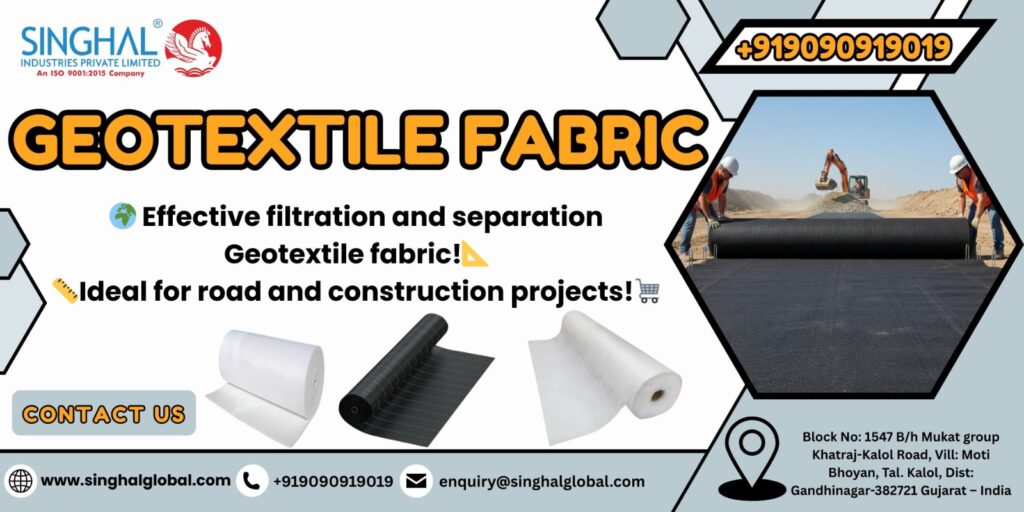
If you’ve ever traveled along a smooth road following a torrential monsoon storm or walked on newly constructed pavements that didn’t sink into hard soil, you may not be aware that a layer under your feet is quietly performing its work – the geotextile material. It’s not a technological breakthrough; it’s the product of the latest technology, dedication, and quiet engineering which literally shields infrastructure from the bottom up.
What exactly is Geotextile Fabric?
Consider geotextile fabrics as the superhero’s cover-up for your ground. It’s a durable, permeable, waterproof fabric made of synthetic materials like polypropylene and polyester, which is intended to be placed under, above, or within layers of dirt. Its job? Separate the sand, filter it, and then strengthen the protection, drain, or separate. Amazing, isn’t it?
For those who aren’t aware, geotextiles used in road construction help support weak soil foundations that allow road surfaces to endure longer, be smoother, and resist the impact of the weight of vehicles. Without this layer of foundation, roads will break, sink, or form potholes more quickly.
The beauty of geotextile fabric doesn’t end with roads. It’s used for river embankments, railways, drainage systems, and some landscaping schemes. The variety of applications for its use makes it among the lesser-known heroes of modern infrastructure.
A Science Behind the Strength
At first impression, geotextile sheets seem like ordinary industrial cloth. But don’t let their simplicity fool you. They are specifically engineered. Their strength is at the level of their GSM – GSM geotextile India generally refers to “grams per square millimeter,” which is the measure of its density and weight. The greater the GSM is, the more durable and robust the fabric. For instance, 300 GSM geotextile is stronger and is commonly used in large drainage projects and roads; however, 150 GSM fabric might be suited for smaller landscaping projects or for filtration.
To ensure the highest quality, Geotextile sheet Manufacturers in India examine each batch to ensure durability, tensile strength, and permeability. Certain top producers even tailor GSM levels based on the kind of project, whether it’s an agricultural road within Uttar Pradesh or an industrial drainage canal in Gujarat.
A Real-Life Experiment: The Roads of the Rain-Prone Regions
Let’s bring this to life. Imagine that you’re traveling through Kerala during the monsoon season. The roads in Kerala are often subject to flooding, erosion, and soil movement. In these areas, engineers are now employing high GSM geotextiles to construct roads. The fabric functions as a barrier between gravel and soil to prevent mixing of materials and ensure road durability.
An engineer from civil engineering once described the concept in a way that was incredibly clear: “Without geotextiles, our roads are just like cakes without an element of base. They break down quickly.” He claimed that the application of just one layer of high-quality geotextile fabric has helped decrease maintenance costs and increase the life of roads by a few years. This isn’t a minor win; it’s a significant change in road engineering.
Why Infrastructure Needs It More Than Ever
India, like many other emerging nations, is seeing rapid growth in infrastructure, including highways, smart cities, metro expansions, and irrigation projects all over the world. However, there’s one issue that we tend to overlook: unstable soil. In many places, particularly close to rivers or low-lying zones, the soil can’t support the heavy weights of construction.
Geotextiles are where drainage and Geotextiles in road construction. They strengthen weak soils, distribute loads evenly, and stop erosion. In the absence of them, the most durable concrete could fail quickly.
Additionally, with climate change causing unpredictable floods occurring across the country, drainage is now an issue. Geotextile fabrics can help with this issue by allowing water to move through while keeping soil in the right place. They allow the earth to “breathe” and not break up.
Beyond Roads: Unsung Uses
Most people think that geotextiles are only for roads, but this is far from the reality. They also serve a myriad of other uses:
- In the field of agriculture: Used to create artificial ponds or in gardens to increase drainage.
- In railways: To stabilize tracks by stopping soil mixing and decreasing the impact of vibrations.
- For coastal protection: To stop erosion of sand and protect embankments from waves.
- In landfills: Serve as filtration and separation layers to keep contaminants under control.
I once sat down with one of the contractors working on a massive fishery project for a pond within Andhra Pradesh. He explained that their first concrete pond had cracked because of drainage issues in the soil. The second time around, they lined the base with geotextile before pouring concrete. The result was zero cracks and better retention of water. Sometimes, small improvements can lead to huge improvements.
Selecting the Best Geotextile Fabric
However, not all geotextiles are constructed the same way. There are two types:
- Geotextiles made of woven geotextiles: They are created by weaving fibers together, great for strength and load-bearing. They are ideal for railway and road projects.
- Geotextiles made of non-woven: The bonded fibers are lighter and more porous. They’re perfect for drainage and filtration.
If you’re in the business, it’s likely that you’ve noticed that the Geotextile sheet Manufacturers typically recommend a hybrid or blend fabric for specific projects in which there is a need for drainage as well as toughness. Selecting the appropriate GSM and the right type of fabric could be an important factor in determining whether a job lasts two years or one that lasts for 20 years.
Qualitative and Supply in India
India has grown into the world’s largest Geotextile sheet Manufacturers. Between Ahmedabad to Chennai, many firms are making world-class fabrics that conform to international standards. Certain GSM Geotextile India brands also export to the Middle East and Africa.
However, the quality varies. Before purchasing, be sure to look for:
- Certifications for manufacturers (like ISO or BIS).
- Tested GSM rating to be suitable for your particular project.
- Durability reports and permeability information.
- The ability to customize.
If you speak with experts in the field, they can assist you in choosing a material that is a balance of price and strength—an important aspect in large-scale road projects for the government in which budgets are important.
Conclusion
Geotextile fabric is proof that there are heroes who don’t don caps. Some lie under the earth all day and night, working to keep our infrastructure strong and secure. If it’s a road for the rural in Bihar or the subway tunnel within Delhi, this fabric helps to support the entire infrastructure.
The next time you travel on an uninjured highway following the rains, stop for some time to consider the hidden layer of intelligence underneath your wheels – an unassuming solid geotextile fabric that’s in the process of transforming the method by which India creates its future.
Frequently Answered Questions (FAQ)
Q1. Can geotextile fabric be used to create drainage systems?
Yes, absolutely. Geotextile fabric is extensively employed in drainage systems since it allows water to flow through without soil getting stuck in chambers or pipes. This makes drainage systems smooth and durable. Non-wovens with a medium GSM are generally the preferred choice in these systems.
Q2. Is geotextile fabric a viable option to construct roads?
Yes. The most popular applications of geotextiles include use in road construction. They aid in isolating layers of soils and therefore ensure that soil materials do not mix, distribute loads and considerably enhance the durability of roads. This is very critical especially where there is dirt or soft ground.
Q3. Is geotextile fabric capable of bearing the burden of heavy loads?
It is definitely one of its strongest assets. Woven geotextiles with higher GSM ratings, are superb load bearers. They are frequently applied to the roads, parking lots, runways on airports, in short, everywhere when heavy loads are frequently in operation.
Q4. Can geotextile fabrics be made to order to suit specific projects?
Yes, top Geotextile sheet Manufacturers offer customized options. They can create products with a particular GSM, roll widths, permeability, as well as tensile strength according to your specifications of the project. Geotextiles are a great choice for all kinds of projects, from small gardens to massive highways.
Q5. Who is the largest supplier of Geotextile Fabric?
There are many prominent players in India. There are several strong players in the Indian market, which includes prominent companies in Gujarat, Maharashtra, and Tamil Nadu. While names can change in response to developments, the most significant manufacturers are usually those who also export internationally. It is easy to find the top suppliers in directories for engineering materials or ISO-certified fabric manufacturers.