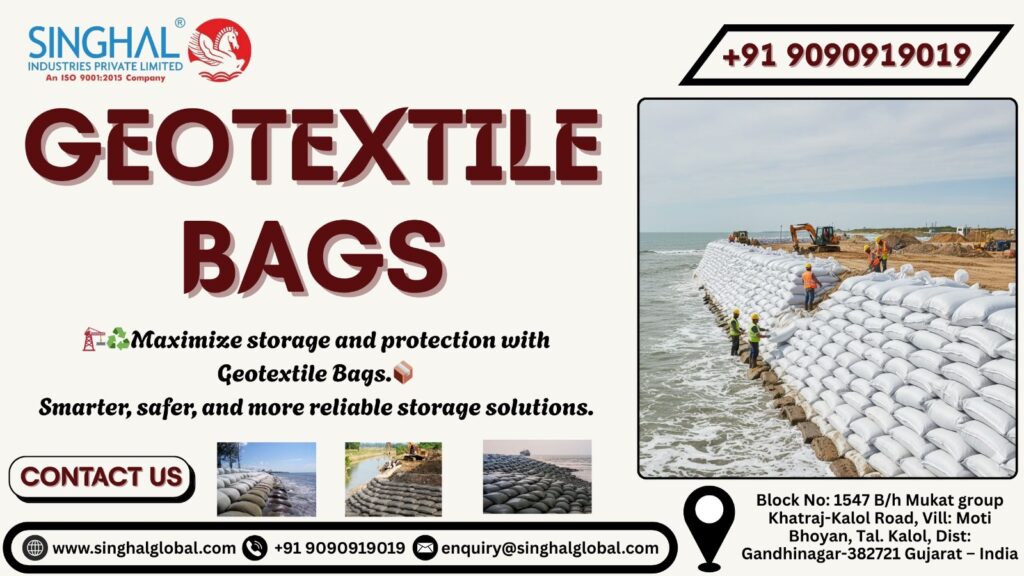
Bags are not the first thing which one would consider when it comes to protecting the delicate shoreline and riverbanks of our planet. However, nowadays, Geo Textile Bags are silent heroes of erosion and flood management in the world of innovative engineering. These rudimentary fabric bags are capable of preventing huge property damage, agricultural lands, and preservation of lives in times of floods. Surprising, isn’t it?
It is time to take a closer look at this interesting world of Geo Textile Bags, how they work, and why more construction and environmental engineers are considering Geo Textile Bags.
What Exactly Are Geo Textile Bags?
On the face of it, a Geo Textile Bag can pass off as a huge, heavy duty cloth sack. But there’s much more to it. The materials used in the making of these bags are geotextile fabrics which are designed as being powerful, permeable and resistant to adverse weather conditions. They are packed with sand, soil or even gravel depending on their use.
These bags are then located in strategic places like along riverbanks, coastal grounds or construction sites to avoid erosion or flooding. The geotextile material enables water to flow slowly when water runs over or around them keeping the soil inside. This is merely a shield that makes the water considerably less erosive and it prevents the land from being unstable.
Most Geotextile bags Manufacturers in India and other parts of the globe are currently spending a lot of money on new material designs that render the bags even stronger. To illustrate, some fabric blends are resistant to UV damage or chemical degradation, which means that it has an extended lifespan in the extreme outdoor environment.
The Role of Geo Textile Bags in Erosion Control
Suppose it is a small seaside town where the waves of the sea are continually consuming the land. Gradually, homes begin to collapse, roads are swept away, and arable land is swept off the ocean. This is not a fiction work, but an occurrence that is rather common than we imagine. Geotextile bags would be an effective and efficient solution in such situations.
They are employed to construct artificial dunes, support embankments as well as constructing retaining walls. They are less intrusive to the visual landscape since they mix easily with the natural environment and they do not need concrete or steel making them sustainable.
Consider the case of the coastline of Odisha- decades of erosion due to frequent cyclones. Geotextile bags have been introduced to enhance embankments and shoreline protection by engineers. It is not a glitzy answer but it works. It provides communities time to recover and acclimatize without further losing ground to the sea.
How Geo Textile Bags Help During Floods
Floods are brutal. They come unannounced, steal all they come across and leave behind them destruction. However, a row of Geo Textile Bags can save a lot. These bags serve as flexible river levees during rainy seasons or when rivers are over. Geotextile bags are easy to install and can be adopted instead of concrete flood walls, which require time and huge budgets.
One of the most amazing ones is one of Assam, India. These textile bags filled with sand are hundreds in number and every year during the annual floods of the Brahmaputra River, local disaster control teams make emergency bunds out of these bags. They are easy to transport and deploy hence they are able to secure an entire village within a few hours.
A large number of Textile bag manufacturers are currently providing specialized flood-control geotextile bags with additional stitching strength and UV-resistant linings and thus last longer when they are exposed to water and sunlight over a long period of time. This versatility has seen them emerge as one of the most diverse instruments in the contemporary flood control mechanisms.
Environmental Benefits You Might Overlook
This is an interesting twist because geotextile bags not only protect nature, but also collaborate with it. Geo Textile Bags do not cause natural habitats to be disturbed as compared to concrete embankments which do. After installation, they perfectly fuse with the surroundings.
That is why fish, birds, and other wild animals will be able to survive. Changes in the vegetation over the years often cover them and what was initially a man-made construction is transformed to a riverbank or dune that looks natural.
One of my friends who is an environmental engineer based in Kerala gave me a great example. She had also been involved in a river restoration program that involved geotextile bags rather than the conventional concrete block barriers. For several months, the bags were covered with grass and bushes. The riverbank not only remained, but was greener and more beautiful than ever. She told me that it is incredible how engineering and ecology can cross hands when we select the appropriate materials.
Why Are Engineers and Builders Switching to Geo Textile Bags?
There are a series of factors that are making Geo Textile Bags highly popular among the engineers, farmers, and even the municipal authorities.
- Cost-effectiveness: They are relatively less expensive than concrete buildings or stone buildings.
- Installation convenience: They can be installed with barely any machinery by almost anyone.
- Flexibility: They are able to adapt to any shape or slope and are flexible in nature.
- Friendliness to the environment: They do not bring about much disturbance to the surrounding ecosystems.
- Durability: A current fabric ensures that it is tear free, chemical free and has protection against UV.
There are numerous Geotextile bag Manufacturers in India such as those located in Gujarat, Tamil Nadu and Uttar Pradesh who are also designing to meet the small-scale as well as industrial applications. The market has been growing at a tremendous pace because climate change has increased the frequency and severity of floods and erosions.
Challenges and Misconceptions
Geo Textile Bags are not without difficulties even though they are popular. Among the most frequent myths is that they are a stop-gap measure. Some of them can be cheap but they wear out easily, but some of the good quality bags can last years when they are installed in the right place. There are also those who think that concrete is stronger all the time. True, however, concrete does not always fit in all the places- particularly in ecologically delicate areas.
Maintenance is another issue. Bags must be promptly replaced in case they are torn or dislocated. In some cases, bags that may hold their sand or can be reused are taken away by locals or unauthorized people, thus causing weak spots. That is why it is necessary to monitor constantly.
However, when used in the right manner, geotextile structures find that ideal balance between stability, flexibility and the surrounding harmony.
Role of Manufacturers in Innovation
The process of manufacturing has a large influence on the efficiency of these bags. Manufacturers of Geotextile bags are always experimenting with combinations of material, methods of stitching and applying coatings to enhance the strength and durability of these bags. Others even test biodegradable substances which can be safely recycled back into the soil once it is used.
Automation and sustainable production lines are also being used by the manufacturing companies of textile bags in order to minimize waste. The shift of the industry towards eco-design is something to be praised. It is not only about profit but how to save the planet by using smart engineering materials.
Conclusion
With the world fighting climate change, rising sea levels and unpredictable weather, it is difficult to deny the necessity of sustainable engineering solutions. Geo Textile Bags are simple to see but the effect of look is immense. They also reflect the notion that in some cases even the most basic things can save the whole community in the wrath of nature, such as a bag, strong, flexible fabric and full of earth.
We may find all these bags becoming widespread as bricks in flood-tone areas in the coming years as people continue to innovate. And maybe that is a glimpse of sustainable development, to work with rather than against nature.
Frequently Asked Questions (FAQs)
Q1. Are Geo textile bags applicable in flood protection?
Yes, absolutely. Geo Textile Bags have been used as one of the best flood protection tools. They are stuffed with sand or soil to block the entrance of water and slow down the speed of the flowing and form emergency levees. They can easily be implemented in times of emergency.
Q2. Who are the users of Geo textile bags?
They are also commonly employed in civil engineering, coastal and river engineering, agriculture, mining and construction. They are even used in soil stabilization and retaining walls in landscaping projects.
Q3. What are the geo textile bag sizes?
The sizes may be different based on manufacturers. In most instances, they are as small as hand-lifting sizes (approximately 0.5 m3) or are large-scale industrial ones of over 2 m3. Custom sizes are also common.
Q4. Are Geo textile bags customizable?
Yes, they may be totally tailored according to need. Geotextile bag Manufacturers provide different types in terms of size, thickness, the fabric strength, color, type of stitching, or even UV protection coated ones.
Q5. Who is the largest manufacture of Geotextile bag?
Although the number of big players is few in the world, the number of reputed Geotextile bags Manufacturers in India is numerous particularly in such states as Gujarat and Tamil Nadu. Singhal Industries Pvt Ltd is one of the companies that have come to the fore because of their modern production and quality and environmentally friendly designs.