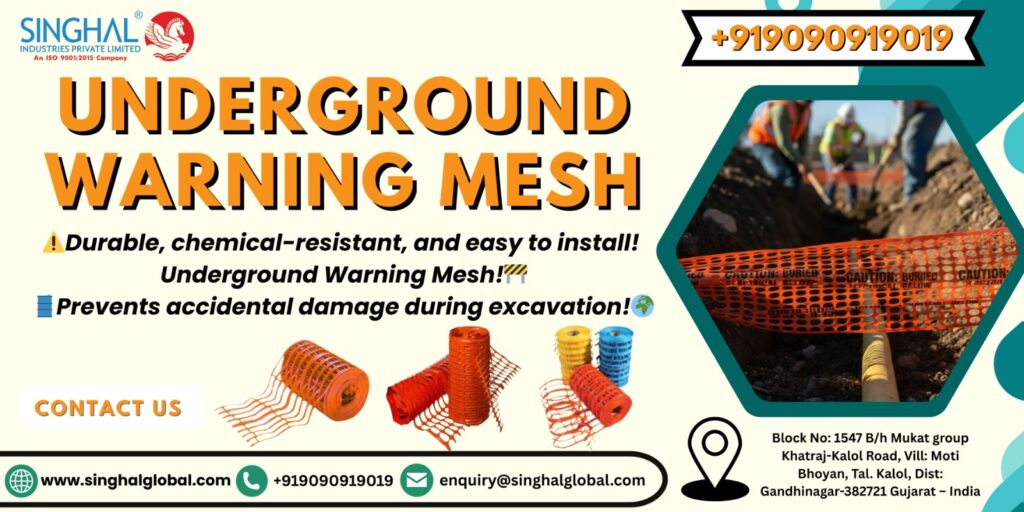
Hey, people working at construction sites or interested in keeping things secure underground. Have you ever dug up a roadway or in a backyard only to hit an unexpected object such as a pipe or cable? That’s right, it can make a straightforward job an unending nightmare. That’s where the high-quality underground warning mesh comes into play. It’s like a safety netting concealed beneath the surface, yelling “watch for danger!” prior to your shovel doing any harm. In this article, we’ll take a deep dive into the subject and why it’s an essential tool for construction sites and how it helps keep your construction projects on track without any unpleasant unexpected surprises. We’ll discuss manufacturers, Cable warning mesh supplier, as well as exporters who are the ones to make it happen. Keep coming back – there are many things to discuss here.
Construction sites are full of chaos. Massive machines in motion while workers hustle under everything? A network of cables, pipes, and utilities that no one would like to ruin. The underground warning mesh is essentially a strong and vibrant grid that is laid over the treasures that are buried. It’s made of sturdy materials such as polyethylene or similar plastics that will not rust or break down easily. It’s bright yellow or orange, which stands out when you dig; you will notice it and then stop. Simple, right? But is it really easy? Some people believe it’s cheap plastic sheeting. But it’s not – this one is made to last through pressure, dirt, and wear and tear.
Let me tell you a quick story. In the year 2000, in an area near my home, there was an expansion of the highway. In the absence of the warning net, a backhoe cut into the gas line. Boom, delays, repairs, delays, and huge fines. If they’d utilized high-quality underground warning nets, the problem could have been prevented. It’s not only about safety; it’s about reducing costs and headaches. Let’s imagine this scenario: you’re a project manager. Do you want your team to be digging blind or do you need an extra layer of security?
Why Construction Sites Need This Mesh
The reason is big time. Okay, let’s get real. Construction sites have foundations, trenches, and excavations every day. Put a cable or pipe in a trench in soil, cover it with soil, and then forget where it is? This is not a good idea. A heavy-duty underground warning mesh can solve this. Set about 300mm over that utility line; it warns diggers well before they can reach the actual site. It’s durable because it can handle heavy loads like trucks that drive over it without breaking. It’s made of high-density polyethylene; it’s also UV-resistant and won’t fade in the dark, where sunlight shouldn’t penetrate anyway. Wait, underground? Yes, but it can be exposed during excavations.
A contradiction is that certain people believe it’s not enough for smaller jobs. So why then do huge projects rely on it? I’ve seen websites where they cut it out to save money but then had to pay three times more in the future for fixes. Absolutely, if you value safety. Statistics from safety boards reveal that utility strikes result in millions of damages each year. In the case of India alone, with all the boom in infrastructure, the issue is huge. The mesh cuts these risks sharply.
As an industry leader in Pipeline warning mesh manufacturers, this specific mesh is for gas, oil, and water pipelines. They are experts at making it visible, often using additives to help locate devices. It’s laid across in ribbons, covering the edges, and boom, protected. It’s flexible, too, so it can be molded around the pipes’ bends. Have you ever wondered how it holds in position? Tiny barbs or simply the weight of soil can hold it in place. Pretty clever, huh?
Materials and How It’s Made
As tough as nails, the inside of it. Underground warning mesh that is heavy-duty uses virgin polyethylene resins. Why is this? The recycled material could shrink under stress. It’s extruded to form a mesh, which is like a net made of large squares of about 50mm x 50mm, or something like that. This size allows soil to move through but also makes it clear. Thickness? About 0.5mm or 1mm for high performance. Colors? An apostrophe for electricity is orange, blue for water, and orange for electricity – standards differ, but orange is the standard color for general warnings.
Manufacturing? A Pipeline warning mesh manufacturer melts the plastic, then pushes it into dies, and then it is cooled and stretched. Checks for quality ensure that there are no weak points. It’s not cheap like garden nets; it can withstand 100kN for each meter of load. It was tested in labs to simulate real-world construction abuse. If you’re purchasing, make sure you ask for tensile strength certificates. Cheap knockoffs snap quickly.
Here’s a human-error moment: I thought all mesh was made of the same. Nope! The heavy-duty versions are made of reinforced weaves. Contrary to popular belief, lighter ones are used for gardens; however, construction requires the most robust. What’s the reason to risk it?
Installation Basics: Don’t Mistake It Up
Installation isn’t rocket science. But if you do it incorrectly, you’ll lose the whole thing. Begin by laying your cable or pipe. Then, remove the mesh about 150-300mm over it, parallel to your trench. Overlap the mesh by 100mm, and secure it with tape, if required. Backfill in a careful manner. Boom, done. For wide trenches, multiple layers. What is the best site for rain? Mesh removes water well, and there aren’t any pools.
Construction sites are where professionals employ it across entire areas and not only lines. As in roads, slabs, or under the floor. Have you ever seen runways at airports? They are similar to fuel lines. In India, the metro project is expanding in cities such as Kanpur. This mesh is all over the place. They ship it in rolls, which are easy to carry.
Benefits That Will Blow Your Mind
Safety first, obvious. It speeds the process too. Being aware of utilities’ markings means more digging speed and less vigilance. Cost? Rolls start at a low cost, but pay off in a big way. Long-lasting underground for 50+ years. Eco-friendly? Recyclable, non-toxic.
As an online provider of cables warning mesh, they have a range of different kinds – power, telecom, or whatever. Delivery is quick, custom prints even. Exporters deliver worldwide and are in compliance with international specifications such as BS EN 12613.
Contradiction: some claim mesh is unnecessary when using GPR scanners. However, scanners can miss things, but mesh doesn’t lie. What do you think? Do you rely on technology or mesh? Long-term, it stops lawsuits. Companies that run utilities mandate it today.
Who’s Selling These Good Products
The construction safety alert mesh exporter. They not only produce it but also export it to the world. All the way from India to the Middle East, Europe – quality stands the test of time. The largest ones are certified with ISO certifications, huge factories. They can customize the gauge – heavy gauge for mining sites or reflective ones for nighttime work? Yeah.
Kits are available from suppliers: markers, tape, mesh. Bulk deals are sweet. Chat with friends and bargain for samples of free. You can test it yourself.
Advanced Uses – Above Basics
Not only pipes. The fiber optics industry, the septic line, even geothermal. The heavy-duty version is for railways and beneath tracks. In disaster zones, it marks temporary utilities. Future? Smart mesh equipped with RFID tags. It can be detected by apps. Cool, right? Old-fashioned orange is still the king of the hill.
Conclusion
Find certificates and samples. Also, read reviews. An Construction safety warning mesh exporter with a global reputation is top. A local Cable warning mesh supplier for fast delivery. The heavy-duty underground warning mesh is no longer optional. It’s essential for smart construction. Saves lives, time, and cash. Got a site coming up? Get it listed.
Frequently Asked Questions (FAQs)
Q1. Can underground warning mesh be reused?
It’s not recommended. After being buried, the soil and pressure will be used to embed it. The act of pulling it up makes it easily damaged. However, for trenches that are temporary? Maybe, if careful. Some claim that yes, however, standards recommend that only one use is safe.
Q2. What sizes of rolls are available?
Standard sizes are 1m x 50m, 2m x 50m, to 4m in width for large sites. From 25m-100m. Custom? A manufacturer of pipeline mesh makes it. Choose the one that best fits your trench.
Q3. Does it meet the utility safety standard?
It’s true, it’s in line with the HSE standards, BS 8518, even Indian BIS when it comes from a reliable exporter. Tested for strength, color fastness, and durability. Always check labels.
Q4. Are bulk amounts of products provided?
Absolutely. A Construction safety warning mesh exporter can handle trucks. Discounts are available for 100-plus rolls. The lead time is between 1-2 weeks.
Q5. Who is the largest manufacturer of underground warning mesh?
A tough call to make – global giants similar to Solmax and local titans like SIPL in India. SIPL is pushing hard to be the leading cable warning mesh provider with massive capacity. It depends on the region; however, they boast huge output.