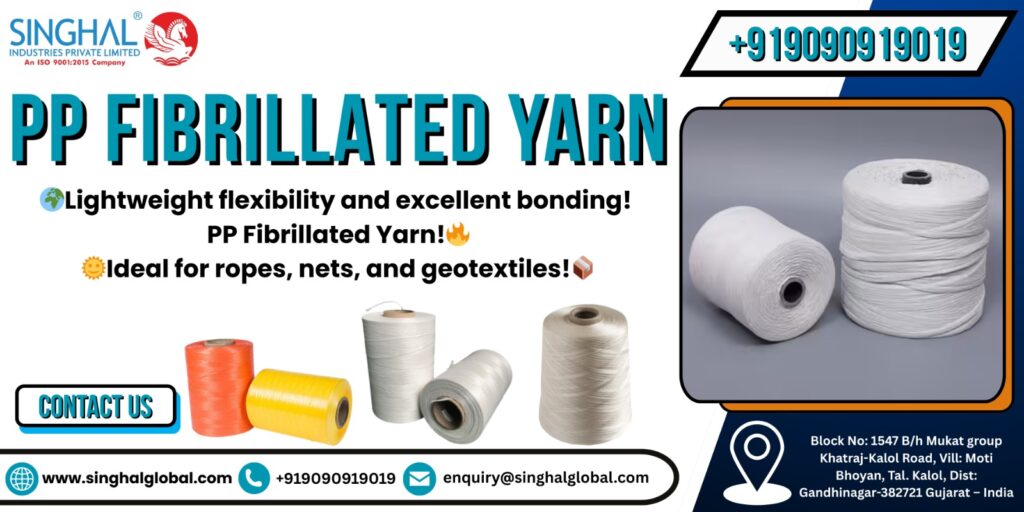
Hey, everyone! Have you ever thought about what prevents huge tarps from falling apart in the midst of a storm or how those tough ropes last despite the most extreme load? Then the solution may be just a PP fibrillated yarn strand. That’s right, this sturdy little thing composed of polypropylene is the unheralded hero for industrial material. In India, where the industries are flourishing from factories to farms, fibrillated yarn is all over the place, quietly performing much of the lifting.
Today, we’re delving into the reasons why PP fibrillated yarn is the best choice for tough industrial applications. We’ll go over the basics of what it is, the process of making it, how it’s used, and the reason the manufacturers of polypropylene yarn are churning their wares like it’s time for a break. Stay tuned – it’ll contain more than 1100 words of information that’s straightforward and useful, written in the style of a chat over Chai.
A yarn that isn’t smooth like regular thread, but is split into tiny strands, much like frayed jeans but extremely robust. It’s PP fibrillated yarn. It’s made of polypropylene, an extremely durable plastic that’s lightweight, inexpensive, and resistant to rain like the back of a duck. Contrary to standard Polypropylene filament yarn, which is smooth and straight, the fibrillated yarn develops that rough, split-like texture thanks to the process of fibrillation. The tape is taken and stretched to a thin thickness and then put through rollers, which split it into an elongated shape. The result is a yarn that’s soft, grippy, and incredibly robust. It’s ideal for applications that require something to gnaw into fabrics or to hold knots and not slip.
The Making of PP Fibrillated Yarn: From Melt to Might
Let’s see the process by which this magic occurs. The process begins by using polypropylene resin pellets. These are pure, with no recycled waste unless stated. They melt it around 300-250°C using an extruder. They then move it into a mold and make flat tapes. These tapes cool in water baths, and then are stretched and pulled up by 7 to 10 times their size. This orients the molecules and increases their strength. The next step is the fibrillation, when embossed rollers split the tape into fibrils. When you wind it, you’ve got a yarn that’s ready to be spun into ropes or woven into fabric.
The filament yarn made of polypropylene is similar to the one used in textiles, but it doesn’t have the slitting feature – it’s a better choice for applications that require smoother edges, such as carpets. However, for industrial applications, fibrillated yarn is the best. Manufacturers alter denier (thickness) between 600 and 20,000, and colors using masterbatches, and even add anti-static or fire-retardant yarns. In India, regions such as Gujarat and Maharashtra are major hubs for this, and fibrillated yarn India is the leading exporter to regions like the Middle East and Europe.
Killer Applications: Where PP Fibrillated Yarn Shines
The fun part is now: industrial applications with a strong foundation. In the beginning, tarpaulins and covers. What are those blue sheets you see on your construction sites or on trucks? Most likely, they are made of PP fibrillated yarn that is woven tight. The fibrils hold, preventing slippage, and UV resistance ensures they can last for 3-5 years outside. In India, during monsoons, they save goods and crops from deterioration.
Next, twines and ropes. Lashing for cargo, fishing nets, agricultural baling – fibrillated yarn’s lower stretch and strong knot make it perfect. Have you ever seen a 10-millimeter rope that can hold a load of 2 tons That’s what this rope is made of. Manufacturers of polypropylene yarn claim break strengths of more than 1000 kg for their thick ropes.
Woven bags and sacks are massive too. For fertilizers, cement, and rice – the 50 kg sacks won’t tear when they are dropped from trucks. The weft has a fibrillated yarn that helps to resist tears. In the Indian packaging industry, it’s a standard, reducing costs by 30%.
Why India Leads in Fibrillated Yarn
India’s not a weakling here. With more than 200 polypropylene yarn producers, the country is the second-largest producer. Costs for labor are low, as is the power, and ports such as Mundra allow exports to be simple. Fibrillated yarn India is the most popular due to its quality; ISO-certified facilities make use of Japanese technology to produce consistent fibrils.
Advantages That Crush the Competition
- Strength-to-weight ratio: Less weight than polyester, more durable than jute.
- Chemical resistance: Acids, alkalis? It’s not a problem.
- Cost-effective: 30-50% less than nylon.
- Non-absorbent: Dries quickly, and there is no mildew.
- Customizable: From fine 2-denier to a monster 10,000.
Sustainability Angle: Green Side of PP Yarn
Recycling PP is a Code 5 Plastic. PP fibrillated yarn manufacture blends 10-20% recycled content, without loss of strength. Biodegradable ingredients make it disintegrate in the soil over time. In Europe, regulations encourage this, and India is in the process of catching up to EPR law.
Lifecycle? There is less energy required to make it than cotton (which consumes water). For those who are concerned about the environment, fibers with green certifications are a hot item.
Conclusion
In 2030, the market is projected to be $4 billion, according to Grand View Research. The main drivers are e-commerce packaging, renewable energies (wind farming nets), and disaster relief tarps. India eyes $1 billion in exports.
Innovations Nano-fibrillated to make ultra-strong, smart yarns that have sensors. Polypropylene filament yarn also evolves; however, fibrillated remains the industrial champion. of industrial strength. From securing your cargo to protecting your fields, it’s as reliable as you can get. If you’re a manufacturer, using top polypropylene yarn producers can help you save money.
Frequently Asked Questions (FAQs)
Q1. Any other colors available?
Yep, tons! From the basic white, blue, and green to customized Pantone shades. Manufacturers mix the pigments when extruding – no dyeing required, which makes them color-fast and UV-stable.
Q2. Can PP filaments be utilized in the field of agriculture?
Absolutely! It’s great in crop protection, shade nets, bird protection, and silage wrap. In India, it improves yields by about 15% due to more effective control of moisture. It won’t rot like natural fibers.
Q3. Can I get custom specifications?
For sure. Polypropylene yarn manufacturers tweak denier, twist, additives, even fibril count. Do you want 4000 deniers, with 5 percent UV? Ask a question; MOQs start at a low price.
Q4. What is the maximum tensile force of fibrillated PP yarn?
The typical is 4 to 6 grams per denier. However, high-tenacity yarns can reach the 7-8 gpd mark. A 1200 denier yarn might break at 5-7 kg. Tested per ASTM D2256.
Q5. Who is the largest manufacturers of PP fibrillated yarn?
In India, the crown belongs to Gujarat-based giants such as Singhal Industries Pvt Ltd that produce thousands of tons every year and dominate fiber-filled yarn exports. To sum it up, the fibrillated yarn of PP isn’t glamorous, but it’s the underlying component