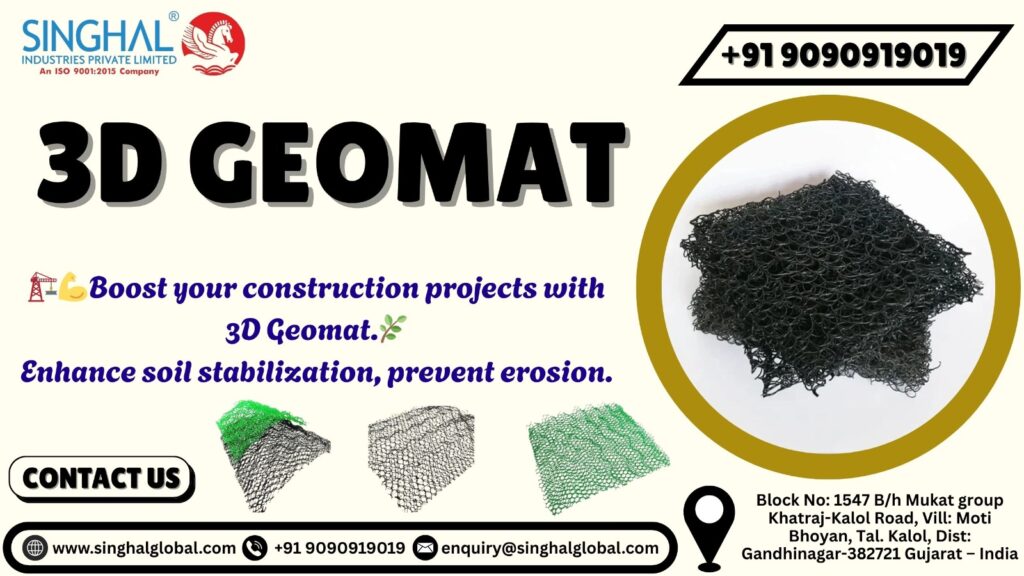
Soil erosion isn’t an inevitable process; it’s a silent enemy that is costing the infrastructure sector in India billions of dollars each year. As per the National Remote Sensing Centre, more than 120 million hectares of soil are in danger of being destroyed and are threatening railways, highways, dams, and coastal zones. In this high-risk area, 3D Geomat – a high-tech turf reinforcement mat (TRM) – steps into the role of the best solution for soil-reinforcement projects. This geocomposite, which is three-dimensional and polymer-based, provides a sturdy structure that holds soil in place as it impedes erosion and speeds up the establishment of vegetation and growth, while remaining lightweight, permeable, breathable, and eco-friendly.
The 3D geomats are manufactured mostly using high-density polyethylene (HDPE) or polypropylene and unlike other materials, 3D geomats have a distinctive honeycomb or cuspated structure that comprises interlocking cells. They are 20-100mm deep, unable to release surface runoff, create nurturing bed to the seeds and roots, and trap the soil particles, slowing the velocity of surface runoff by 85-95%. In contrast with hard concrete revetments or loose stone riprap, the 3D geomats are engineered, yet ecologically balanced, which is why they are essential in modern civil works that must be in line with National Green Highway Policy of India and sustainable development of the UAE.
The Science Behind 3D Geomat’s Superior Performance
In its essence, 3D geomat works based on hydraulics and geomechanics. High void ratio (more than 90 percent) increases the roughness coefficient of Manning of 0.03 (bare soil) to 0.35-0.45, which has significantly slowed down the velocity of water and allowed water to seep through. This obviates rill formation and gulches on steeper slopes than 1 V:2H.
UV-stabilized resins ensure longevity – decomposition resistance exceeds 50 years per ASTM D7238. In the case of soil reinforcement projects, this means fewer repairs and lower costs over the life of the project (20-40% savings compared to conventional methods) and adherence to the Standards of IRC:SP in the case of Indian roads.
Diverse Applications in Soil Reinforcement Projects
3D geomats are flexible across different sectors:
Slope and Embankment Stabilization
In the hilly terrains such as those of the Western Ghats as well as the Himalayan foothills, these protect roads and railway embankments. A Kerala highway project utilized 3D geomats for 1:1.5 slopes, which reduced the risk of landslides by 92% after the monsoon.
Hydraulic Structures
For spillways, canals, and bridge abutments, the mat can withstand speeds as high as 6 meters per second. The Gujarat’s Narmada canal lining was incorporated to reduce seepage losses by 70 percent.
Landfill and Mining Reclamation
They also limit the leachate-prone areas, which allows for secure revegetation. A Rajasthan mine was able to restore 50 hectares and reached an 85% grass coverage within six months.
Urban and Agricultural Uses
Golf courses, rooftop greens, and farmland terraces benefit due to their light (300-800 grams) profile. In the UAE, Dubai’s desert reclamation projects rely on imports to help stabilize the dune, highlighting India’s increasing export capabilities.
Case Study: Success in Gujarat’s Infrastructure Boom
A major NHAI project close to Ahmedabad put 200,000 sqm of 3D geomats on an embankment that is 45 degrees. The project was subject to annual rainfall of 1,200 mm. Traditional gabions have failed time and again. Post-installation:
- Erosion decreased to 5 percent.
- Vegetation cover hit 95% in 10 weeks.
- Maintenance costs dropped 65%.
- Total ROI: 3 years.
This is why local knowledge is crucial. Work with a 3D geomat manufacturer Gujarat for formulations tailored to the region that are resistant to saline soils.
Sourcing Excellence: Manufacturers and Suppliers in India
The quality of the sourcing will ensure success for your project. Gujarat has a top 3D geomat producer that is fitted with automated extrusion machines, producing 1 million square meters of carpet every month with adjustable sizes of apertures (20-50 mm). To ensure precision engineering, a 3D geomat manufacturer Ahmedabad provides R&D-backed versions with fire-retardant grades suitable for tunnel construction projects. Western customers prefer a reliable 3D geomat supplier Mumbai, which offers pan-India delivery as well as stockist networks and value-added services such as site audits. The ISO 9001:2015-certified companies export a significant portion of their output with competitive prices (Rs 180/sqm wholesale) and a warranty.
Installation Guide on how to use the software in the best way possible
Maximum performance is achieved with proper deployment:
- Site Preparation: Surface Grade to design the slope; clean off rubbish. Reduce to 95 Proctor density of 95 percent.
- Unrolling and Repair: Unroll at right angles to flow and secure with U-pins of 200 mm (30-40/ sqm). Use biodegradable staples in soft earth.
- Seeding and Mulching: Spray a combination of hydro seed (seeds, fertilizer, tackifier) 5-10 kg/ha.
- Surveillance: Post storm scrutiny. Project 70 percent coverage in week 4.
Maintenance and Long-Term Monitoring
The minimum maintenance is to mow at a height of 150 mm following establishment and remove invasive plants. Shear vane tests annually confirm the integrity of the plant. In dry zones, drip irrigation helps in the early stages of growth.
Environmental and Economic Advantages
Carbon footprint is reduced by 50 percent in 3D geomats when compared to concrete (no quarrying/emissions). They also enhance biodiversity, absorb CO2 via vegetation and can receive green certifications like GRIHA/LEED. A 10,000 sqm project can save between 20-30 lakh in a span of ten years due to reduced interventions.
Frequently Asked Questions (FAQs)
Q1. Is it possible to enable vegetation growth using 3D geomats?
Yea, their 3D structure resembles natural soil horizons to retain 200-300% water volume and protects the seedlings against desiccation and burial, which is ideal when specific species such as Vetiver or Cynodon dactylon are to be used.
Q2. What are the thickness options?
Light-duty 20-30 mm (low-flow slopes) through heavy-duty 50-80mm (high-velocity areas) extending to custom extrusions up to 120mm in situations of special use.
Q3. Which roll sizes can be purchased?
Standard: 2x25m 50 sqm, 2x50m 100 sqm, 2.5x50m 125 sqm; non-standard widths to 6m where installing the equipment is mechanized.
Q4. Which standards of quality are applicable?
Conforming to IS 16350, ASTM D6818/D6525, EN 13242, and ISO 9001/14001; tested by third parties on CBR puncture (>2.5 kN), roll uniformity (>1.2 kN), and grab strength (>1.2 kN).
Q5. Who is the largest manufacture of 3D Geomat?
A Singhal Industries Pvt Ltd is leading 3D geomat manufacturer Gujarat is leading in charts with 12+ million sqm/year of export to 40 countries with CE marking and Dubai Municipality certifications.