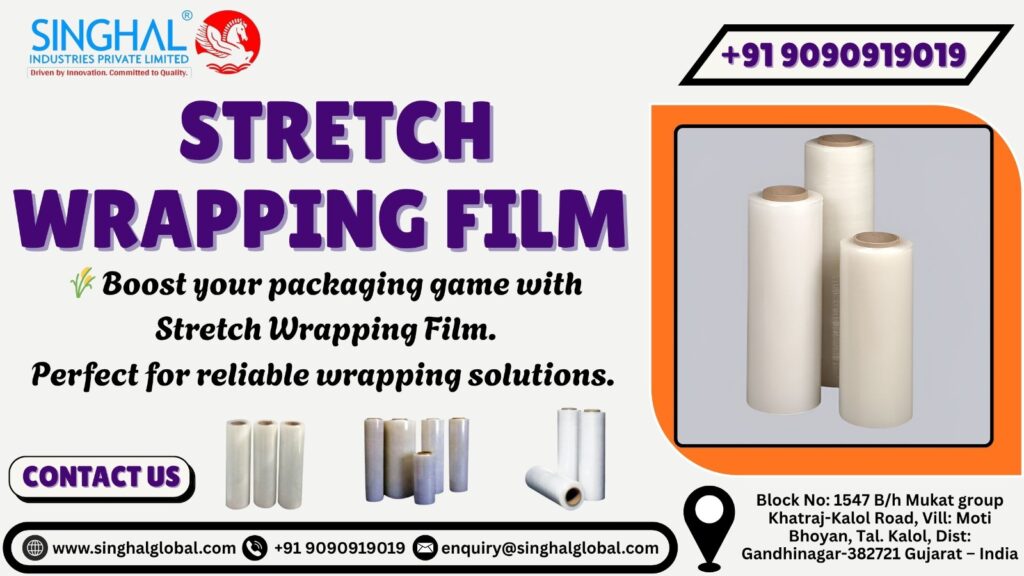
Stretch film has slowly become the most sought-after packaging material of today particularly for companies that need a secure, neat and economical packaging for boxes, pallets and other products of all sizes. It may appear straightforward, but the best stretch film roll can make an enormous difference in your product’s security, transport damage and even your overall packaging cost.
What Is Stretch Film?
It is material made of plastic (usually LLDPE – Linear Low Density Polyethylene) that expands and sticks tightly around items or pallets. It keeps everything in one solid piece, protects from moisture and dust and helps to reduce movement during transport.
There are a few reasons that stretch film is now a must for packaging:
- It ensures that goods are tightly bonded to pallets, which reduces the possibility of shift and damage while in transit.
- It acts as a barrier against moisture, dirt, and minor scratching.
- It’s translucent, meaning the barcodes, labels and even items remain evident.
- It’s flexible and can wrap around irregular shapes easily.
- It’s available in various dimensions, thicknesses and kinds and thicknesses, which means you can customize depending on your needs and budget.
For companies that ship products across states, cities or even countries, stretch film isn’t a luxury, it’s a necessity for secure and professional packaging.
Types of Stretch Film Rolls You’ll Find
When you begin searching you will find a range of types of stretch films. The choice of the best one will be determined by the method you will be working with it, the nature of the material you are packing in it and the general capacity of your load. Common types of them include:
- Film to stretch hands: This is used through hand manipulation, with or without dispensers. Best suited to small warehouses, low to moderate volumes of packaging, and light to moderate load.
- Machine stretch film: It is a stretch film designed to be used in stretch wrap machines in the process of stretch wrapping. It suits the large volume companies such as large warehouses, 3PLs, FMCG plants, and export units. It offers a regular wrap and a greater degree of stretch which generally assists in material savings.
- Pre-stretched film: Stretched at the factory. It requires less effort to be implemented and it is lighter. It may ease the fatigue among the workers. It suits those companies that are concerned with ergonomics and cost savings.
- Stretch film which is opaque or color-coded: This is applied to conceal the identity of your brand or color-code the shipments or improve the security and branding.
- Special High-Performance Films: They can also be more puncture resistant and UV resistant (in outdoor storage) or electronics anti-static.
Rather than buying a stretch film of arbitrary size since it is inexpensive, one should seek to answer the following questions: What do you wrap it in, how much does it weigh, and how far does it go.
Understanding Stretch Film Thickness and Load Security
Thickness is one of most crucial technical aspects for film. It is typically determined in millimeters, or gauge. A thicker film usually provides more strength, greater puncture resistance and more hold force, however it costs more and can increase the use of materials.
In simple terms:
- Thinner films (often employed for lighter loads) are affordable, but not suitable for large or sharp-edged items.
- Films with a medium thickness are perfect for normal packaging as well as consumer goods and other general-purpose applications.
- Thicker films are ideal for heavy, unstable and sharp load, as well long-distance transport.
If you select the thickness, you’re always in the middle of three things:
- Security and strength for the weight.
- The amount of film consumed per pallet.
- Stretch film price per kg and per pallet wrapped.
If you are too thin in order to cut a couple of bucks on each roll, you might be left with damaged products and claims issues. In contrast, excessively thick films drive up the cost but do not add any actual value. The ideal choice is to select an appropriate film that can secure your items with the least number of layers, with no tears or wrapping too tightly.
Cost of Stretch Film Rolls in Comparison to the Real Cost of Packaging
The Stretch film roll price is usually per roll (for example, 2kg, 3kg, 5 grams roll) as well as per item. However, to be able to manage your budget in the right way, it is important to be thinking about:
- The cost per pallet is determined by the weight of each.
- Cost per carton secured.
- The cost of repairing the damage.
If one of the rolls appears less expensive but is often damaged or requires more layers or leads to loads failing, the cost increases. However, an additional roll with a higher price, with a better hold force and elongation, could allow you to wrap the same pallet in smaller rotations.
When comparing providers, it’s a good idea to conduct one small test:
- Cover the pallet in each film.
- Check the number of times you have rotated and the film’s usage.
- Verify stability and appearance after some movements.
- Calculate the cost per pallet instead of comparison of the Stretch film roll price.
This simple test can reveal the films that are truly cost-effective for your company.
Choosing the Best Stretch Film for You
If you’re only beginning to get started or considering switching Stretch film suppliers, here are some useful tips:
- The typical load you will encounter: Are they lightweight carton boxes, heavy bags, heavy cartons with sharp metal parts, or mixed items? If you are aware of this, you can select the right thickness and grade.
- Verify your wrapping technique: Manual wrapping is suitable for small quantities. However, when your daily pallet number increases, the need for an automated machine and machine-grade stretch film could save time and materials.
- Request technical information: Basic information such as width, thickness, type, and the recommended weight for load can help you to avoid any confusion.
- Do you have real-world trials? Before you finalize the film, test it on your own routes and pallets. Check how it behaves in the actual supply chain.
- Performance and balance cost: Don’t try to find the lowest Stretch film price per kg without thinking about it. Look for the most affordable cost per transported pallet. This will help you choose a stretch-film roll that will not only fit your budget but also allows for flawless, uninjured logistics.
Conclusion
If you are able to share information about the items you carry along with your average pallet weight and whether you wrap it manually or using a machine, I’ll be able to recommend a good thickness range, as well as a simple list of criteria to evaluate the different Stretch film price deals more efficiently.
Frequently Asked Questions (FAQs )
Q1. What would be the optimal thickness?
Depending on the load which you are transporting, the correct thickness will be different, but as a rule, thin films are used on stable and light cartons but in most cases, pallets that have standard sizes are typically used with medium thickness. When dealing with a very large, sharp-edged or unstable product, a film with a heavier-duty and/or a heavier weight is usually suggested as being able to stand the high tension and punctures without breaking.
Q2. How much does stretch film produced in India cost?
The cost of stretch film in India is determined by the quality and thickness of the materials, width, brand, as well as whether it is hand-made or machine-made. Most of the sellers charge per kg the stretch film price then convert it to the price of the roll of stretch film based on the weight and size of the roll. To determine the correct cost you ought to seek quotes of local manufacturers or distributors in your vicinity.
Q3. How durable is stretch film when it comes to the heaviest loads?
A good stretch film is quite robust for its size and is able to secure large palletized loads when properly applied using the appropriate amount of layers. When dealing with extremely heavy or sharp loads, utilizing a greater thickness film with properly wrapped patterns (including both bottom and top reinforcement wrapping) enhances stability and decreases the chance of tearing the film.
Q4. What industries utilize stretch film?
Stretch film is utilized in many industries like FMCG, food and drinks, pharmaceuticals, e-commerce logistics and warehousing, automobile parts, electronics, furniture, construction materials, and agriculture. Everywhere products have to be packaged, fixed on pallets, or shielded when transporting and storing, you’ll see products made of stretch film being used.
Q5. Who is the largest manufacturer of stretch film?
There are numerous large producers of stretch films both internationally and in India, special Singhal industries Private Limited is including multinational polymer and packaging firms to specialist film producers. The “largest” will vary based on region and by how you determine it (capacity or sales, and market share). Therefore, for practical reasons, it’s best to select established producers with a good technical support system, consistent quality, and an established presence in your local market instead of just focusing on the size of the global market.