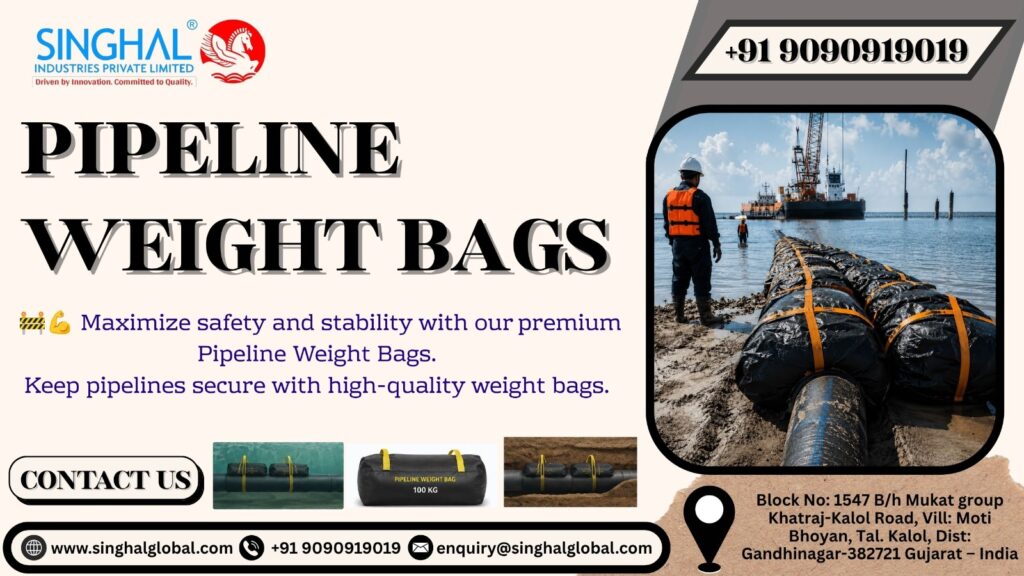
The industry of oil and gas is dependent on extensive pipeline networks that traverse all sorts of harsh environments – under streams, through marshes in soils that are loose and through rough ground. Under these conditions, pipelines have a significant challenge to overcome: maintaining stability and staying in their place. When pipelines are buried in soil that is soft or laid in water, it flounder and move or shift due to buoyancy and shifting ground conditions. The movement could damage joints, pipes and coatings. It may cause ruptures or leaks. To stop this from happening the possibility of damage, engineers employ pipeline weighting systems. A highly efficient and advanced solution is the heavy-duty pipe weight bags.
Many project managers and contractors favor these bags over traditional solid concrete blocks as they are flexible, safe and ease of handling but still provide a sturdy solid, stable ballast. This is the reason why the need for a reliable Pipeline weight bag manufacturer is growing constantly, particularly in the gas and oil industry where reliability is the most important thing.
What Are Pipeline Weight Bags?
Pipeline Weight Bags are designed to be ballast systems that are used to keep pipelines securely in place and stop any movement or flotation. Instea of using fixed, rigid concrete blocks These bags are typically compose of durable outer fabric or casings that are filled with concrete, aggregate or some other material. When they are place on top or around the pipes they can add strength and stability without damaging the coating or limiting the movement caused by thermal expansion.
In a nutshell the pipeline weight bags work as well-place anchors that ensure that the pipeline remains on grade and in its place when groundwater levels fluctuate or pipes are laid out in submerge or very soft soils. Some designs can be adapted to curve around the pipe and surrounding soil, which can help spare the weight more evenly. This decreases pressure at the point and also protects the pipe’s coating. In many cases they are call Pipeline ballast bags because their main purpose is to supply secure and reliable ballast.
Why Heavy Duty Pipeline Weight Bags Are Important in Oil and Gas
When it comes to oil and gas usage, there are conditions that can be extremely challenging. Pipelines traverse rivers, swamps, flood-prone zones, and areas along the coast where groundwater levels are elevated. If the pipeline is not filled or only partially filled, the buoyant force of the groundwater can outweigh the capacity of the pipeline, which causes it to float or rise. This can pose a significant danger. It is possible to break or bend the pipe, deteriorate welding joints, and cause misalignment of supports.
Pipeline weight bags that are heavy-duty solve this issue by introducing controlled, engineered weight to the pipeline. They are designed to be placed precisely in the areas where additional ballast is required. They keep the pipeline secure, stable, and safe throughout its operation, and also during hydro testing. In comparison to rigid, fixed concrete blocks, these weight bags tend to be easier to carry as well as install. They are also made to be soft on the coatings of pipelines. Different types spread the load across a larger surface, thus reducing the possibility of damage or coating failure. For both contractors and owners, this is not just more secure, but also economical over the long term, since coating damage is often an issue for problems with maintenance and corrosion.
Concrete Weight Bags and Pipeline Ballast Bags
The concrete weight bag is a common option when durability and high density are require. Instead of lifting and casting large solid blocks with fixed designs, these systems utilize fille bags that are placed on top of or beneath the pipeline. This allows installation to be more scalable and secure, particularly in areas with limited access or on uneven ground.
Pipeline ballast bags are another popular term used in the field of products. The term “ballast” refers to the weight that stops movement. They can be known as Pipeline weight bags for pipelines or ballast bags; the goal is the same: to keep the pipeline exactly where it is supposed to be in a secure and controlled way.
The bags are designed to withstand the harsh conditions of a site, such as the effects of UV, moisture, as well as rough handling. The materials used in their interior and the sealing technique or stitching are chosen to take the load and last for a long duration. In a lot of cases, they are designed to remain in place for a long time after installation.
Key Advantages Over Traditional Weights
The pipeline weight bags made of heavy-duty provide a variety of advantages in comparison to conventional saddle weights or concrete blocks. One of the most noticeable advantages is their flexibility. Bags are often able to better conform to the pipe’s surface which makes contact more consistent and lessens stress points. This protects both the pipe’s walls and the system of coating.
Handling is a further advantage. Weights that are traditional can be large, heavy, which makes them difficult to maneuver, usually needing the use of special equipment for lifting. Weight bags, depending on the design, may be carried empty and filled close to the place of installation or delivered in a manner that permits more secure lifting and repositioning. This could reduce the time needed to install and enhance safety of workers.
They also permit an even distribution of the weight along the pipeline. Instead of placing a few large blocks arranged in a series engineers can utilize several bags to spread the ballast out more evenly. This is particularly useful in soils that are in soft or unstable conditions where localized overloading may result in pipe deformation or settlement.
Conclusion
Instead of focusing on the top exporter, it’s usually better to choose a manufacturer of Pipeline weight bags exporter on the basis of product quality, conformity to international standards, demonstrated performance in projects involving oil and gas as well as the capacity to offer technical assistance. Examining the references, certifications as well as past experience in the field is often the best option to select the most suitable supplier for your pipeline project.
Frequently Asked Questions (FAQs)
Q1. What kinds of pipe weight bags can you purchase?
Pipeline weight bags are available in various designs based on material, design, and use. The most common type is concrete weight bags, in which concrete or another heavy material is used as the primary load inside a sturdy outer bag. Another kind of bag is sand-filled, bags or aggregate-filled bags that are able to be handled and then placed on the pipeline if required. There are also special-shaped ballast bags for pipelines, which are designed to hold the pipe, often in a saddle and distribute loads over a broad space.
Q2. How can I keep the pipeline bags of weight?
The maintenance of pipe weight bags mostly is about inspection prior to and after installation. This is because once they’ve been place in the ground after the pipeline has been put, operating access is generally restricted. Prior to installation, bags should inspected for damage, tears or tears to seams or stitching, as well as any imperfections in the fabric’s outer shell. When handling and filling the bags, care should be taken to prevent cutting and abrasions caused by the sharp edge of objects and rough surface.
Q3. Are pipeline-weight bags weatherproof?
The majority of pipeline weight bags that are used in gas and oil projects are constructe to be weatherproof. The exterior materials, the closures, and stitching are design to stand up to rain, sun or wind as well as temperature fluctuations when they are stored and installed. If they are used in conditions that require buried installation they have to also stand up to soil chemical and moisture.
Q4. What are the advantages compare to traditional weights?
Pipeline weight bags provide a variety of advantages over traditional concrete weights. They’re generally simpler and safer to work with since they are lighter per unit and more shaped for lifting and placing. Their flexibility allows them to shape to fit the pipe and ground and distribute the load evenly and lessening the chance of damage to the coating or a sharp impact to the pipes.
Q5. Who is the largest exporter of Pipeline weights bags?
The designation that it is “largest exporter” of pipeline weight bags may fluctuate over time and depend on the criteria used to measure it in terms of total quantity of products supplied, the amount of projects completed, or the countries that are supplier. Numerous manufacturers across various regions like Singhal industries Private Limited are sell these products across the globe.