Underground infrastructures keep our cities running smoothly, including power lines, water pipes, and telecom cables. Without the proper infrastructure, they could shift, break, or even fail with time. This is the reason HDPE spacers for ducts are a must-have. They’re robust little heroes made of high-density polyethylene, which holds all of your equipment in position, ensuring that your underground system will last for years.
What Exactly Are HDPE Duct Spacers?
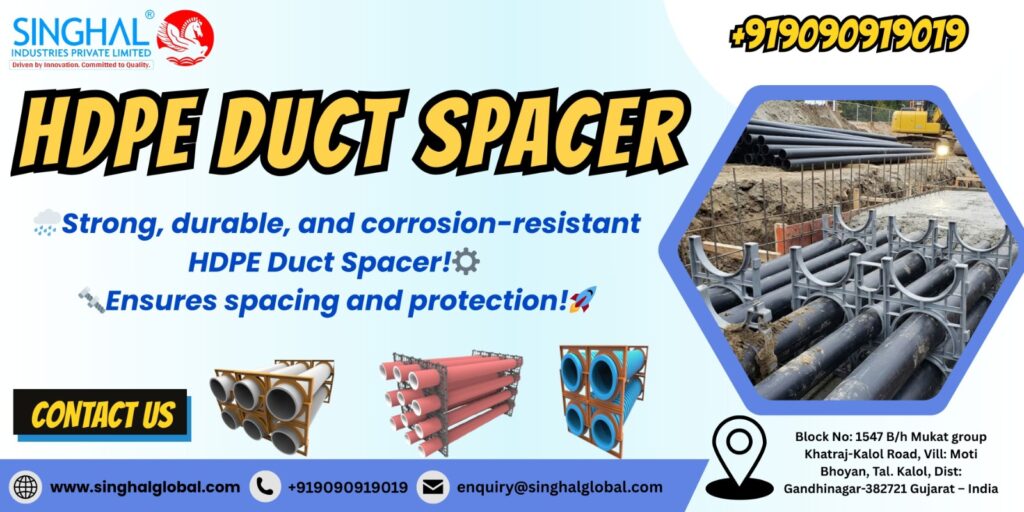
HDPE duct spacers can be described as simple but effective components that are used to construct underground structures. They’re constructed from high-density polyethylene (HDPE), which is a sturdy plastic that’s lightweight, elastic, and doesn’t get rusty or decay even when placed in deep dirt or in difficult conditions. Spacers are able to be inserted between many pipes or ducts within trenches and keep them apart by a fixed distance so that cables don’t get squished or become squished when backfilling. Imagine them as guardrails that line the highway – they stop chaos from happening.
In India, the country where infrastructure is growing rapidly with projects such as smart metros and cities, spacers are everywhere. They’re stackable, simple to join, and are available in sizes that accommodate ducts ranging from 25mm up to 500mm in diameter. It’s no wonder that companies are rising to the top position as the best HDPE duct spacer manufacturer India, producing high-quality products that comply with global standards such as ISO and ASTM.
Why HDPE Stands Out for Underground Use
HDPE isn’t a generic plastic. It’s made to be a high-performance material. It is able to handle loads of high compression – up to 10 tons per square meter on certain models — without cracking. In addition, it’s chemically inert, which means that salts, groundwater, or acids won’t nibble the material away. Its UV resistance ensures that it will not be brittle if it is stored outside prior to installation.
In contrast to spacers made of metal, HDPE won’t corrode, and unlike wood, it won’t decay or attract insects. Installation is also easy; simply clip them to ducts at intervals of about 1-2 meters, and you’re done. This makes maintenance easier and reduces costs by a significant amount. In areas with growing networks such as Kanpur or Mumbai in India, where soil may be difficult due to shifting clay or sand, HDPE duct spacers will ensure cables are in alignment, signals remain robust, and power flows with no interruption.
Key Benefits That Make Networks Bulletproof
- Reliability begins with the right spacing. If ducts are not spaced, they could be shaped into an oval under pressure from soil, which can cause pinching of cables within.
- HDPE spacers keep their round shape and allow for load.
- They prolong the life of systems, as they are designed to last for 50+ years, instead of only 20.
- Lightweight design reduces labor time, and one worker is able to handle hundreds of pounds.
- Affordable at 20-50 Rs per piece, dependent on the size.
- It is eco-friendly because HDPE can be recycled and doesn’t release toxins.
For underground systems, minor errors can cause major problems such as signal loss in fiber optics or overheating on power lines. Spacers can fix this by offering consistent support. In addition, given the push by India for underground cable within urban zones, the use of high-quality spacers isn’t an option; it’s essential to ensure safety and effectiveness.
Applications Across Industries
HDPE duct spacers are a hit in telecom, as fiber optic bundles require exact separation to prevent bends of more than 30 degrees, which can cause signal loss. Power utilities employ them for HV cables to prevent problems caused by ground shifts. Lines for sewage and water are beneficial also, as they prevent pipes from coming into contact and deteriorating. Gas pipelines? The same thing happens with spacers. They decrease friction when thermal expansion occurs. Metro rail projects even place them with multi-layer banks of conduits that carry wires for control.
In renewable energy installations like solar power plants, the underground feeds are secure. Highways, airports, and data centers all depend on these trenches to keep them organized. Anywhere in the project, whether it’s rural or mega-city grids, spacers can make everything seamless.
Installation Tips for Best Results
Making spacers work is just the first step. Begin by thoroughly cleaning the ducts — no dust or pumice stones. Make spacers each 1.5 meters, laying them out like bricks on the wall to ensure security. Utilize bolts or ties if you need to fill in high-load areas. When backfilling, proceed layer-by-layer: first sand, and then spacers, compress with care to avoid any jolts. A tip to remember: mark spacer locations on the plan to ensure consistent spacing.
HDPE Duct Spacer Manufacturer India Spotlight
The Indian market is booming for these kinds of products, with Gujarat being the most popular — think of Rajkot as the center. HDPE manufacturers of duct spacers in India, similar to those from Polymers and Tecafine Polymer, crank out block-type and modular designs in black HDPE that range from $24 to $35 per unit. They use injection molding for precision, providing customized ribs for ducts with odd dimensions. They don’t just make spacers but also customize them for Indian climate and soils. As HDPE duct spacer supplier India, they ship across India with MOQs of as little as 100 pieces and delivery within 2-7 days. Quality tests include load tests as well as chemical resistance tests.
HDPE Duct Spacer Supplier India Network
Suppliers help you find what you require quickly. For everything from Singhal indutries Private Limited listings to factory direct sales, choices abound. HDPE duct spacer manufacturer India has everything you need: single blocks to fit two pipes, multi-ribs to accommodate six or more banks. They manage large requests from EPC contractors and provide warranty and GST invoices. Local sourcing can reduce lead times and means no having to wait for months, as is the case with imports. Prices are competitive thanks to the concept of “Make in India,” and a lot of companies offer free samples to test.
HDPE Duct Spacer Exporter India on the Rise
Exports are on the rise, with Indian producers shipping into the Middle East, Africa, and Southeast Asia. HDPE duct spacer exporter India makes use of low-cost and high specifications to be competitive in the global market. Companies load their crates with export-quality products and meet CE standards where required. Demand is soaring due to UAE metro projects as well as African fiber rollouts. Exporters concentrate on modular structures that can be stacked flat for shipping, which saves shipping costs. This global reach increases India’s image as an infrastructure hub while ensuring that the supply of domestic goods is strong.
Conclusion
Once they’re buried, spacers require minimal effort. However, during installation, check for cracks. After backfilling, observe trench settlement and levels. If uneven, use a rod to gently adjust. Every five years, in the accessible vaults, remove an unused duct sample to test wear and tear on the spacer. HDPE decays slowly, but UV exposure before burial reduces its lifespan, so keep it in the vault in a shaded area. Cleanse with mild soap if exposed. No harmful chemicals.
Frequently Asked Questions (FAQs)
Q1. Can duct spacers and ducts be personalized?
Yes, many HDPE manufacturers of duct spacers in India can offer modifications to the number of ribs, bolt holes, rib counts, or colors. Simply share the OD of your duct size, bank size, and load requirements. They will be accommodated in just two to four weeks.
Q2. What are the uses of spacers in ducts?
They’re the stars of telecom fiber bundles as well as power cable banks, sewer lines, water/gas lines, and railway signaling. Everywhere underground, multiple ducts are connected together.
Q3. How can I keep duct spacers maintained?
The simplest task: inspect the installation prior to installing, store dry, and backfill the area carefully. Examine every couple of years through manholes for signs of deformation.
Q4. What is the main difference between HDPE and PVC spacers?
HDPE is stronger, more flexible, and chemical resistant; PVC is less expensive, but it cracks more easily under pressure. HDPE is suitable for heavy-duty use, while PVC is for light jobs.
Q5. Who is the largest exporter of HDPE Duct Spacers?
It’s difficult to pinpoint one “largest,” but Gujarat firms such as Singhal Global are leading exporters with pan-Indian supply and international shipments. They rank top in terms of volume and reach.