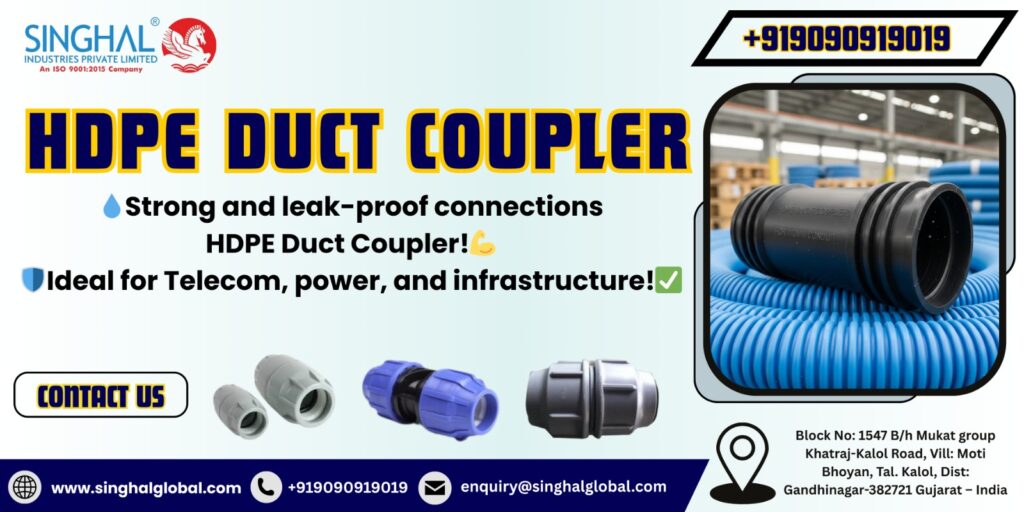
Infrastructure doesn’t stop changing; it changes in a very fast way, which at times seems almost unreal. A couple of years back, laying down the cables for telecom or electricity was slow work that required a lot of labor. But now, through new materials and smarter designs, things are changing fast. One element largely overlooked that is instrumental in this transformation? HDPE duct coupler. These tiny yet extremely important pieces are making the lives of engineers, contractors, and even end-users a lot easier. However, what are HDPE duct couplings really? And why do they matter to you? Let’s find out with a deeper investigation.
What Are HDPE Duct Couplings?
HDPE duct couplings are connectors that facilitate the sections of high-density polyethylene (HDPE) ducts to be joined. These ducts are the most popular ones for the shelter of electrical and telecom wires in the ground. Just take the internet cable at your home or the mobile network – the wires that run under the roads are mostly in HDPE ducts, and couplings are those that make sure everything is still connected, safe, and shielded.
Producers of duct couplers have improved their product significantly over the years. In the past, couplings were commonly made of metal or simple plastic, but HDPE has transformed the market. It is lightweight, high in flexibility, and does not get corroded. So, it is of fewer troubles during fitting and far less upkeep over time. If you have ever seen a group struggling with their heavy, rusted metal joints, then you will really see the huge difference that HDPE brings.
Why HDPE Duct Couplings Matter
What if you are building a new housing estate? The city has requirements for internet, power, and water supply that are reliable. You are not allowed any delay or leaks. HDPE duct couplings make it possible to prevent both of them. They are very handy during setup, do not rust, and can tolerate a variety of environmental pressures. Actually, there was a time when I was involved in a project and metal couplings were experiencing leaking issues after only 2 years, so by replacing them with HDPE couplings, maintenance expenses and the time to be inactive were greatly reduced. It was the easiest decision.
Duct coupler producers have taken the initiative to meet such demand by enhancing designs and offering better prices. The Duct coupler price has become lower over the last couple of years; therefore, it has turned out to be more affordable for minor projects and the people living in remote areas as well. Certainly, prices might vary due to the size, quality, and brand of the product, but in general, it is a wise choice.
Real-Life Applications
A small town in Rajasthan had been suffering from power outages that happened frequently due to the problem of damaged underground cables last year. The contractor, who works locally, recommended the change to HDPE ducts with HDPE duct couplers. Initially, there were quite a few people who doubted the proposal. “Isn’t plastic less strong than metal?” they said. But after the change, the town witnessed that the situation had improved considerably. The cables were kept dry, and there were no outages caused by water ingress. It was a straightforward change, but the effect was enormous.
This is only an instance. HDPE duct couplings are installed in urban, rural, and even remote places. They are indispensable to the establishment of telecom networks, electricity grids, as well as water supply systems. HDPE’s pliability makes it possible to endure dips in the earth, temperature fluctuations, and even minor earthquakes.
Choosing the Right Size HDPE Duct Coupling
One of the frequently asked questions is, “How do I find the appropriate size for my HDPE duct coupling?” The essential thing is to adjust the diameter of your duct with that of the coupling. Almost all of the Duct coupler manufacturers have size charts, and it is always wise to double-check before making the purchase. I made a mistake once where I ordered the wrong size and had to spend time and money on it. The moral of the story is: measure twice and order only once.
Are HDPE Duct Couplings Waterproof?
Yes, that is true. HDPE is water-resistant by nature, and a coupling that is installed properly will not allow any moisture to come out. But here’s the thing – the installation is important. If the coupling is not sealed properly, water can penetrate. I’ve come across situations where poor workmanship caused leaks even though the best materials were used. So, don’t ever assume that your installation crew is competent.
Durability in Harsh Environments
How well can HDPE duct couplings withstand harsh surroundings? They are very robust. HDPE is capable of bearing extreme temperatures, UV radiation, and even acid corrosion. I can tell you that there are some HDPE couplings in arid areas where the temperature goes over 45°C, and they are still in good condition. The heavy movement of people or vehicles, sharp objects, and bad installation can still hurt the couplings. Therefore, even though HDPE is strong, it should not be considered invincible.
Supporting Telecom and Electrical Ducts
Are HDPE duct couplings capable of supporting both telecom and electrical ducts? Yes, indeed. That is one of their greatest benefits. Use them for what you will – be it laying fiber optic cables or power lines with high voltage – HDPE couplings are up to the task. They’re a versatile, dependable, and budget-friendly solution. Actually, a lot of big infrastructure projects have now gone the way of using HDPE couplings for both kinds of ducts. It makes the supply chain easier and lessens the need for different connector types.
Who Is the Largest Exporter of HDPE Duct Couplings?
Largest exporter of HDPE duct couplings? That is not so easy to answer. There are quite a few large companies in the market, predominantly located in India, China, and Europe. The Indian producers have been on the rise lately due to lower prices and better quality. Several brands are now shipping their products to the Middle East, Africa, and Southeast Asia. However, the “largest” exporter can be different every year depending on market demand and global trends.
The Future of HDPE Duct Couplings
If not sideways or backwards, where are HDPE duct couplings going?
The answer is pretty straightforward: forward. The shrinking of cities and technological progress will cause the need for infrastructures that are reliable and easy to install to skyrocket.
HDPE couplings have everything to be the suppliers to this demand. Some companies are switching their production to new designs, using better materials, or even producing couplings with smart features that can sense cable health.
What if a coupling could notify you when it is leaking or blocked?
It sounds very futuristic, but the reality is that such a product is currently in the works.
Conclusion
HDPE duct couplings might be the ones that are hardly visible in the big infrastructure puzzle, but their role is actually enormous. They are the ones that make cities smarter, greener, and more resilient.
As a matter of fact, sometimes it’s the smallest pieces that matter the most. What are your thoughts? Are HDPE duct couplings the next big thing, or will someone else come and take their place? I would be very glad to receive your feedback.
Frequently Asked Questions (FAQs)
Q1. How do I choose the right size HDPE duct coupling?
It is essential that you know the diameter of your duct in order to make the right choice. Most of the manufacturers have sizing charts; however, it is always a good idea to check twice before purchasing. Getting the measurements of your duct and looking at the chart is an easy task, but it is very important.
Q2. Are HDPE duct couplings waterproof?
Yes, HDPE has waterproof capabilities by its nature. Nevertheless, the installation should be perfect. In case the coupling is not sealed properly, there is a chance for water to infiltrate. Make sure the installation of your coupling is impeccable.
Q3. How durable are HDPE duct couplings in harsh environments?
Very durable indeed. HDPE is capable of withstanding extreme temperatures, UV radiation, and even acid corrosion. However, like all other materials, it can be harmed by heavy traffic or poorly executed installation.
Q4. Do they support both telecom and electrical ducts?
Yes. HDPE duct couplings are versatile, and duct couplings for telecom and electrical can be the same. This is what makes them so attractive to the large infrastructure projects sector.
Q5. Who is the largest exporter of HDPE duct coupling?
Top exporters have been a good number of them, predominantly from India is Singhal Industries Pvt Ltd, China, and Europe. Due to competitive pricing and quality, Indian manufacturers have been gaining more and more market.