Ever been curious how those super big metal tanks you see in a factory are able to hold super strong acids and keep rusting and wearing safe for so long? It may be that you didn’t notice they were covered with these special kinds of sheets called PP Glass-Lined Sheets. This is a powerful sheet which is made of polypropylene and reinforced with a glass mat layer and one of the most popular industrial lining materials that protects metal surfaces from corrosion even in the hardest environments. Moreover, they are pretty light in weight, do not react at all with acids and alkalis, and so far, they have been the salvation of many companies, in terms of avoiding costly breakdowns and halting production for a period of time. Well, that is what we are going to explore in this blog: how manufacturing of customized PP Glass-Lined Sheets revolutionizes the method of handling specific industrial needs, mixing up industrial lining facts, my personal opinion, and even a couple of contradictions which make you question your point of view.
Imagine a chemical plant in Gujarat, India, where every year tank inspection was an ordeal due to corrosion which went through the steel like termites through wood. People were scared, leaks, fires, you know the drill. After that, PP Glass-Lined Sheets were used. In effect, the tanks were kept for several more years, employees experienced safety, and the manager was thanking his lucky stars since expenses were reduced. That is not a mere talk for sealing the deal; it’s a huge relief for real. I have spoken to several engineers who could not be more convinced and they even say that it’s like putting on your equipment armor plating. But is it flawless? No, a little more on that later.
What Are PP Glass-Lined Sheets Exactly?
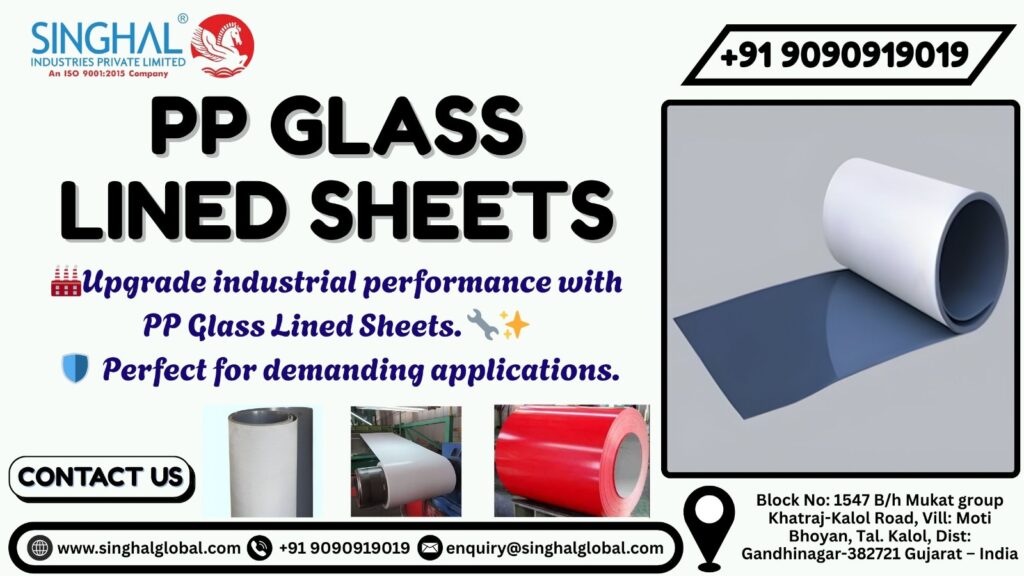
PP Glass-Lined Sheets or PPGL sheets is a product which is made from chemically resistant high-density polyethylene that is particularly strong in nature, and after that a glass fabric or mat layer is bonded on one side. That combination results in a product which is not only strong but also bonds very well with polyester resin and fiberglass for lining applications. The surfaces are easy to work with, they’re elastic enough for weird shaped objects, and the thicknesses can range from 2mm, 3mm, up to 5mm with an approx width of 1.5 meters.
Why should you customize? As a matter of fact, no two industrial plants are the same. One may require the bending of the sheet to fit a reactor vessel while the other needs it super thick for a scrubbing tower. The manufacturers change aspects like sizes, colors—even performance under sunlight can be improved. It’s like making a suit for your industrial beast. What about the cost of PP Glass-Lined Sheets? The price is not fixed but is estimated by the kg to be between ₹100 and ₹200 in India and the price is influenced by the specifications—good as it is long term, it is still quite costly compared to traditional.
Why They’re a Must for Harsh Environments
These sheets perform at their best in environments where regular metal or plastic won’t last for long. The use of the glass lining elevates the mechanical strength of the material and it also becomes more resistant to heat, it can be exposed to a temperature of even 100ºC without any distortion being caused. These are the perfect protection for acidic baths, scrubbing with alkalis, or the most horrible types of wastewater. They are very effective in the case of dilution tanks or neutralizing pits as they ward off leakages which can lead to disasters—things like environmental fines or even dangers to human health are what leaks brought about by these solutions could lead to.
Just to name one: a textile-dyeing facility located in Mumbai suffered a monthly loss of thousands because of pipe corrosion. After the implementation of the custom PP Glass-Lined Sheets strategy, the problem was solved—replacements hadn’t been necessary for more than five years.
Industries That Can’t Live Without Them
Chemical processing? Absolutely. You can find them everywhere – on lining reactors, storage tanks, and scrubbers in which acids are bubbling away continuously. Furthermore, steel and cement factories employ them in their pickle tanks, i.e., those corrosive baths that remove rust but also consume the metal, while textile industries use them to line dyeing vats, paper mills protect their bleaching processes, and even the food sector utilizes them for safe zones of mild processes.
Battery manufacturers are really into them for the handling of electrolytes—safe, non-conductive material. Nuclear facilities? Yes, for non-critical areas. Also, don’t forget electroplating or defense setups where trust cannot be doubted. A wastewater treatment plant in Ahmedabad was telling how PP Glass-Lined Sheets helped them to transform their leaking sumps into strongholds which contributed to river protection. Pretty nice, huh? Putting emotions aside, it is really a wise move.
Durability: How Long Do They Really Last?
Generally, you can count on them to last between ten and twenty years in harsh areas, and maybe even longer if they are well installed. During installation, the glass mat keeps the product from being scratched or rubbed while the PP surface is resistant to heat changes. Upkeep? Just clean them; they don’t require any special coatings. However, if you decide to use an inferior product or improperly bond it, you might find that your sheets will start to bubble when exposed to heat.
Personal experience: A colleague from the chemical industry said that his lined blower ducts had been long-lasting way beyond his expectations and even doubled the time, although the area was dusty and chaotic. It was like winning the lottery. But there is a catch—they are low weight, which is an advantage during the installation process, however, if done by unskilled workers they may become too flexible and you will have problems with the high-pressure areas.
Customization: Tailored for Your Chaos
Indeed, the sizes are from 1m x 10m rolls to custom pieces. What about the thickness? Choose the one you want. PP Glass-Lined Sheets Exporters in India are ready to serve the global market, they can shape their product to fit not only your reactor but also your pit. You may incorporate colors for quick visual identification or patterns for hand grip. It is rather empowering—your factory, your rules.
Prices remain quite affordable because Indian manufacturers are good at keeping MOQs flexible.
Cost Breakdown and Exporter Scene
The PP Glass-Lined Sheets price is approximately between ₹110 and ₹190 per kg, however, it can be more expensive if it is a tailor-made job. Long-term use should also be considered here—ROI will be very high.
Indian firms like Singhal Industries, which are leading suppliers of PP Glass-Lined Sheets, are exporting to the Middle East and Africa. They are experts in combining affordability with quality.
Installation Feels and Pitfalls
Use resin and fiberglass to attach them—resins close perfectly. The even surface means that there are no places where bacteria can hide. However, the question arises: Why are some people disliking the smell while the process is curing? A temporary inconvenience for a permanent advantage.
An electroplating plant once improperly carried out a task leading to delamination due to unpreparedness. The moral of the story: Train your employees. If not, everything will be fine here too.
Sustainability Angle and Future Vibes
Compared to full tanks, they use less material, and their PP base is recyclable. Eco-win? Sort of. However, the recycling of the glass mat is not very developed.
In my opinion, it is better than constantly throwing corroded steel in the trash.
The future? There will be thinner and more durable ones. Exciting!
Conclusion
Custom-made PP Glass-Lined Sheets are not flashy, but they perform well where it matters – time, money, and nerves saving. They are a great help, for instance, in chemical vats or steel pits. Yeah, they are not invincible, but they are very close to it. Custom go, pick good exporters, and see your ops flourish. High on emotions? Good- there’s a need for heart in the industry.
Frequently Asked Questions (FAQs)
Q1. Are PP Glass Lined Sheets safe for acidic environments?
Completely. They are highly resistant to strong acids and alkalis and therefore are an ideal solution for chemical tanks. They are certified for the harshest conditions, however, it is always a good idea to perform tests first.
Q2. What industries commonly use PP Glass Lined Sheets?
Those would be the industries of chemicals, steel, textile, cement, paper, food, and batteries. The answer is any place where corrosion is a threat.
Q3. How long do PP Glass Lined Sheets last?
On a good day, they will last from 10 to 20 years easily, and even longer if work is taken care of. Their lifetime is dependent on the installation and the exposure. A very safe wager.
Q4. Can PP Glass Lined Sheets be customized in size or thickness?
Certainly, widths, thicknesses, shapes—all can be made to fit your specific requirements. Exporters do it without any problem.
Q5. Who is the largest supplier of PP Glass-Lined Sheet?
Not an easy answer – India is home to large-scale producers such as Singhal Industries that are capable of producing lead tons of products. It is better to check the production capacity rather than just taking the word for it.