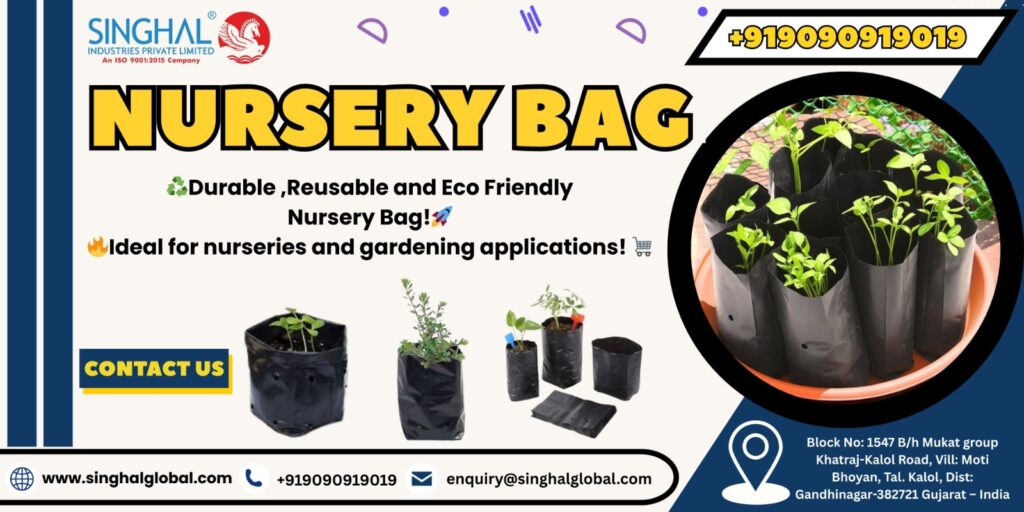
Eco-friendly nursery bags are gradually changing the way farmers and gardeners grow their plants, a change that is visible one sapling at a time. They might seem like a minor thing, but they actually embody the big concepts of sustainability, intelligent agriculture, and a better future for our planet.
Why eco-friendly nursery bags matter
Traditional plastic nursery bags are a source of cheap and convenient solutions for everyone; however, they are a big threat to the environment as they stay for a long time and create microplastics when they break. Eco-friendly nursery bags, particularly compostable and biodegradable ones, are made for the purpose of holding seedlings in a safe way and then decomposing in the soil, thus leaving it free of any kind of pollution.
For farmers and nursery owners, this gives a chance to have less plastic waste around them which they can no longer burn or dump, and for the soil, it means less pollution and better health in the long run. There are also many growers who say that by using green products, it elevates the status of their brand and provides them with a way of getting in touch with eco-friendly customers who not only want to know the source of their plants but also how they were grown.
How these bags help plants
Eco-friendly nursery bags are not just a gesture towards the environment; they are a commitment to plant health as well. The best nursery bags are the ones which can hold the required amount of water, but at the same time, air circulation is not interrupted through the roots, which in turn eliminates root rot and encourages the growth of a healthier, more fibrous root system. Some fabric or compostable nursery bag types even encourage “air pruning,” where roots naturally find their end and branch out instead of going round and round like in hard plastic pots.
Stronger roots result in stronger transplants. Usually, when a tree has a dense, fine root network and it is taken to the field, the tree will not be long in recuperating from transplant shock and will probably grow more rapidly, which might be the reason for a weak plant losing out to a strong one surviving in a hard climate. Farmers often say that they can “witness” the change in the field: greener leaves, faster new shoots, and less wilting during the first week after transplanting.
Sizes, materials, and options
Lots of environmentally friendly nursery bags are available on the market as far as sizes go; you can choose from tiny seeds of vegetable or flower sacks up to bigger bags for shrubs and young trees. For really small plants, the size 1–2 liters (or the small standard poly sizes used in nurseries) is mostly found, while trees and fruit plants may be raised in extremely big grow bags that can hold several kilograms of soil.
Choosing the Materials
Choosing the materials may become very diverse:
- Compostable and biodegradable bags made of starch blends, vegetable waste, or bioplastics that break down into organic matter within several months under the right conditions.
- Nonwoven fabric or woven polypropylene bags that can be used for several seasons and provide good airflow around the roots.
- UV-stabilized plastic nursery bags that are not always biodegradable but have a longer lifespan and decrease the number of frequent replacements; thus, some growers still consider them as a transition stage towards sustainability.
Questions around Nursery Bag Price and Cost
First of all, the thought about Nursery bag price comes most often to the minds of farmers. And it is quite reasonable; the profit margins in farming are usually tight, thus every extra rupee needs to be accountable. Prices of nursery bags in India are generally set per kilogram and can vary based on material, thickness, and whether they are compostable, UV-stabilized, or standard poly. To a great extent, compostable nursery bags as well as top-quality fabric ones are priced higher per unit than simple plastic bags; however, they have the potential to provide savings in wages, plant survival rate, and waste disposal.
Cost could be figured out in the following way: what if a bag having a slightly higher price is instrumental to the reduction of transplant shock and the survival rate of the saplings is increased by 5–10% only? In that case, the extra income generated by a healthy, more uniform crop can not only pay for the price difference but also, apart from that, several institutional buyers and eco-minded brands can be willing to pay higher for plants that have been raised in sustainable packaging, turning the nursery bag price situation from being that of an investment into that of a mere expense.
India has a growing ecosystem of nursery bag manufacturers, offering both conventional and eco-friendly options. There are companies that focus on standard poly nursery bags and UV-stabilized products, often serving large nurseries, forest departments, and landscaping projects. Alongside them, newer players specialize in biodegradable and compostable nursery bags designed specifically to reduce plastic pollution and support sustainable agriculture.
Many manufacturers also collaborate with farmers and nursery owners to personalize the size, thickness, and even the punching of drainage holes of the bags based on the crops, climate, and handling methods. Buyers of these products can also do a lot to prevent quality problems by checking the reputation of Nursery bag suppliers, figuring out their years of doing business, and requesting test samples prior to placing large orders that are subject to ripping, weak seams, or poor composability claims.
Role of Nursery Bag Suppliers
Nursery bag suppliers are the facilitators who link the production units and the end users or farmers, garden centers, landscapers, and hobby gardeners. Across India, small shops and regional distributors commonly stock different brands and varieties of nursery bags—ranging from cheap thin poly to premium compostable ones—giving buyers the freedom to try and compare the performance. Some suppliers have also taken the initiative of educating the consumers about eco-friendly options, such as explaining the working of a biodegradable nursery bag and the reasons for its high price, thus gradually shifting the demand in that direction.
They usually bulk order from leading Nursery bag manufacturers in India, handle the paperwork for these bulk purchases, and plan the movement of goods from one place to another, thus providing timely delivery and hale and hearty products for large plantation activities—like government plantation drives, corporate CSR tree-planting, or commercial orchards. When a person wonders “Who is the largest supplier of nursery bags?”, the truthful answer will be that there is no single global giant; instead, India and other countries are home to several large regional players and marketplaces that together facilitate massive volumes on different brands and materials.
Conclusion
list a multitude of Nursery bag suppliers and nursery bag manufacturers in India, thus providing an open field for buyers to compare prices, materials, and certifications rather than depending on just one dominant supplier. Eco-friendly nursery bags won’t solve all the problems in agriculture. Nevertheless, they represent a small but very tangible step towards more compassionate farming practices that are more considerate not only of plants but also of farmers and the earth we all rely on.
Frequently Asked Questions (FAQs)
Q1. Are nursery bags suitable for all types of plants?
Nursery bags can be used to grow a large variety of plants such as vegetables, flowers, herbs, shrubs, and small trees, provided that the right size and material are used for each type of plant. For extremely large trees or perennial crops that are grown for a long time, the growers may still choose to use the field nursery method or grow them in rigid containers after the initial stage in nursery bags.
Q2. What sizes do nursery bags come in?
Nursery bags come in various different sizes, which range from extremely small ones for seedlings up to large ones for saplings and ornamental plants, and the sizes are most commonly indicated in either inches or liter/gallon equivalents. Typically, Indian manufacturers are capable of providing a wide range of sizes, and they can also change the dimensions for bulk buyers who need certain crops or trays.
Q3. Are nursery bags biodegradable?
Some nursery bags that are completely biodegradable or compostable, for instance, those made of starch-based or bioplastic materials and are designed to decompose into organic matter within a few months when placed in proper conditions, exist. Nevertheless, a great number of traditional nursery bags which are manufactured from HDPE or LDPE are not biodegradable and thus have the potential to stay in the environment for a long time; consequently, buyers should be very careful with the product descriptions if they intend to purchase eco-friendly products.
Q4. Do nursery bags improve root growth?
Properly constructed nursery bags that are made from breathable fabrics or are compostable and therefore allow exchange of air can lead to the roots getting healthier and more extensive as the waterlogging is avoided and moisture content is retained. Thus, more fine and fibrous roots develop rather than the usual hardened roots that bind the bag and get tangled. This generally results in better survival and faster growth rates after transplanting, which happens to be one of the main reasons why many growers choose bags instead of rigid plastic pots for certain crops.
Q5. Who is the largest supplier of nursery bags?
It is impossible to single out one largest supplier of nursery bags worldwide as the market is composed of various regional manufacturers, exporters like Singhal Industries Pvt Ltd and trading platforms, with the production mainly concentrated in countries such as India. Numerous online and offline platforms that cater to the needs of B2B and B2C markets