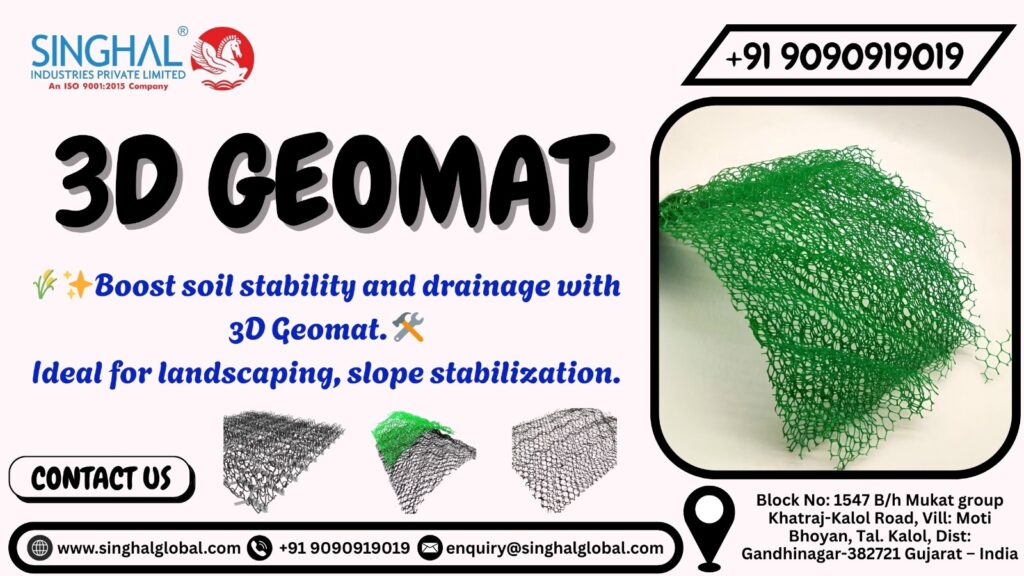
The 3D Geomat enhances soil retention and vegetation growth. Geomats 3D are three-dimensional mats for erosion control that help grass and plants to grow stronger and faster. 3D Geomat in India and other countries, they are used extensively on slopes and highways as well as riverbanks and construction sites.
What is a 3D Geomat?
A 3D Geomat is a lightweight, flexible synthetic material made from intertwined filaments of plastic that form a thick and springy mesh. This mesh holds soil particles in its structure, giving plant roots a place to grow. The mesh is designed to allow water to pass through, but soil remains where it belongs even in heavy rains or strong winds.
Engineers and contractors prefer 3D Geomats to concrete or stone pitches because they better blend with nature. As plants cover the geomat, it becomes invisible over time. What you are left with is a green slope.
Why 3D Geomats are Important in India
India is struggling with soil erosion due to monsoon rains, rapid construction, and deforestation. 3D Geomat in India has proven to be a useful tool for preventing soil erosion and allowing greenery to flourish. These mats are used on:
- Road and railway embankments
- River and canal banks
- The steep slopes of hilly states
- Covers for industrial and landfill areas
People often compare 3D Geomat prices in India to more traditional methods such as stone pitching and concrete retaining walls. Contractors have found that, even though the 3D Geomat initially costs more, it is more cost-effective in the long run due to reduced maintenance and better vegetation.
How 3D Geomats Enhance Vegetation Growth
A 3D Geomat’s greatest value is in its ability to help plants grow. The mat is made up of many layers and voids, which act as a nursery on the slope. These voids allow seeds to settle, moisture to stay longer, and roots can be wrapped around the filaments as support.
What Happens in Detail?
The topsoil should be spread on the mesh and over the mat after it is placed. The seeds are mixed into the soil or sprayed on top. The mat allows rainwater and irrigation to enter, but soil and seeds remain trapped. As the roots grow, they move through the mat, forming a root-mat-soil network.
The first time you see a slope with 3D Geomats, it may look artificial. It’s like a green mesh hugging the ground. After a monsoon, the mat will disappear under shrubs and grass. This transformation brings a quiet satisfaction, as you see nature and engineering working together.
The Steep Road Embankment
Imagine that a road is being built through a small mountain near a city. After excavation, the contractor thinks that grass will naturally grow on the slope. Then comes the monsoon. In a few weeks, the slope will be ravaged by rills, the soil will slide onto the road, and the traffic will be disrupted. The result is panic, complaints, and increased maintenance costs.
Imagine the same slope, but with a 3D Geomat: The crew spreads topsoil and seeds the area after fixing the mat with pins. This time, despite heavy rains, the soil remains in the mat. The surface is not washed away by the water. After a few weeks, the mud is covered with a lush green covering. It is amazing how much the emotional impact on the team has been. They no longer dread every rainy day, but instead feel confident that the slope is going to hold. Locals see greenery and not a dusty cut. This often results in a positive view of the project.
Materials and Structures of 3D Geomats
The majority of commercially available 3D Geomats are made using synthetic polymers such as:
- HDPE (High Density Polyethylene)
- PP (Polypropylene)
- PET (Polyester), also known as Polyester, is sometimes used.
The materials chosen are UV-resistant and durable. They can withstand harsh conditions outdoors for many years. The mat is typically produced in a three-dimensional mesh that is easy to transport. Some variations combine the plastic mesh and geotextiles with natural fibers to increase soil holding capacity. Others can be filled with soil, seeds, or concrete (for specific applications) for different levels of reinforcement.
3D Geomat Suppliers in India and Pricing
In India, there are many 3D Geomat suppliers, including those who supply geomats to highways, rails, and river training projects. Geomats are categorized by thickness, mass per square meter, and tensile force. When people look at 3D Geomat prices in India, they find that:
- Prices are quoted in square meters.
- The cost of a geomat varies depending on its thickness, GSM, and whether it’s a plain geomat or a composite geomat/geotextile.
- Bulk orders for large government or private projects are often cheaper than smaller retail orders.
Conclusion
It can be confusing for a buyer: a supplier may offer a low price but use thinner material which might not work well on steep slopes. A slightly higher grade may be recommended by another supplier. Sometimes this feels like a contradiction—everyone claims “best quality,” but specs differ. In reality, it’s better to choose a product that matches the slope angle, the soil type, and the rainfall intensity, rather than chasing the lowest price.
Frequently Asked Questions (FAQs)
Q1. How does a 3D Geomat help in erosion control?
The 3D Geomat is an effective erosion control tool. It creates a three-dimensional structure that traps soil and prevents it from being washed away by surface runoff or rain. The mat slows water flow and reduces the impact from falling raindrops. It also allows water to penetrate while locking soil particles in place.
Q2. What are the materials used in 3D Geomats?
The majority of 3D Geomats are manufactured from synthetic polymers such as HDPE or polypropylene. These polymers are well-known for their durability, chemical resistance, and UV resistance. These materials are able to maintain their strength in outdoor conditions for many years, making them ideal for slope protection and soil preservation.
Q3. How does a 3D Geomat support vegetation growth?
A 3D Geomat promotes vegetation growth on sloped ground by acting as a permanent bed of sponges that hold topsoil and moisture in place. The mat’s voids create micro-environments that allow seeds to germinate and roots to grip soil and filaments without being washed out..
Q4. Are 3D Geomats suitable for use on steep slopes?
Generally, they are mixed with the earth, covered with green vegetation, and securely fastened. A designer can choose to use a thicker or stronger geomat if the slope is steeper. Also, they can determine a shorter distance between the fixing pins or bring in extra support like a toe wall and drainage.
Q5. Who is largest suppliers of 3d Geomat ?
Producers in highly developed countries which have a well, developed geosynthetics sector are the main players in the global market for 3D Geomats. Worldwide, a handful of big exporters spread their products in various markets. Based on various trade listings and industry platforms, China is frequently cited as the leading exporter of 3D Geomats, like Singhal Industries Pvt Ltd erosion control products, and other related products. These markets comprise India, the Middle East, and Africa.