Hey, everyone! Imagine that it’s a hot summer in India. Your taps are leaking, and you’re standing on your roof wondering how you can take every drop of this precious rain. This is the place where HDPE pond liners for rainwater harvesting systems can be found like superheroes. These flexible, tough sheets made of high-density polyethylene (HDPE) can be game changes in rainwater storage with no leaks or concerns. They’re more than just plastic—they’re designed to last for many decades, resist UV radiation, and keep your collected water in good condition and ready for use. In areas like Varanasi or any other spot that is water-stressed within Uttar Pradesh, rainwater harvesting isn’t an option for luxury. It’s an essential requirement. The greatest part? An Hdpe pond liner for ponds allows for this by turning pits and ponds into sturdy storage tanks.
Understanding Rainwater Harvesting
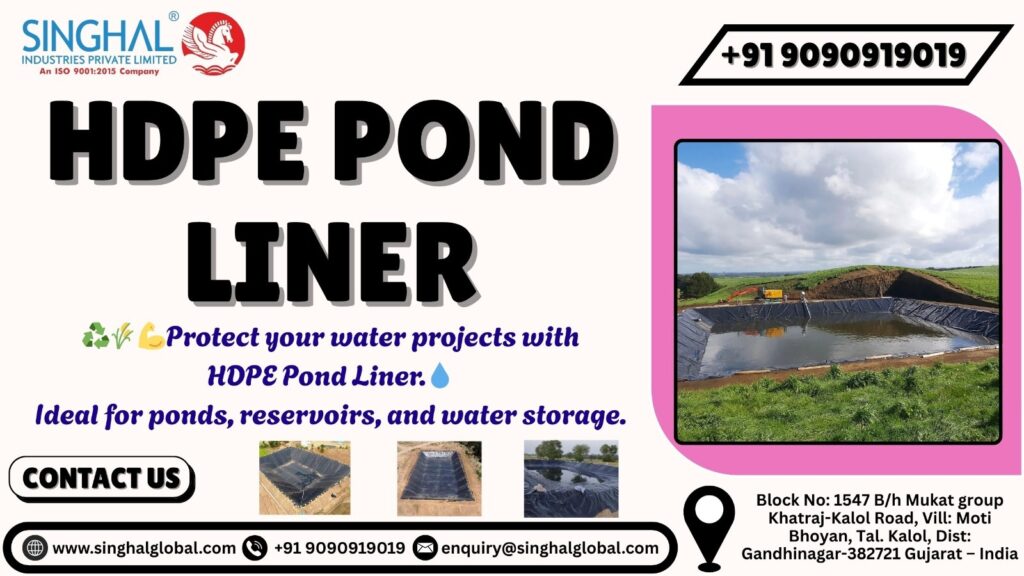
Let’s take it apart. Rainwater harvesting involves collecting rainwater from roofs, land, or catchments and then keeping it in storage for later use such as drinking water, irrigation, or recharge of groundwater. If you don’t have a suitable filter, the pond will turn into a messy mess as water dries out and algae begins to take over. So, HDPE pond liners are the answer. They’re very thick (usually 0.75mm up to 2.5mm); they are seamless when they’re welded and extremely impervious to fractures. Imagine laying one down in a pond that has been dug out. It hugs every curve, seals each crack, and boom! An impervious reservoir.
Why HDPE is Superior
Why is HDPE superior to other products? Rubber liner rots, PVC cracks in the sun, and concrete is expensive and can crack too. HDPE? It’s inert and doesn’t release chemicals, and is resistant to salts, chemicals, and even the oils of animals. Rainwater systems are rainwater-friendly, which ensures that your stored water remains pure and free of unpleasant tastes or contaminants. It’s also lightweight, making it easy for a small group to put in without heavy equipment. I’ve witnessed farmers in rural India install these over a weekend before filling them up in the next monsoon.
Why Rainwater Harvesting Needs HDPE Pond Liners
The water shortage is affecting us hard. In India, we’re experiencing droughts, even in the rainy regions. Government policies such as the Jal Jeevan Mission scream for more efficient harvesting. The HDPE liner for ponds fits perfectly, being affordable and scalable for farms to homes. For a family-friendly system, put a liner in a 10×10 feet pit. For ponds that are community-based, go 100×100. Costs? Between Rs 100 and 200 each square meter, depending on the thickness. It’s less expensive than building tanks and can last for 20 to 50 years. There are no maintenance issues, just periodic inspections for dirt.
Installation Process
Installation’s straightforward, almost fun if you like DIY. Create a pond with sloped sides to ensure stability. Install a geotextile material underneath to create a cushion for stones. Unroll the HDPE liner for the pond, heat-weld seams using extruders (rentable from locals), and secure edges with stones or soil. Fill it with water slowly, so that it settles. The best way to do this is to overlap seams by 10cm and look for leaks. If done correctly, there is no evaporation loss—saving thousands of liters per year.
Finding the Right HDPE Pond Liner Manufacturer
Not all liners are created equal. The quality of the liner is important. Thin junk tears quickly. Find a certified Hdpe pond liner manufacturer using virgin resin and not recycled (which makes it weaker). The specifications to be inspected include: ASTM D4976 standards, UV stabilization, and tensile strength of 20MPa or more. Some of them offer guarantees, site visits, and custom thicknesses.
India is booming with Pond liner Manufacturers. Companies like those from Gujarat or Rajasthan produce rolls that are up to 8 meters wide with minimized seams. They are shipped across the nation, frequently using installation crews. The best option to buy is an online-only option to eliminate middlemen. A reputable Hdpe pond liner manufacturer offers different thicknesses: 1mm for small-sized home ponds and 2mm for large farms. Prices fall when bulk purchases are made. Negotiate for free samples.
Have you ever wondered about the source of your next project? Check out trade shows such as IFAT or directories online. The best players are tested for safe fish and potable water quality grades. One company I know of supplies massive projects, ranging from Narmada canals to solar-powered pond farms. They also offer black, blue, green, or black colors that match your landscape. For example, black is the best for cutting algae.
Benefits That’ll Blow Your Mind
Let’s make a list since who doesn’t like bullet points?
- Durability: Stands up to temperatures of -70°C and 80°C, hailstones, and roots. Nothing can stop it.
- Cost-effective: Pay one time, harvesting for a lifetime. ROI within 2 to 3 years through savings on water bills.
- Eco-friendly: Recyclable, with a low carbon footprint in comparison to cement.
- Versatile: Ponds, tanks, canals, even landfills.
- Low Maintenance: No painting, no repairs—nature-proof.
Compared to ponds with earthen surfaces, earthen ponds have a 50% loss of water. HDPE? Below the threshold of 5% loss. Rainwater is more water to water drips, wash, and filtration in the drinking water. Farmers have reported 20-30% increases in yields after using the reliable water that is available during off-seasons.
Challenges
The initial dig costs money; however, subsidies from MNREGA or other state schemes aid. Slippery when wet—use non-slip pathways. Wildlife? Fences keep animals from entering.
Installation Step-by-Step: Your DIY Guide
Want hands-on? Here’s how:
- Plan: Survey the site and calculate the size (e.g., 500 sq feet per 10 lakh liters of water at 2m deep).
- Dig: Gentle slopes (1:1.5), smooth base—no sharp edges.
- Prep: Geotextile overlay, sand layer.
- Lay Liner: Roll from the center out, 2 people per 6m width.
- Welding: Use hot air guns at 400°C, testing seams for pressure.
- Anchors: Bury the edges of your anchor 30 cm deep.
- Fill: 20cm/day, keep an eye out for shifts.
- Additional accessories: Inlet pipes, overflows, cover for mosquito control.
Tools? Basic: welders, shovels (Rs 10k hire). Time: 2-5 days. Find a certified Pond liner Manufacturers team for large installations. Safety first: gloves, no smoking near welds. Post-installation, stock fish or plants to provide natural removal.
Maintenance and Longevity Hacks
Simple. Remove silt each year using pumps. Trim overhanging weeds. UV? Already dealt with. Pinholes? Kits for patching from the manufacturers. Lasts for 30+ years with ease. Recycle after use, using granules or granules as new liner. Improvements to solar pumps to improve circulation, oxygen aerators. Connect to IoT sensors to alert you of levels through an app. Future-proof!
Conclusion
HDPE ponds liner for rainwater harvesting aren’t just equipment; they’re your way to water autonomy. In a climate that is drying out and a need for them to be there, they’re vital. Talk to an HDPE manufacturer of pond liners near you. Start small and grow to a larger size. Monsoon awaits!
Frequently Asked Questions (FAQs)
Q1. Can HDPE pond liners be used in ponds for fish?
Yep, absolutely! Food-grade HDPE is oxygen-permeable and non-toxic. Rohu, tilapia thrive—no chemical leaching. A multitude of aquafarms swear by it.
Q2. Can HDPE pond liners be used in agriculture?
100%. Ideal for ponds and irrigation drip systems. Resists pesticides, fertilizers, and saves water while increasing yields—your best ally.
Q3. Can HDPE pond liners be made to order?
For sure. HDPE manufacturers can cut liners to sizes, thicknesses, and colors. Logos even! Specifications customized to fit up to 8m in width, and fabrics are embedded.
Q4. Are HDPE pond liners ecologically safe?
Totally. Inert, no BPA/phthalates. Recyclable, reduces water consumption. Much better than concrete’s hefty emissions. Earth is a fan of them.
Q5. Who is the largest manufacturer of HDPE pond liners?
Singhal Industries Pvt. Ltd. is recognized as one of the largest manufacturers of HDPE pond liners in India, offering high-quality solutions for water conservation, aquaculture, and agricultural applications.