Hey, people! Have you ever watched a huge tree root snaking its way through your sidewalk, tearing into an eggshell? Yeah, it’s frustrating. The roots of the trees and shrubs are known to slam into concrete pipes, foundations, and pipes, which can cause problems and repair costs that hurt. But the hero in this tale: HDPE root barriers. Made from high-density polyethylene (HDPE), the hard-wearing sheets work as an invisible barrier, stopping roots in their tracks but without destroying the plant. In this post, we’ll take a deep dive into the ways that Root barrier HDPE can help your infrastructure, the reasons it’s an excellent choice, and some important questions. Keep reading – you could be able to save your driveway.
What Exactly Are HDPE Root Barriers?
Imagine a thin, extremely durable plastic sheet, buried close to your hedge or tree. This is a sheet for preventing root damage. HDPE is the key material in this case – it’s recycled plastic that is as tough as nails and is resistant to UV rays, chemicals, and even cuts from sharp roots. These barriers are available in sheets or rolls and are simple to cut and put in using a few tools.
Why Is HDPE Superior to Other Materials?
Metal barriers do get rusty with time. Fabric barriers tear easily. But root barrier HDPE? It’s been around for 50 years underground. That’s more than the majority of marriages! Maybe not, but you’ll get it. They’re pliable, yet sturdy enough to direct roots downwards, which is in the direction they should be – the earth, and not to your sewer line.
But wait a minute, isn’t this plastic environmentally harmful? HDPE is recyclable, and many companies use post-consumer waste. There are some who claim HDPE is “forever plastic”; however, research shows it is less brittle than concrete’s roots. Which is more harmful? Your choice.
The Root of the Problem
What is the root of the issue? Trees provide shade and oxygen; they are also bird homes. But are their roots? They are sneaky invaders. In urban areas, such as sidewalks, driveways, or foundations that are being built, roots look for water. Pipes leak? Boom, roots take over. Sidewalks levy? Your roots are and they’ll be squeezing them up.
Statistics aren’t lying: in the US alone, root damage is estimated to cost billions of dollars each year in repairs. In India, due to our monsoon-driven frenzies and the rapid growth of cities, this is even worse. In the city of Varanasi, the ancient ghats are gone. New roads and buildings are facing the same problem. Roots aren’t concerned about traditional or high-rise.
The question is: do all trees contribute to this? But ficus, banyan, and acacia are known for their ill effects. What about the shrubs? Don’t get me started. Without protection, you’re staring at swollen pipes, cracked pavements, and basements that are flooded. Have you ever scoured a backyard and discovered roots bigger than the arm you’ve got? Nightmare fuel.
What Is HDPE?
HDPE Root Barriers Perform Their Magic
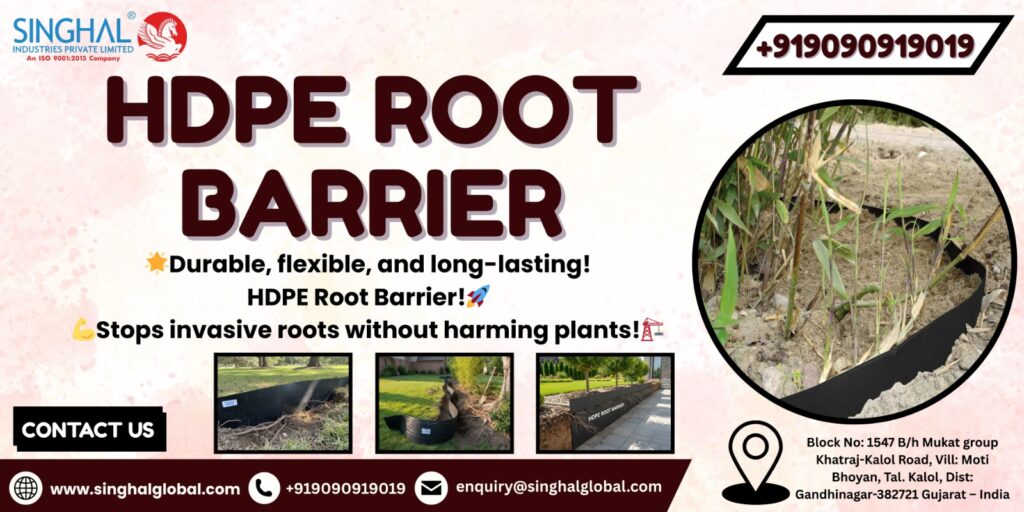
Simple: Put the sheet of a root barrier vertically into the soil a few feet deep, in the direction that roots could follow. That smooth, HDPE-like surface? The roots hit them and then slide downwards, not over. It’s as an official “no entry” signal for roots.
The scientific evidence supports it. The low coefficient of friction in HDPE (around 0.1-0.2) allows roots to slide off. It is also impermeable – no air or water passages which can impede growth. Depth is crucial: 60-90 cm for the majority of trees. Wider barriers for big boys like oaks.
Informal Suggestion
Make a trench. Unroll the sheet, backfill it with soil. Done in hours. You don’t need heavy machinery unless conducting something like a park. However, here’s a paradox: there are some who recommend installing the fences deeper to provide maximum protection; however, shallow ones work well for smaller yards. Why should you overdo it?
Installation Guide: Step-by-Step (No Sweat)
Are you ready to tackle DIY? Let’s take it apart.
- Find the location: Draw the areas where roots could head toward walls, pipes, or pathways.
- Dig the trench about 2 feet of depth and 2 inches wide. Moist soil? Easier digging.
- Cut and position the root barrier HDPE sheet. Make sure you hammer it straight.
- Cover seams with 6 inches; secure by tape.
- `
- Backfill carefully: Layer soil, then tamp down.
- Mulch over the top to add a nice look.
- Tree maintenance: Water well after installation. Roots adapt quickly.
Pro tip: use the textured HDPE to give you extra grip on sandy soils. Cost? The Root barrier price will be reached in the near future. It takes a weekend effort, but it saves thousands of dollars. Did you make a mistake when digging? I’ve smashed a water line once. Learn from the experience: call utilities first!
Benefits That Will Make You Smile
- Life expectancy: 50 years, there is no rust or rot.
- Eco-friendly: Recyclable, non-toxic.
- Versatile: Homes, parks, roads, farms.
- Cost-effective: upfront investment, but it reduces repair costs by up to 80%.
Contradiction
Barriers that are cheap fail quickly. The best root barrier HDPE is worth the investment. Skimp? Regret. Also saves water – roots stay where they are; more pipe breaks mean less wasted water.
Root Barrier Price Cracking Down the Bucks
Ah, the most important question: What is the price of the root barrier? In India, what is the thickness of a 1 mm roll of 1 m x 50 m? Around Rs 5,000-Rs 10,000. A thinner 2 mm? Double that. Per square meter, Rs 100 to Rs 200. Factors? Brand and thickness (1-3 mm) and length. Local vs imported – local is less expensive. Bulk purchase? There are discounts galore.
Example: For a 10 m driveway barrier, Rs 2,000-Rs 5,000 materials, plus labor Rs 1,000. What’s the difference between Rs 50,000 sidewalk repair? No-brainer. Prices fluctuate – post-2025 inflation hit plastics. Check suppliers like SIPL for deals. Are they worth it? Absolutely, unless you’re a root-ignoring gambler.
Potential Drawbacks?
Let’s face it. It’s not perfect. Installation isn’t right? Roots are pushed through or underneath. It is expensive for large areas. What about clay soils? Might need drainage tweaks. Contradiction: Promoters claim 100% efficiency; in reality, 95% with good pre-planning. Still killer odds.
Maintenance?
Minimum effort. After that, look for any shifts. Cut roots if they are peeking. That’s it. No painting, no replacing.
Conclusion
Root barriers made of HDPE are much more than sheets of plastic; they’re infrastructure saviors. From the root barrier HDPE to the Root barrier sheet, they’re there to protect you against roots invading. The price of the root barrier is budget-friendly for the long run. Install one, then watch the roots perform.
Still pondering? Contradiction: Trees require space, and barriers provide the space underground. Win-win? Tell me.
Frequently Asked Questions (FAQs)
Q1. Do HDPE root barriers appropriate as commercial landscaping?
You bet! Commercial areas like malls, parks, offices, and malls are awestruck by the root barrier HDPE. It can handle large foot traffic and huge trees. They can be scaled for acres. In fact, Singapore’s Gardens by the Bay swears by these gardens. Drawback? Initial digs disrupt business; however, it’s a quick recovery.
Q2. What are the best ways to use HDPE root barriers to help to prevent the possibility of structural damage?
They stop roots physically. A smooth surface diverts growth downwards. The absence of penetration means there is no rising sidewalks or pipe bursts. Think force field; branches bounce back off.
Q3. Could HDPE roots be utilized in plantations for agriculture?
Absolutely, especially in orchards. It protects irrigation lines from mango or fig roots. It increases yields by keeping the roots in focus. In India, wineries use these. Contrary to popular belief, some farmers believe it restricts spread, which harms the quality of nutrients. But, roots that are deeper grab more.
Q4. Why should you choose HDPE root barriers that are made by a reliable manufacturer?
Quality matters. It is important to choose reputable companies like SIPL that make use of virgin grade HDPE with exact thickness and certifications. Cheap knockoffs can crack or warp. Plus, warranties. Who wants to have a failure within a year?
Q5. Who is the largest exporter of HDPE roots ?
India is growing fast; however, China has the largest volume. SIPL plastics from India? Leading exporter in the Middle East and Africa. Huge production, global shipping. Find out their price at the root and be competitive!