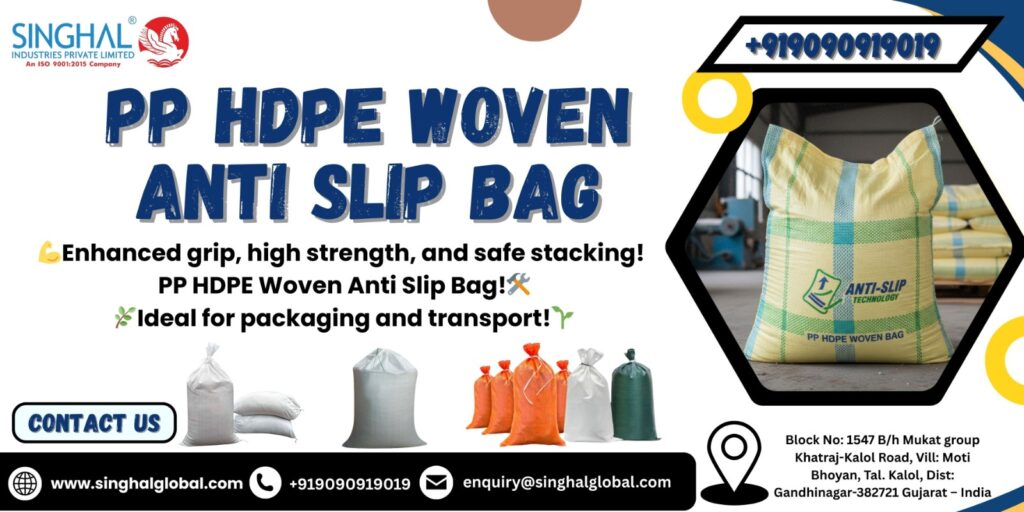
Anyone in the supply chain knows that packaging is far from simple. Packaging is not only about protecting, but also about safety and trust. It’s not just about wrapping things up—it’s also about protection, safety, and trust. One of these unsung heroes is you: PP/HDPE Woven Anti-Slip Bags. These bags are quickly becoming a favorite among industries such as agriculture, cements, fertilizers, and sugars. It’s not hard to understand why—they combine affordability, durability, and grip in one package. Anti-slip bags can be the difference between chaos or control when you’re storing grain in humid weather or stacking cement on pallets in an overheated warehouse.
What are PP/HDPE Woven Anti-Slip Bags?
They may look similar to other bags made of polypropylene or high-density polyethylene. There’s more. These bags are created by weaving flat polymer strips into a tight weave, creating a flexible and strong surface. Anti-slip bags are distinguished by their special surface treatment, which gives them extra grip and prevents them from slipping.
Imagine a truck carrying bags piled one on top of another and going on a bumpy road. A sudden turn or heavy braking can result in the spilled products making a mess of the whole truck. The use of HDPE woven Anti-Slip Bags keeps the entire stack firm and safe while the transport is going on, thus loss is lowered. The addition of an anti-slip coating to modern industrial packaging has revolutionized the industry.
Why are businesses switching to anti-slip bags?
Safety and stability reign supreme in the packaging world. How many times has a logistics manager complained about ripped packaging or shifting loads? Countless. It is not only the brand reputation that suffers from the losses of materials, but also the delivery schedules that are impacted.
What makes HDPE Woven Anti-Slip Bags special?
- The grip and stability is excellent. Anti-slip coatings act like friction that is invisible. The anti-slip coating prevents the bags from slipping over one another during storage, shipping, or stacking. This is especially useful for industries that have hundreds of bags stacked high. A logistics manager in a fertilizer factory once told me: “Before we switched to anti-slip woven bags, our losses were at least three to four bags per week when loading and unloading.” His losses dropped to almost zero after switching to anti-slip woven bags.
- The stronger and longer-lasting. PP and HDPE are durable materials. They are more resistant to moisture, punctures, and tears than paper or jute bags. These bags are stronger because of the woven structure. They can carry heavy loads with no tearing or stretching. The packaging of a small rice mill in India dropped immediately after switching from paper bags to PP/HDPE Woven Anti-Slip Bags. Each bag was more durable, kept the grains dry, and could be reused multiple times.
- Ideal for rough weather conditions. The monsoon in India is bad for packaging. Humidity, moisture, and damp storage can damage goods. These woven bags, however, are weather-resistant and waterproof. They dry quickly and do not lose their structural integrity even if they are slightly damp. This is a great advantage if your warehouse does not have perfect climate control, which most do.
- Cost-effective, reliable, and affordable. The PP/HDPE Woven Anti-Slip Bag Price may be slightly more than that of regular woven bags. However, in the long run, the benefits far outweigh this cost. The bags are more durable, reduce waste, and provide safer transportation. This is one of the rare investments that will actually save you money over time.
Environmentally Friendly Packaging Option
Plastic-based materials are often viewed as being bad for the environment. PP and HDPE woven bags tell a different story. These bags are highly efficient and recyclable. They can be reused again. Modern manufacturers use cleaner production processes to ensure less energy consumption and waste. They are plastic, but their durability and reusability help to reduce carbon emissions. This is what makes them an environmentally friendly choice for industrial packaging.
Where are these bags commonly used?
Many sectors use PP/HDPE Woven Anti-Slip Bags in their daily operations:
- Cement and building material – provides stability during stacking, transport, and transportation.
- Fertilizers and chemical industries, is a product that comes with tightness features, resists rusting, and other types of wear.
- Packaging for grains and food, is a means which makes the products hygienic, safe, and dry.
- Sugar and salt industries are goods that provide protection from moisture and side by side stacking is possible.
- Textile and polymer packaging is a pack which is designed for granules and fibers.
Everyone, from large multinationals to small local producers, is recognizing the benefits of these bags.
Conclusion
Without safety and consistency, it would be hard to imagine the industrial world of today. PP/HDPE Woven Anti, Slip Bags represent the ideal compromise between strength, money, saving, and usability. These bags ensure that your products reach their customers without damage or spillage, whether you are sending cement across state boundaries or rice to another continent. The PP/HDPE Woven Anti-Slip Bag Price is also a great deal from a financial, performance, and sustainability perspective. Great packaging isn’t just about protecting products. It can protect the brand’s reputation, customer satisfaction, and even worker safety at the loading dock. These anti-slip bags are worth all the attention that they receive today.
Frequently Asked Questions (FAQs)
Q1. How does anti-slip coating enhance bag performance?
The anti-slip surface coating increases friction and prevents bags from sliding when transporting or stacking. This increases safety, reduces loss of product, and makes handling and storage easier.
Q2. What are the best products to pack in anti-slip woven bags?
Cement, fertilizers, and sugar are all commonly used in these bags. They can also be used to store grains, animal feed, or polymers. These bags are useful for any product that requires stable stacking or long-distance shipment.
Q3. Are PP/HDPE anti-slip bags suitable for export packaging?
Definitely they are the best choice for export packaging. Besides being strong and resistant to water, they also have anti-slip properties. By this, the goods that are transported in such ways remain safe even if the transport is shaken or thrown around.
Q4. Can anti-slip woven bags handle heavy loads?
Definitely yes. The woven materials made of HDPE and PP are extremely strong from a tensile point of view. These woven materials can be loaded with heavy substances like cement or chemicals in a safe manner without any risk of tearing or stretching, even if they are subjected to pressure.
Q5. Who is the largest exporter of PP/HDPE Anti, Slip Bags?
Singhal Industries Pvt. Ltd. (India), which provides the best, quality anti, slip woven bags at affordable prices, is considered the leader.