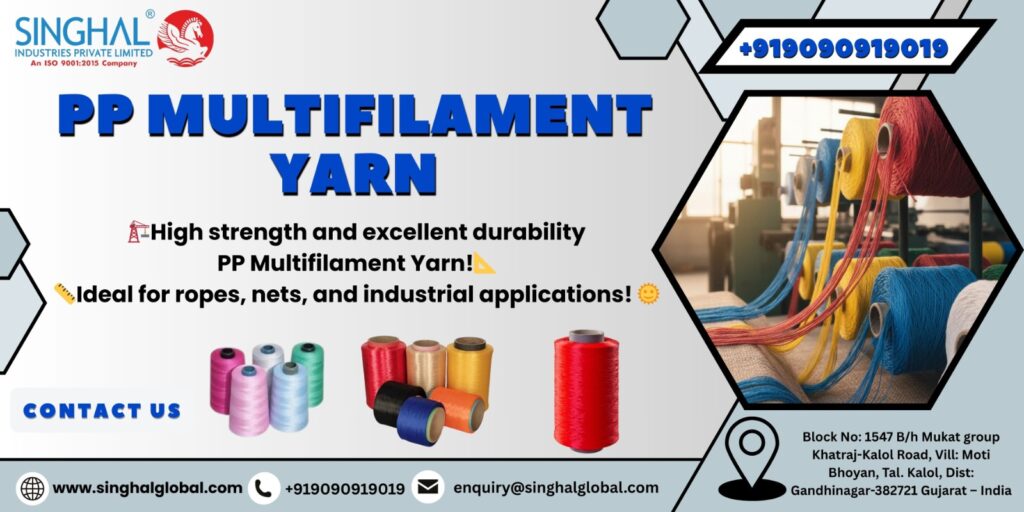
With the ever changing prerequisite of industrial materials, PP Multifilament Yarn has made an interesting niche in the world. What was a minor component of the packaging and textile industry, is now an essential component of all things and ropes to geotextiles. Powerful, light and most importantly, versatile – such a kind of yarn is much more crucial than most people can imagine.
Why is Polypropylene multifilament yarn so big? We shall divide it into bits that even a person who is not in the textile industry can comprehend.
What is PP Multifilament Yarn?
PP Multifilament Yarn is an abbreviation of Polypropylene Multifilament Yarn. It is produced using thin stands of polypropylene which are twisted or woven in order to make a strong thread which is smooth and flexible. Multi-filament yarns have several tiny filaments mixed together (as opposed to monofilament yarn, which is made of a single continuous fiber) and this makes them stronger and gives them a better feel.
When that is technical, consider it in the following way: picture yourself weaving several fine threads. One of the strings would be easy to break, but when there are several strings, they create a rope and they are able to carry much more weight. This is the effect of PP Multifilament Yarn–power in solidarity!
Owing to the fact that polypropylene is a thermoplastic polymer, it has the added advantage of being lightweight, resistant to chemicals and waterproof. That’s why industries love it. In the packaging industry or rope-making, or even in high-quality textiles, PP yarn forms the foundation of most of the products that we wear or use without thinking.
Key Properties That Make It Special
Polypropylene multifilament yarn magic is in the physical-chemical properties of the product. It is not a thread, it is a fabricated material.
The following are some of the features that make it to be unique:
High tensile strength: Ideal in applications of heavy load such as ropes or nets which have to support huge weights.
- Low moisture absorption: It does not easily absorb water making it remain light even in a wet environment.
- Abrasion resistance: It is able to endure friction and wear without disintegrating too fast.
- Chemical resistance: It is resistant to most acids, base and organic solvents.
- Cost-effectiveness: Multifilament yarn is rather cheap in comparison with other synthetic yarns.
This explains why manufacturers and consumers are moving towards polypropylene yarns once you have ever had the experience of lifting or using nylon rope and thinking that it felt heavy or slippery. Faster and cheaper, yet equally powerful–what can be wrong with it?
PP Multifilament Yarn in the Packaging Industry
Be it food grains, fertilizers or construction materials-packaging is a very important factor in ensuring the protection of the valuable. And this is where PP yarn mutely is a conqueror.
Woven sacks, FIFB (Flexible Intermediate Bulk Containers) bags, and strapping tapes are made of Polypropylene multifilament yarn. It is these types of bags which you find at mills, ports, and warehouses-the ones which can carry hundreds of kilos and not tear to bits.
It happened once when I was in a small rice mill in Uttar Pradesh and the people were filling their grain with 50 kg sacks. What makes these not burst, said the owner pointing to the sacks? It’s the yarn.” That really stuck with me. Although they are commonplace, such bags are as strong as they are thanks to the PP yarn that is tightly woven into the fabric.
In the case of export packaging aesthetics are also important. The finish and homogenous texture of PP multifilament yarn is very convenient in printing logos and product information. This functionality coupled with design has seen it become a norm in contemporary packing solutions in industries.
Why PP Multifilament Yarn is Perfect for Ropes and Nets
Ropes, nowadays, are something different. They are under constant tension, friction, UV exposure, and wear -not to mention that they have to be flexible. That would be a high order of any material. But PP multifilament yarn flies in triumph.
It is highly strong to weight ratio which makes it applicable in marine ropes, fishing nets, safety nets and load-bearing cords. You will see it in the vessels that enter and come out of the Mumbai ports, in the construction safety nets of the high-rise construction and even in the nets used at sporting grounds in schools.
One of the sailors I have talked to used to say, jokingly enough, that these ropes did not appear to be fancy, but they had saved him his boat over seventy-five times since he had been sailing. Practical trust–and it is experience.
Ropes are also easily identified by the bright colors that can be obtained using polypropylene, which is a crucial aspect in industries where color coding provides a basis of safety and organization.
PP Multifilament Yarn in Textiles
When most people hear “textile,” they think of cotton, silk, or wool. But synthetic fibers are now everywhere, from carpets to upholstery. The textile industry uses PP multifilament yarn for non-woven fabric fabrics, ribbons, stitching threads, and sometimes even decorative textiles.
Textile designers appreciate the flexibility of polypropylene because it can mimic different finishes—matte, glossy, rough, or silky—depending on processing and finishing. That versatility is why we see PP yarns used in both industrial and consumer products.
A Word About Costs
One of the biggest advantages driving its popularity is the Multifilament yarn price. The production process uses less energy, and the raw materials are relatively inexpensive.
But the truth is, not all cheap products are of inferior quality. High-quality PP yarns produced by trusted suppliers will not differ much from nylon or polyester when it comes to strength and looks. In fact, the notion that cheaper products are weaker was already disproven by actual testing.
Conclusion
It is a simple material that has been quietly at work in many industries around the world, from delivering parcels without damaging their contents, supporting ships in their berths at sea, to producing some of the most beautiful fabrics.
It honestly defies understanding exactly how much weight—one thinks literally, too, when considering the actual meaning here, so much literally too—is actually supported by such a thin strand as a ball of yarn. Perhaps this in itself is simply an example of something else in itself: strength does not always have to be loud, after all.
However, with the advancements in technology, we can see a trend of more sustainable & stronger polypropylene yarn in the future. However, there is indeed an end to this story of this small thread. This is yet to be discovered.
Frequently Asked Questions (FAQs)
Q1. Can multifilament yarns, such as PP multifilament yarn, and multifilament
Yes, definitely. Its uses include woven sack manufacturing, cement sack manufacturing, FIBC jumbo bag production, strapping tapes, because of its properties of being strong, lightweight, and resistant to numerous chemicals.
Q2. How is PP multifilament yarn produced?
It is created by melting polypropylene granules using spinnerets to make fine filaments. These filaments are then stretched, cooled, and finally twisted to make a yarn.
Q3. Can PP multifilament yarn be used as rope and net materials?
Absolutely. It possesses tensile strength, is resistant to the effects of UV rays, and is flexible. It is used to make ropes for the marine sports industry, fishing nets, sports nets, and more.
Q4. How to choose the appropriate PP multifilament yarn?
This will depend on the intended application. For example, there may be a requirement for medium strength for packaging, whereas high resistance to UV rays may be necessary for marine rope materials. Denier numbers, color fastness, and reputation are always relevant.
Q5. Who is the largest supplier of Multifilament yarn?
Going global, some major players exist, but when it comes to the Indian market, one could identify some players like SIPL and other major multifilament suppliers who stand out in terms of their advanced spinning technology and quality.