Polypropylene (PP) rope is now among the top dependable materials for reliable and safe binding options for farms, industries, construction sites, farms and even the ocean. Because of its superior strength-to-weight ratio as well as its resistance to chemical attack, PP rope delivers reliability without the bulky feel or maintenance requirements of the traditional ropes. In India the demand for these ropes are growing and this is where the high strength pp rope manufacturer India and the marine PP rope supplier India and an industrial exporter of pp rope India become relevant.
Why PP Rope is Perfect for Safe Binding
PP ropes are made of polypropylene yarn that is usually wrapped or braided into long strands which offer excellent tensile force and flexibility. In contrast to many natural-fibre ropes it is not able to retain water, and so remains light, is resistant to decay, and is able to perform even in humid or wet conditions. This makes it perfect to tie, bundle and secure items in trucks and warehouses or cargo boxes.
If you’re in need of a high strength pp rope manufacturer India the most important thing is selecting a brand which is committed to consistent the extrusion of yarn, controllable braiding and quality-control testing for each batch. These companies offer PP ropes with different sizes (commonly 3 millimeters to 32 millimeters) as well as load bearing capacities therefore there’s always a suitable option for light-duty packaging, or heavy-duty industrial tie-up.
Marine-Grade PP Rope: Built for the Sea
In marine and offshore settings the marine pp rope supplier India should offer ropes that are not just robust, but also UV-stabilized and able to withstand saltwater as well as mild chemicals. PP Marine ropes are commonly used to moor small boats, for securing cargo on decks, attaching nets and affixing buoys or fenders. Because polypropylene naturally buoys the rope it can float in water, and this is an enormous advantage in marking the towing and safety net applications.
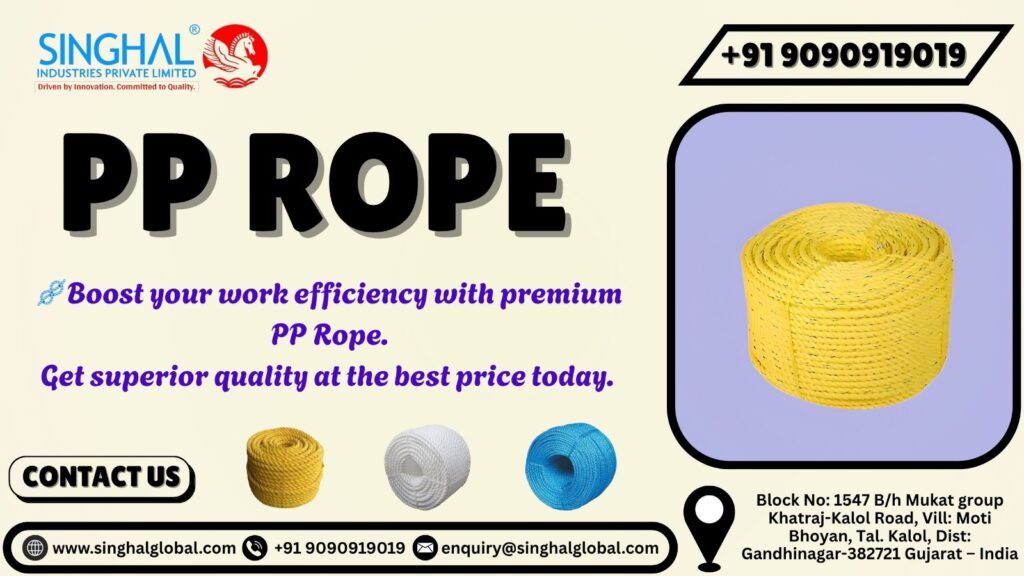
A variety of Indian manufacturers now offer yellow PP danline, or blue polypropylene that are specifically made for fishing and marine use. These ropes provide colour visibility with durability for a long time, ensuring that anchors, buoys, as well as nets are in view and safe even after years of constant exposure.
Industrial PP Rope for Heavy-Duty Needs
In terms of the safety of industrial operations, packing and construction, businesses increasingly rely on the Industrial PP rope exporter India supply chains that are backed by India. These ropes can be used to tie down pallets as well as to secure construction materials and also to provide temporary safety nets and fencing. The durability as well as flexibility and the minimal creep (minimal stretching when under stress) makes PP suitable for repeated use in logistics hubs, warehouses and fabrication yards.
The industrial PP ropes are usually offered in large spools or coils with the option of plain white, yellow green, or blue shades, based on the need. Some manufacturers offer customized braiding designs (e.g. 3-strand, 8-strand and multifilament braided) to meet particular requirements for load and abrasion.
Types of PP Rope
There are a variety of common kinds of PP ropes, each of which is best suited for a specific purpose:
- Braided PP rope weaved structure that distributes the load evenly, providing a smoother feeling and better resistance to abrasion for industrial and marine applications.
- Multifilament rope: Commonly employee in construction and fishing These ropes are make up of many fine filaments for quality and strength, as well as a good knot-holding capability.
- Sheathed PP rope is encase in an outer sleeve that protects an untwisted or braided core, increasing the durability and resistance to abrasion, UV and.
Based on the task The choice of these options will allow you to weigh durability, flexibility, ease, and price.
Applications of PP Rope
PP rope is among the materials that appear everywhere when you begin looking. The most popular uses are:
- Logistics and packaging: Secure boxes, sacks and pallets at warehouses, as well as transportation.
- Agriculture: Tying the hay bales together, bundling crops and nets for support or trellises.
- Safety and construction Safety and construction: Supporting temporary nets, the fencing and tie.
- Marine and fishing nets for mooring boats net tying and buoys and general-purpose ropes for decks.
- Home and DIY Clotheslines, garden tie and temporary fixation of materials or tools.
The flexibility that is PP rope, in conjunction with its cost-effectiveness and weather-proofing, makes it an ideal solution for virtually any binding tie, temporary, or anchoring needs.
PP Rope vs. Nylon: Key Differences
In simplest terms Polypropylene is more lightweight, more affordable, and naturally floats however it is not as elastic and wears faster when subjected to constant friction. Nylon however has a higher elasticity and higher abrasion resistance. This is why it is ideal for high-end towing climbing, towing, or any other situation in which shock absorption is a concern.
In most binding or tying tasks, as well as tasks that aren’t critical to marine. PP rope gives excellent quality and performance for cheaper cost. Nylon is the best choice when you need the most durability. And shock absorption capacity, like for winch lines and heavy-lifting tasks.
Conclusion
If you’re in search PP rope manufacturer India or a dependable Marine pp rope supplier India or an dependable industrial exporter of pp rope India look for suppliers with a proven track record and clear load-rating information as well as a variety of colour and braiding alternatives. When it is choose properly. PP rope becomes a reliable, economical and durable partner for nearly every binding or securing job you’ll have to encounter.
Frequently Asked Questions (FAQ)
Q1. What’s the distinction in PP or nylon rope?
PP rope weighs less, is less expensive and floating, with strong strength. And low water absorption, however it stretches less and wears more quickly when abrasion is severe. Nylon rope is more durable with regard to its elasticity. It is better able to handle shock loads, and resists wear better however it is also heavier and costs more.
Q2. Does PP rope flotation on water?
It is true that PP rope will float on the water since. Polypropylene has a natural buoyancy and doesn’t absorb water. This makes it suitable in fishing, marine and rescue-type situations. Where the rope has to be well-lit and visible at the surface.
Q3. What is the most common type of ropes make from PP?
The most popular types include braided PP rope, PP danline/ multifilament rope and sheathed PP rope. Each has a different level of flexibility, strength and abrasion resistance to construction, marine, packaging and agricultural use.
Q4. What are the uses of PP rope?
The rope is extensively use in logistics and packaging, construction safety, agriculture, fishing and marine operations. As well as in DIY household tasks. Its strength, low cost and resistance against moisture. As well as certain chemicals makes it ideal for both outdoor and indoor binding solutions.
Q5. Who is the largest exporter of PP rope?
India has a variety of major producers and suppliers of PP rope. Many of them contribute to India’s status among the most prestigious Industrial pp rope exporter India hubs. Although there isn’t a single “largest” exporter in the world that is certified by a global body. Indian companies like Singh Industries Pvt Ltd and a variety of other professional certified. PP rope producers consistently are among the top exporters that ship to more than 50 countries.