RPE pond liners play a much larger role in sustainable water management than simply stopping leaks. They protect every drop of water, support aquatic life, and can save money and stress over the years. Climate change, population increase, and unpredictable rains are all putting pressure on water resources. Smarter storage using better liners is a must in a world under such stress.
What is RPE Pond Liner?
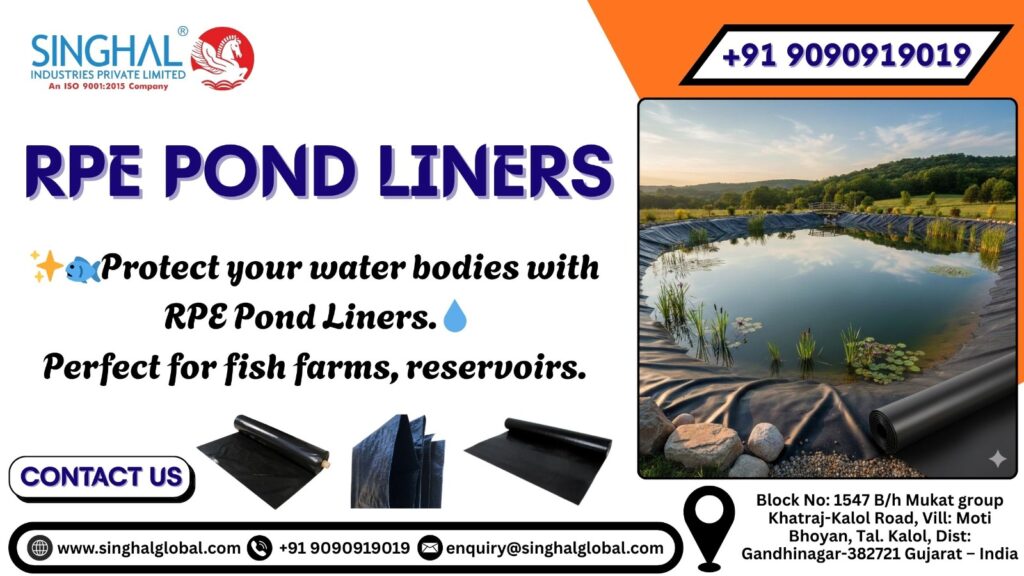
An RPE (Reinforced Polyethylene Pond Liner) is a flexible geomembrane that’s made of layers of polyethylene and reinforced with scrim. It’s designed to safely store water in ponds and reservoirs. RPE pond liners, unlike older options such as PVC or simple LDPE sheeting, are designed to be strong, UV resistant, and durable for outdoor use. The liners are much lighter than rubber ones, but they can last for decades if properly installed and covered. It’s like an “eco-friendly” waterproof skin for your pond. This skin is crucial if you are managing a farm pond or fish pond.
Pond Liners are Important for Sustainability
Sustainable water management involves using water efficiently without wasting any and protecting the environment. Good liners directly support this goal in many ways. You can store more water for the same amount of rainfall or pumping costs. This prevents contaminated groundwater and soil from leaching into the pond. The volume of stored goods is predictable each month, which allows for better planning by farmers and industry. Imagine a farmer who has been saving for years in order to build a large irrigation pond. Then, every year, the pond slowly leaks away. A pond without a lining becomes a symbol of frustration, not hope. A durable RPE pond liner can transform this story and turn it into an asset.
RPE Plays a Role in Various Water Systems
Pond liners made of RPE can be used in a variety of water-related applications and are all directly related to sustainable water management.
Farm Ponds and Irrigation Reservoirs
Every drop saved on farms can be used to grow crops. RPE pond liners can be used to:
- Ponds for irrigation of vegetables, orchards, and sugarcane.
- Reduce seepage by using lined channels and mini-canals.
- Percolation tanks and lined check dams are used when you only want to control seepage in a specific zone.
Imagine a small farmer who grows flowers and chilies. The pond could dry up sooner than expected before lining. This would force the farmer to purchase expensive tanker water or risk losing the crop. The same pond could hold water longer after installing a RPE pond liner. This would allow the farmer to bridge the gap until the next rain. You stop worrying about the water level every morning.
Aquaculture and Fishponds
The pond is more than just a tank for fish farmers. It’s their entire habitat. Pond liners made of RPE are used for:
- Ponds with intensive fish culture for catfish, carp, or tilapia.
- Shrimp farms with biofloc systems.
- Garden ponds and ornamental koi.
They help to maintain water quality by preventing sudden leakages and reducing the risk.
Urban Ponds and Rainwater Harvesting
RPE pond liners are used in housing societies, factories, and institutional campuses. They can:
- Line rainwater collection ponds with lining to store monsoon water.
- Create landscape lakes that can also be used as a fire-water reservoir.
- Treat greywater in small treatment ponds and constructed wetlands.
These systems can reduce the dependence on municipal and groundwater supplies. Some people may argue that “natural soil” ponds are more environmentally friendly, but if your soil is porous, then you could be wasting water underground, where it can’t be easily used. In such situations, a lined pond is more sustainable because the water can be stored for a longer period of time.
RPE Reduces Waste and Improves Durability
Durability is one of the most important, yet least visible, contributions RPE pond liners make to sustainability. The membrane will be less likely to tear when mechanical stress is applied if it has a reinforced construction. RPE formulations have UV stability, meaning they can withstand sunlight and resist cracking. This is a great advantage over some plastics that are cheaper. RPE is resistant to mild acids and hydrocarbons at low concentrations. A longer life is more than just a way to save money. This means that fewer replacement rolls are manufactured, shipped, and installed in a 30- to 40-year time period. This reduced turnover is an important but quiet way to save the environment.
RPE Pond Liners: A Great Way to Work with Suppliers
It is important to choose the right RPE pond liners Suppliers as much as the type of liner. The best suppliers do not just sell sheets; they also:
- Provide guidance to help you choose the right thickness and grade of material for your application.
- Offer a guide for preparing the base, anchoring trenches, and covering it with soil or water.
- Provide warranty and after-sales support.
Conclusion
Many reputable suppliers offer pond liners as large sheets that are factory-welded and tailored to the dimensions of your pond. This reduces seams on site and the risk of leaks. In a country like India, you’ll often see both local and international brands on the market. Others focus on performance, while others are more concerned with cost. You may be tempted to choose the cheapest option, but you could end up spending more money in the long run on repairs, redigging, and frustration.
Frequently Asked Questions (FAQs)
Q1. How much time will an RPE pond lining be of use?
If RPE pond liners are installed on a smooth surface, covered with water or soil, and are protected against severe physical damage, they can live up to 30, 40 years. The lifespan of an RPE pond liner may be shortened in tougher surroundings or due to improper installation, however, it is still longer than most PVC ones.
Q2. Is RPE pond lining harmless to fish?
Good quality RPE pond liners are absolutely safe for plants and fish. They do not have any harmful plasticizers that can be released into the water. These liners are the safest and most reliable solutions for aquariums, fish tanks, aquaculture tanks, and ponds with sensitive species that can live for years.
Q3. How does RPE reduce stress cracking in concrete?
RPE technology mainly achieves the reduction of the cracking stress through the reinforcement in its material and structure. The internal reinforcement layer spreads the mechanical stresses, and the polyethylene blend with stabilizers not only resists UV, induced brittleness but also environmental stress cracking. The liner can become heat expansion and movement of the subgrade are changes that it can tolerate better than rigid plastics.
Q4. What are the thickness options available for RPE Pond Liners?
The thickness of RPE pond liners will be determined by brands and applications. Thicknesses vary from 20 mil to approximately 45 mil (around 1 mm) depending on the brand. Thin liners may be selected for small decorative ponds while the thicker grades can be chosen for the reservoirs with rough subgrades or.
Q5. Who is the largest exporter of RPE pond liner?
It is not easy to single out the “largest exporter” of the global market. There are numerous manufacturers, particularly in North America and Asia, who export RPE pond liners in large volumes. It can change over time because the global market is very competitive. In fact, it would be more practical to focus on the RPE pond liners that have a good reputation, provide technical support, and quality assurance rather than the export volume.