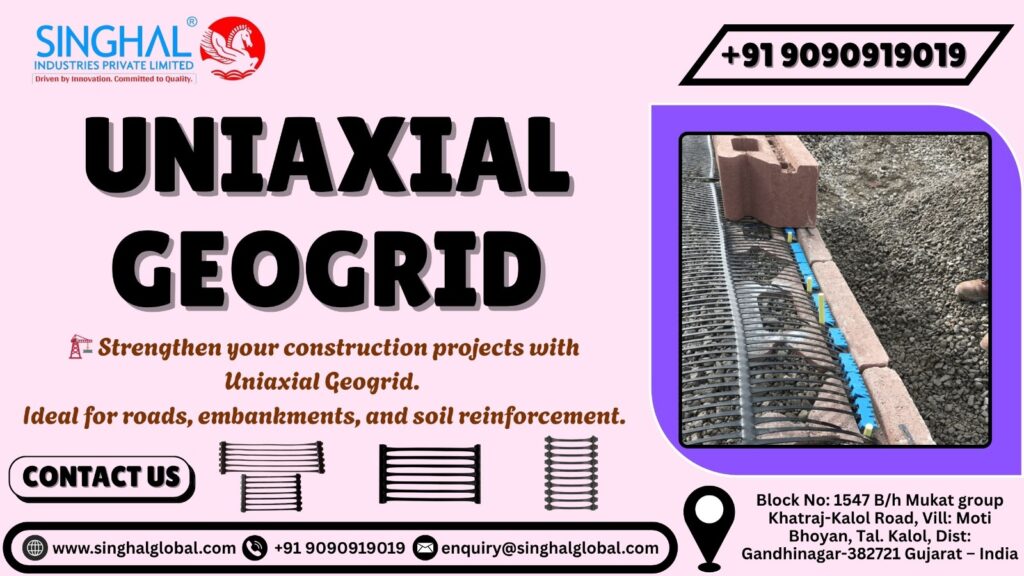
The infrastructure of today appears glamorous at first glance. However, when looking deeper into its composition, the key element behind such durability lies under the surface in the form of the soil. One of the best reinforcements for soil that provides structural stability to the roads, highways, retaining walls, and slopes is the uniaxial geogrid. While seemingly ordinary, looking more like a simple plastic net, uniaxial geogrid completely transforms the properties of the soil.
What Is a Uniaxial Geogrid?
A uniaxial geogrid refers to geosynthetic material for reinforcement that is predominantly composed of high-strength synthetic materials (polymer materials like HDPE or PP). The name of the geogrid comes from its main feature, i.e., ability to resist tension only in one axis direction.
Due to the presence of voids in the design of geogrid, soil can easily get entangled within the structure. When subjected to loading, soil remains responsible for providing compression resistance while the grid absorbs all the tensile stresses.
In layman’s terms, uniaxial geogrid acts like a powerful “belt” that binds all the material together and prevents the soil particles from dispersing and sliding down. By itself, soil may be weak but once geogrid comes into the picture, it behaves very obediently.
Why Does Soil Need Reinforcement Today?
The reasons are many:
- Higher loads in highway and city road construction
- Higher heights of retaining walls due to limited space
- Steeper slopes and embankments in the design of modern projects
- Weak natural soil in many areas for projects
Old ways of reinforcement include using concrete or stone walls, which are costly, take much time, and consume huge amounts of natural resources. This makes the geogrid an intelligent solution that enables the creation of lighter designs and better use of local soil resources.
It is for this very reason that PP geogrid India based systems find extensive usage in highways, railway embankments, flyovers, and industrial platform constructions. Domestic markets have grown rapidly since contractors and consultants have understood the value for money in practical applications.
How Uniaxial Geogrid Stabilizes Soil
There are three principal ways in which uniaxial geogrid stabilizes soil:
Interlocking between geogrid and soil
Soil particles occupy the geogrid apertures and lock themselves into it. Any attempt by the soil to shift is thus prevented by the geogrid, which limits the spreading and settling process.
Tensioned membrane action
In cyclic loads, the geogrid becomes a tensioned membrane which distributes the pressure evenly, thus increasing the soil stability and bearing capacity of soft subgrades and backfill materials.
Improved stress distribution
Rather than stressing the soil at a point, stresses are distributed throughout the geogrid. This has particular significance when considering highway subgrades and retaining walls, since overstressed zones can be sources of failure in these soils.
It is interesting to note that there are individuals who consider geogrids to be the substitutes for concrete or steel. In fact, the claim that geogrids replace concrete or steel is partially correct and partially incorrect. Geogrids cannot be used to substitute concrete beams and columns but can decrease concrete pavement thickness, foundation sizes, and granular fill volumes.
Important Application in Current Infrastructure
A wide range of backbone infrastructure developments make use of uniaxial geogrids:
- Highway/expressway embankment: to ensure long-term structural stability due to heavy load traffic.
- Retaining/reinforced soil walls for flyovers, bridges and grade separations.
- Steep slope stabilization: usually in case of hilly and urban cut/fill sites.
- Railway embankment/yard platforms for minimizing settlement/structural deformations.
- Landfill site slope stabilization and erosion protection for side bunds.
In India, most Uniaxial geogrid manufacturers produce uniaxial HDPE and PP types that have been developed for such applications, tested according to international norms of tensile strength and creep resistance.
PP Geogrid India: Material and Market
Polypropylene (PP) geogrid is widely used in India because of its lightness, excellent chemical resistance, and cost-effectiveness. The common applications of PP geogrid India include stabilization of soil and reinforcing of the base as long as the environmental conditions are not extremely hot.
Properties of PP uniaxial geogrids:
- They have great tensile strength in one direction for use in retaining walls and sloping areas.
- They provide excellent resistance against soil chemicals, allowing their application in landfills and industrial structures.
- They are easier to work with because of their relatively lighter weight than metals.
However, if the design life of the project is very important along with the environmental durability, HDPE uniaxial geogrids should be selected.
Manufacturers of Uniaxial Geogrid and Prices
There are various Uniaxial geogrid Manufacturers in India catering to both domestic and foreign clients. They provide geogrids with varied strengths, roll sizes, and polymers depending on project requirements.
Some important parameters that affect uniaxial geogrid prices are:
- Type of raw materials (PP, HDPE, Polyester)
- Strength levels (for instance, 40, 80, 120 kN/m, etc.)
- Additional coatings or protection (polymer coating, etc.)
- Dimensions of the rolls (length, width, and weight)
- Bulk order (the bigger the project, the lower the price)
The typical Uniaxial geogrid price in India may be quoted in terms of cost per square meter. The exact price is subject to change based on market conditions, crude prices, and the size of the project. Therefore, it is always advisable to ask for quotations on a project-to-project basis.
Advantages of Uniaxial Geogrids in Soil Reinforcement
The advantages associated with uniaxial geogrid technology include the following:
- Greater bearing capacity of soil, which will allow construction on poor soils.
- Minimal settlement or ruts formation on road pavements and embankments.
- Use of thinner paving or reduction in granular sub-base layer, which will reduce costs.
- Enhanced durability and longevity of constructions with minimal maintenance costs.
- Possibility of constructing steeper slopes with reinforced soil techniques.
In terms of practical use, the above means that construction projects can be completed fast without difficulty, materials will be easy to handle, and there will be less dependence on importing quality stone aggregates from distant quarries.
Conclusion
In conclusion, while a uniaxial geogrid may seem like an ordinary grid, its significance cannot be underestimated when it comes to reinforcing soils for contemporary constructions. Such a material allows constructors to create stronger, taller, and more stable buildings on soils that would otherwise not support these constructions due to their instability or high cost. With increasing needs for efficient construction methods, the importance of such geogrids as PP geogrid India will become even more critical in the future.
Frequently Asked Questions (FAQs)
Q1. Explain the difference between uniaxial and biaxial geogrids?
Uniaxial geogrids are made for applications that require only one direction of reinforcement Biaxial geogrids are made for applications where reinforcement is needed in two directions.
Q2. Explain some advantages of geogrids?
They increase soil strength, reduce settlements, save costs on materials, allow greater slope angles, and prolong the lifespan of roads and structures.
Q3: What is the strength of uniaxial geogrids?
The strength of the uniaxial geogrid depends on the load that will be put on it, as well as its life span.
Q4: Can geogrids be applied in road and highway construction?
Of course, geogrids can be utilized in road bases, sub-bases, and in embankments.
Q5. Who is the largest manufacture of Uniaxial Geogrid?
There are many manufacturers both internationally and in India. It would be better to select an established manufacturer rather than focusing on the largest one like Singhal indutries Private Limited.