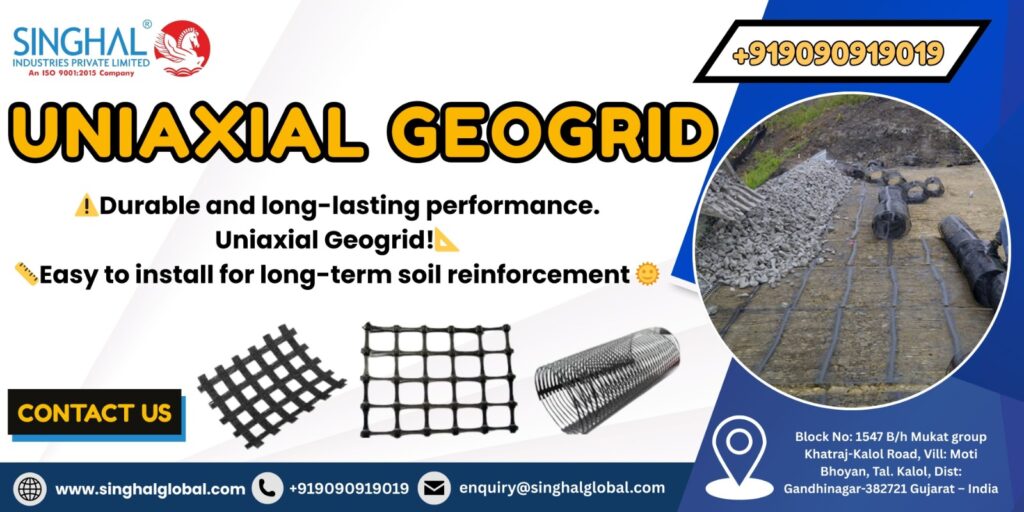
Uniaxial geogrids are designed to last and perform. Hey, everyone! Have you ever wondered why some roads endure for years and others fall apart in the wake of torrential rain? It’s not just luck. It’s related to smart materials such as geogrids with uniaxial construction. These geogrids are designed to provide top performance and insane endurance, particularly in difficult areas like walls, slopes, and foundations. Made of high-strength plastics, they can stretch only in one direction, resulting in “uniaxial” grabbing soil like a pro and securing it. But, is it really that easy? Let’s get into the Geogrid Fabric India and discover what they do to make these fabrics function.
Imagine making a road in wet Mumbai as well as stabilizing the slope within the Himalayas. If you don’t have the right reinforcement, everything falls down like a sled crash. Geogrids that are uniaxial become the heroes. They’re grids similar to a net, but extremely durable. They are pushed in a particular direction during production, and they are able to produce ribs that have high strength throughout the length. This idea? Brilliant for carrying loads without sweating. I’ve seen some projects that used these grids to transform soft ground into solid rock. Is durability just a gimmick? It’s not, but it’s supported by real-world tests, with tensile strengths as high as 200 kN/m and at times even more. They are resistant to UV rays, chemical substances, as well as installation damage. Crazy, right?
Let’s get started on manufacturing. Geogrid manufacturers are experts in their field. They extrude polyester or polyethylene into sheets, then punch holes and stretch them across the length of the sheet. Boom—uniaxial magic. In India, geogrid producers are flourishing because of massive infra-related projects. Imagine Smart Cities, Bharatmala highways. They use the best resins to ensure that the grid doesn’t shift or degrade after 100 years. But do all companies provide? It’s not always the case. Some companies make a mistake, which leads to failures. That’s why selecting reputable Geogrid manufacturers in India is important. They offer guarantees as well as lab certificates and even support for the site.
What is the Importance of Performance in Real Projects
Performance isn’t just a buzzword; it’s the thing that keeps your project from going into disaster. Geogrids with a uniaxial design shine on the walls of retaining. They bind soil particles and reduce pressure on the wall surface. Research has shown that they reduce the wall’s height requirements by 20-30 percent. Durability? They’re deep in the ground and are exposed to the elements of stress and moisture every day. HDPE or high-density polyethylene (HDPE) versions mock that, as they don’t have slow deformation as time passes.
However, here’s a paradox: while uniaxial grids are the best for single-way pull with high loads, biaxial grids may be more effective than them in an omnidirectional spread. What should you pick? It depends on the soil you have and the load. Confusing? That’s the technology for you. In the geogrid fabrics India markets, the uniaxial is the most popular in the production of MSE wall (mechanically stabilized earth). I’ve spoken to contractors who affirm their faith in their use to build railway embankments. One man from Varanasi said that his project saved him 15 percent of the costs by using geogrid fabric locally made by local Indian suppliers.
Installation is easy, too. Lay out the grid and then overlap it by 20-30 centimeters, put it in place. No heavy equipment is required. The water seeps in and the durability is ruined. Have you ever experienced a geogrid failure? It’s usually due to user error and not the material.
Durability Under the Hood: Materials and Testing
What is it that makes them last? They have a polymer-based backbone. HDPE is the king, a material that is flexible yet solid in the areas that matter. Antioxidants block UV and additives combat the oxidation. Lab tests? Testing for pull, creep, and even an acceleration of the process of aging. Results? They’re durable for a long time. In scorching Indian summers, they won’t melt; in monsoons, they don’t get rotten. Geogrid manufacturers in India modify their designs to suit local soils, including expansive clays in the Deccan and sandy loams to the north. Custom apertures are designed to match the size of the aggregate exactly. Some claim 120 years of design life. In the real world? A Punjab highway had them 10 years ago, and they’re sturdy. Labs say that they are forever, but poor construction causes them to fail fast. What is the reason we don’t pay attention to fundamentals?
Performance is at its highest when junctions are solid. The punched-and-drawn technique fuses nodes with no weak points. Compare it to welded grids; these are able to unzip. Geogrid fabric India is a top producer exporting to the Middle East too.
Applications That Wow
Slopes? Check. Walls? Yup. Foundations that are weak on soil? Absolutely. In the mining industry, they are used to reinforce haul roads. Trucks batter them daily, and there aren’t any road ruts. Landfills utilize them to make caps to stop leaks of leachate. Durability guarantees no callbacks.
In India, geogrid manufacturers fuel growth. NHAI specifications call for them to be used in flyovers. One Delhi project: 50,000 sqm installed, zero issues post-quake simulation. Performance? Load distribution equalizes settlements by 50 percent. However, the question is: do they make sense for smaller jobs? Sometimes, yes. Costs add up.
The Indian Edge: Local Geogrid Fabric India Scene
The geogrid fabric India industry is expanding. Starting from Gujarat factories to Tamil Nadu hubs, production has increased. Why? The government pushes to Make in India. Geogrid producers provide BX along with UX series, specifically designed for the tropics. Prices? Competitive—Rs 50-150/sqm, depending on strength. But not all are created equal. They model Indian conditions: high humidity and seismic zones. Result? Grids that perform better than imports. Ever imported? Costs and fees can reduce margins. Get local rapid service and support.
Challenges? The supply chain’s hiccups in COVID revealed weaknesses. Now, they’re stockpiling. Future? Recycling recycled polymers to earn green creds. Sustainability contradiction: durable means less replacement, but plastic? Debatable.
Innovations Pushing Limits
New uniaxial geogrids? Coated versions are resistant to salts found in coastal areas. High-tenacity polyester provides ultra-strength. Durability? 50% more resistance to creep. Geogrid producers experiment with hybrids—uniaxial with geocomposites. One test in Kerala stabilized the slope; no slides after two monsoons. Do standards keep pace? IRC codes are constantly being updated.
Cost-Benefit: Is It Worth the Investment?
Cost upfront is more expensive than gravel, but the lifetime savings are enormous. Filling up is reduced by 30% and decreases earthwork by 30%. ROI within 2 to 3 years for large projects. Small developers hesitate—education gap. However, the data says yes. In the geogrid fabric India, bulk buys can reduce costs. Geogrid Suppliers in India provide financing, even. Data on performance taken from IIT study seals the deal.
Conclusion
Uniaxial geogrids are designed for durability and performance. In the wild terrain of India, they’re game changers. Geogrid fabric India offers a wide selection. However, it is important to choose the geogrid manufacturer with care. Durability isn’t just luck; it’s the result of engineering. Yet, the paradox is that technology has advanced, yet failures do happen. Why? Human error. Test everything, test your suppliers, and train your staff.
Frequently asked question (FAQ)
Q1. Are uniaxial geogrids a viable option to stabilize slopes?
Absolutely, yes! They’re pros at it. They wrap them around soil layers, and they’ll stop slides. It works on slopes that are 1:1. But is it steep? Include anchors. I’ve seen faces that are 60 degrees that were held in place.
Q2. What options in tensile strengths are there in geogrids with uniaxial geometry?
Tons! From 20 kN/m for light tasks to 400 kN/m monsters for massive walls. Common: 50, 100, 200 kN/m. Choose by design software such as ReSSA. Geogrid makers can design their own.
Q3. Can geogrids made of uniaxial be modified?
You bet. Size of aperture, width of roll, and strength can be adjusted. Geogrid Fabric India makers can do it quickly. Are you looking for 4m wide? There’s no problem. Simply specify the type of soil you are using.
Q4. Can uniaxial geogrids be sold to other countries?
For sure. Indian geogrid makers export across Africa, SE Asia, even the US. CE registered, ASTM compliant. Quality is in line with global standards, sometimes beating the competition on price.
Q5. Who is the largest manufacturer of geogrids?
It’s a tough call: global giants such as Singhal Industries Pvt Ltd and Maccaferri lead. In India? SIPL and Strata are the top two geogrid producers. Massive capacities and 100% local resin. However, “largest” shifts due to expansions—who’s next?