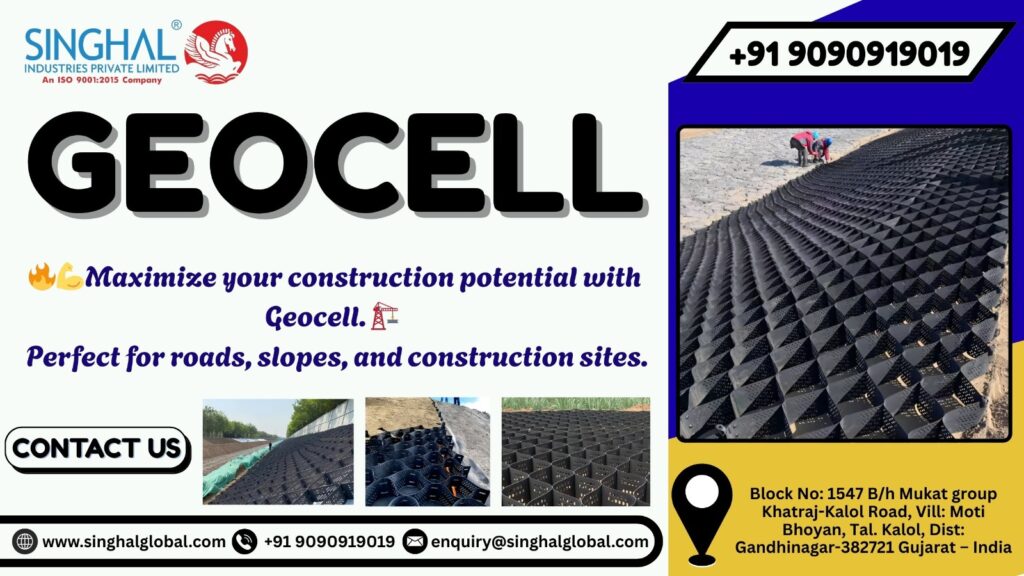
Innovative geocell designs have quietly revolutionized civil engineering worldwide, and that impact is visible in the Indian subcontinent more than anywhere else. These 3D honeycomb-like grids, which are made of advanced polymers, have not only changed the construction of roads, highways, and driveways but have also altered the conventional ways of soil stabilization, environmental protection, and cost savings. Any person walking across a geocell driveway or driving on a geocell highway, both of which are the products of years of silent innovation in engineering, can literally say that they are walking and driving over the innovation itself.
What Exactly Are Geocells?
Geocells represent a new concept in a cellular structure that is three-dimensional and is most often produced from high-density polyethylene (HDPE) or recycled plastics. After placing them flat on the ground and filling them with soil, sand, gravel, or even recycled aggregates, they form a firm, stable layer that supports heavy traffic and helps in the prevention of erosion. To put it simply, think of them as giant, flexible egg cartons for the earth — the only difference being that instead of eggs, they hold together the rock, soil, or sand which tends to move or slide away.
Evolution of Geocell Design
Initially, geocell designs were rather simplistic. However, now you can get geocells that are specifically designed for India’s harsh mountains, sandy deserts, and flood-prone plains. The new designs of plastic waste products, as proposed by CRRI and BPCL, are an innovative way of managing plastic waste which was tested by using plastic waste geocells along the DND-Faridabad-KMP Expressway. This is an excellent illustration of the solution of two problems simultaneously: how to dispose of plastic waste and how to make durable roads.
Nowadays, many geocell manufacturing firms in India are offering a range of products that are not only of different sizes but are also of innovative shapes, have greater flexibility, and even contain eco-friendly materials that combine durability with sustainability.
How Geocells Are Changing Civil Engineering
Theoretically speaking is one thing, but you can only really feel the benefits of a geocell driveway, India-style — and in the case of road construction with geocell generally — when you see the results. During the last monsoon season, a village in the north of India witnessed the miracle that the new geocell driveways did not get destroyed while the neighbors’ traditional gravel roads washed away within hours. People were very emotional: angry, happy, and sometimes even incredulous.
If you ask engineers, they will share their views with you and sometimes even argue with each other. The old ones recall the tough times of battling with muddy subgrades and watching their hard work being washed away by the first big rain. Whereas the new ones cannot stop wondering how much faster and less wasteful a geocell-based project can be — even if it is sometimes “too easy” that way.
Geocell Driveways in India
Geocell driveway India is not a matter of extravagance. For numerous rural communities, it is the only means of ensuring transportation during floods or heavy rains. The local civil engineer documented the process of installing a low-cost geocell driveway merely using local labor and sand – it has withstood two years of truck traffic with only minor repairs.
Highway Projects: Big Scale, Big Impact
Highway contractors witness savings in maintenance costs and less inconvenience to vehicle flow. The major highways of India, including those traversing the mountains of Uttarakhand and the marshy plains of Assam, are now using geocell stabilization methods. Soils that had caused project postponements due to instability are now being fixed in time, and complaints from drivers and local officials are decreasing.
Geocell in Road Construction: Transformative Benefits
- Soil Stabilization: Geocell in road construction a structure of the soil that supports the soil mass, lessening its movement and enabling roads to be established on weak or waterlogged grounds.
- Reduction of Material Costs: The condition of the base being stable implies that fewer (or less expensive) aggregate and concrete are needed.
- Good for the Planet: There is less need for natural resource extraction, and sometimes geocells are also made from recycled materials.
- Longevity: Roads are less prone to damage and wear from pressure, and also potholes, as well as frequent repairs.
- Speed: The building of the road takes less time, maybe mostly local materials and labor are used.
However, there is a contradiction — sometimes residents say that the road surface feels “too hard,” or the system fails because of poor design or unexpected drainage problems in extremely rare instances. It is a human system, not a perfect machine.
Who Makes Geocells in India?
India has a concentration of large Geocell manufacturers in India such as Strata Geosystems, Singhal Industries, Sachi Geosynthetics, and Terram Geosynthetics, to name a few. While some emphasize big infrastructure projects, others develop small-scale solutions for rural development or landscaping. Besides that, Ocean Non Wovens and TechFab (India) Industries Ltd. are two other significant contributors.
Geocells Beyond Roads: Wider Civil Engineering Applications
- Railways: Geocells firm up the track beds that are made up of soft soils, thus extending the time interval between maintenance works.
- Slope Protection: Geocells are used for reinforcing the slopes of the hills in landslide-prone areas, thus the risk of natural disasters is significantly lowered.
- Retaining Walls & Embankments: With the help of geocells, one can gradually do away with the conventional concrete walls which are used for retaining, most of the time, at a small percentage of the cost.
- Canal Lining: The prevention of erosion and leakage through strengthening the canal slopes.
Conclusion
Geocell pattern breakthroughs mean not flawless but more versatile choices that can meet the varied Indian landscapes and differing economic conditions. Leveraging next-generation geocells — especially those made from recycled plastics — is helping civil engineering to become more sustainable, less costly, and tough against nature’s unanticipated challenges.
It is next time that you see a newly constructed highway or step on a solid Geocell driveway India, don’t forget: you are stepping on a lattice of old problems and new solutions, woven together, keeping progress going — in every sense of the word.
Frequently Asked Questions (FAQs)
Q1. How do Geocells help in soil stabilization?
Geocells limit the soil to one cell of each, thereby, it becomes a single, firm mat. When a weight is brought, it is spread over a very large surface, thus, the shortage of the ground is avoided and the sinking is minimized. A honeycomb is a good analogy here — each cell supports the other, shares forces, and resists movement.
Q2. Can Geocells be used for slope protection?
Yes, the answer is emphatically yes. Geocells are highly trusted by engineers not only for stabilizing steep slopes but also for preventing them from landslides, and for holding soil and plants securely. Apart from that, geocell frameworks can be covered with grasses or planted with shrubs to get the combined effect of nature and strength for roadsides and embankments.
Q3. What are the benefits of using Geocells in road construction?
Among the benefits of geocells are the reduction of aggregate requirement, speeding up of the construction process, extension of the lifespan of roads as well as the improvement of their performance in weak soils. They take care of load distribution and save the surface from rutting or potholes, even when it is heavily trucked, which is critical, in particular, to India’s rapidly expanding road network.
Q4. Are Geocells suitable for both permanent and temporary applications?
Indeed! Geocells might serve the purpose of constructing durable, all-weather roads or short, temporary access tracks for areas such as construction or disaster relief. Temporary geocells can either be taken out after the completion of a work or, in certain situations, left to merge with the earth.
Q5. Who is the largest manufacturer of Geocell?
Companies like PRS Geo-Technologies and Presto Geosystems are among the leaders of the industry worldwide. The well-known manufacturers in India are Strata Geosystems, Singhal Industries, and Sachi Geosynthetics. A manufacturer’s decision is often influenced by the size of the project, the need for technical support, and the specification of the site.