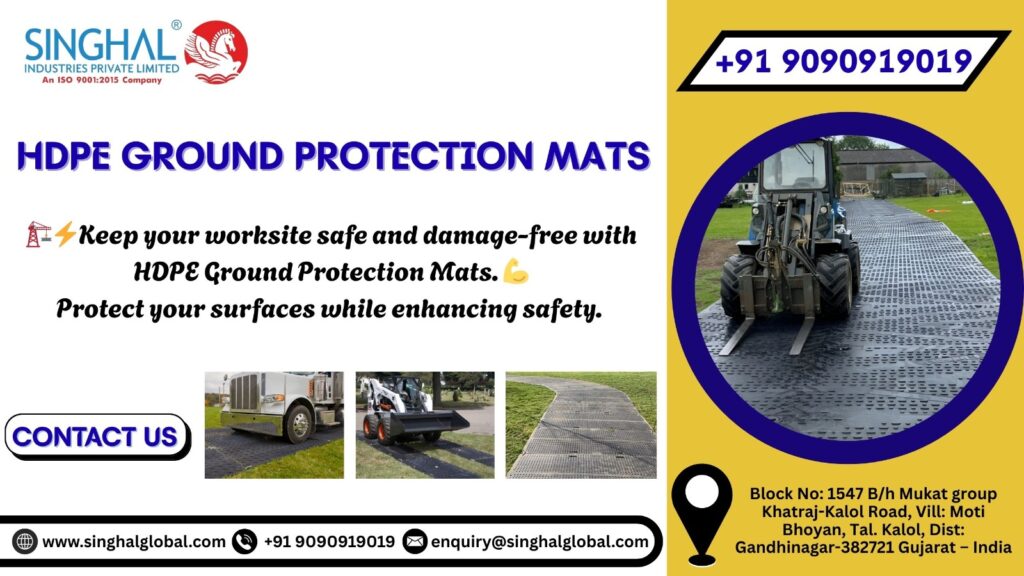
These are like a strong shield that goes between your project and the earth, preventing ruts, mud, and grass damage from happening, at the same time, keeping both people and machines safe and going. Irrespective of the fact that you are operating a construction site or an outdoor concert, or even if you are simply getting a heavy crane into a farmhouse backyard, the said mats are most likely your best defense against both the expensive site damage and the hostile landowners.
What are HDPE ground protection mats?
HDPE Ground Protection Mats are massive panels that are created from hard, high-density polyethylene. Their function is to serve as temporary roads, platforms, and work areas by being placed on the ground. With such a design, the weight of the vehicles and machines is spread over a larger part of the ground; hence, the soil underneath is not crushed or turned into mud. When compared to plywood or metal plates, HDPE mats are very water, chemical, and UV light-resistant and do not warp or decay, which, in turn, gives them a longer service life.
Almost all HDPE mats are made to be durable, easy to maintain, and can be used in any weather condition, be it snow or hot sun. A number of HDPE ground protection mats manufacturers provide products having either smooth or rough traction surfaces depending on whether a person needs a safe walkway or a firm trackway for excavators.
How HDPE mats protect your site
The primary role of these mats is to protect the land surface from harm by sharing the load. When a truck wheel or a support foot comes down on bare soil with great force, that force is concentrated in a very small area and can cause ruts as well as structural damage to the subgrade. HDPE mats perform the function of a bridge, hence, they can distribute the same load over a larger area thereby effectively reducing the ground pressure and preventing soil from getting deformed.
Also, an equally important protection benefit is the prevention of contamination. For instance, in industrial or construction sites, leaks of oil, fuel, or chemicals can directly infiltrate the ground and the water sources. The presence of HDPE mastic on the ground serves as a barrier that restricts penetration and facilitates the cleanup process, as the spilled material remains on the mat surface and can be cleared or washed off. They additionally work to keep the likes of asphalt, concrete, and decorative paving safe from cracking, scratching, and staining.
Strength and load capacity
One major factor that makes HDPE Ground Protection Mats beloved by a vast number of users, is their notable load-bearing capacity. To enumerate a few, numerous HDPE mats, depending on design, ground, and thickness, can support weights of 80-120 tons and more, which is enough for cranes, excavators, and heavy utility trucks. A few of such products have compressive capabilities within the range of hundreds of PSI, thereby allowing them to be used in harsh construction and industrial environments.
Naturally, the performance in the real world is always reliant on the soil below – soft, waterlogged clay will behave very differently from compacted gravel. This is the reason why reputable HDPE Ground Protection Mats suppliers inquire about soil conditions, equipment weights, and safety margins before deciding on a mat type and thickness. However, when these mats are put to use in the right manner, they are capable of withstanding the repeated passing of loaded trucks without causing fractures or irreversible dents, and they can also be used again in different intervals of work.
Sizes, thicknesses, and configurations
The HDPE ground mats aim to fulfill different size needs and operations are available in various sizes and thicknesses. Generally, the dimension of a 4 ft x 8 ft or 3 ft x 8 ft panel is used for simple access ways and work pads, while heavy roadways systems use larger formats such as roughly 13 ft x 6.5 ft or 8 ft x 14 ft. The thickness parameter mostly varies from 10 mm (approximately 3/8 inch) for light-duty ground mats to 1 inch, 1.5 inches, or even 4 inches for heavy industrial or rig-mat style applications.
There is a possibility that a few mats contain a traction pattern or an integrated cleat on one or two sides for the purpose of facilitating the grip of tires and tracks in the mud while other mats have a smooth surface to protect the floors and turf. The majority of the platforms employ connection holes or specialized connectors so that one mat can be linked to the other and thus the individual mats will function as a single continuous road instead of separate plates that can be displaced. This adaptability allows you to establish straight access roads, turning areas, staging pads, and pedestrian walkways with the help of a single set of basic components.
Conclusion
The HDPE Ground Protection Mats Price can be very different depending on various factors such as size, thickness, load rating, surface pattern, whether that is a purchase or a rental. Without a doubt, the price of light-duty mats that are used for small vehicles and pedestrian traffic is less than that of heavy-duty, crane-rated rig mats; in some cases, the difference in price is a reflection of more material, longer life, and stronger design. Apart from that, region-related factors still matter—import duties, shipping distance, and local availability are among several factors that inline with these elements; the final price is determined at the buyer’s location.
Most contractors compare the price of HDPE mats with that of plywood and come to the conclusion that the first option is more expensive. However, if you include in your calculations how many times you can reuse one mat, how the risk of damage claims decreases, and how the ground remediation costs go down, then the total cost per use becomes very reasonable. Suppliers in some areas are even providing the rental model as an option, so you can synchronize mat expenses directly with the duration and size of the project, which is more convenient from a cash flow point of view.
Frequently Asked Questions (FAQs)
Q1. How do HDPE mats protect the ground surface?
HDPE mats save the ground from destruction by spreading the weight of cars and machines over a larger surface, thereby diminishing the pressure on the ground and stopping the formation of deep furrows, compacting, and soil or finished surface structural damage. In addition, they serve as a wall against spills and leaks, thus giving oils, fuels, and other contaminants no access to the ground and groundwater.
Q2. How much weight can HDPE ground protection mats handle?
Typically, HDPE mats for the ground are capable of bearing weights from tens of tons, and some can be up to around 80–120 tons and thus be used for heavy machinery such as cranes and large trucks, the maximum load also depending on mat thickness and design. The actual verification of the performance must always be done for the ground beneath; as a result, wet and soft soils necessitate more cautious loading and sometimes even thicker or an additional layer of mats being used to ensure safety.
Q3. Are HDPE ground mats environmentally friendly?
Considering their reuse possibility, production from recyclable or recycled polyethylene, and the fact that they contribute to the reduction of soil damage and disturbance, HDPE ground mats can be regarded as relatively eco-friendly products. They take away the need for disposable materials, temporary gravel roads, and expensive ground restoration, thus, they can lower the overall carbon footprint and economic side-effects of temporary works.
Q4. What sizes and thicknesses do HDPE mats come in?
Standard sizes comprise panels approximately 3 ft x 8 ft and 4 ft x 8 ft which are suitable for normal access, while even larger panels with length ranging from 8 to 14 ft may be used for heavy-duty road applications. The thickness of the different variants normally varies from around 10 mm or 3/8 inch intended for lighter applications up to 1 inch, 1.5 inches, or even approximately 4 inches that are utilized for high-load or rig-mat style products.
Q5. Who is the largest exporter of HDPE Ground protection mats?
The market of HDPE ground protection mats has a worldwide scope and there are many exporters. The Asia-Pacific region, with China as the leading player, is mainly credited for the large export volumes of polyethylene-based mats. Other than the Asian exporters, suppliers of ground protection from North America and Europe are also in a position to pump a significant volume of their products into the international market.