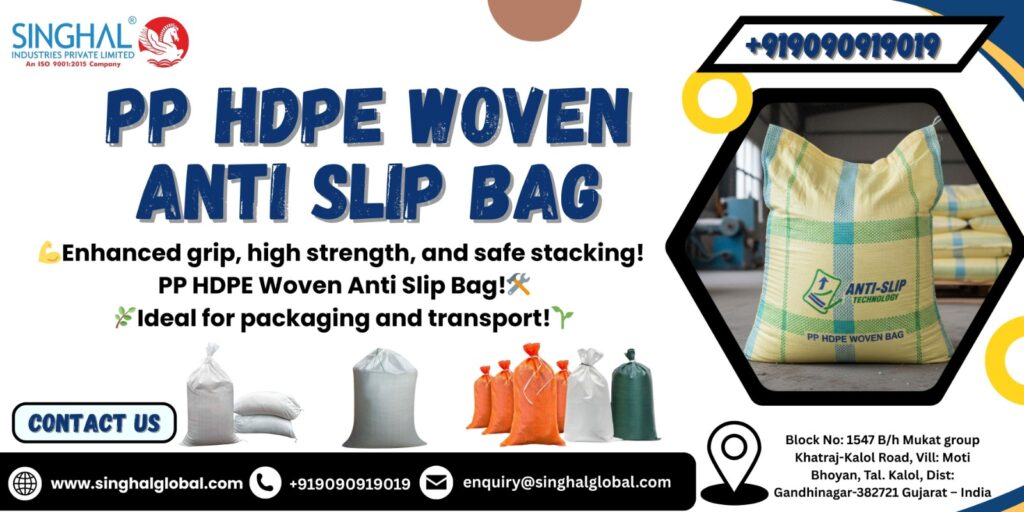
In the contemporary world, we are in a society where sustainability is not a fad, but a must. Every industry, from construction to agriculture, is focusing on reducing the amount of waste produced, increasing durability, and finding more efficient packaging solutions. The PP/HDPE Woven Anti-Slip Bags is one of the innovative products that are gradually transforming the packaging industry, and this is a modern hero in the bulk packaging. It is recyclable, durable and lightweight. The bags are a perfect balance between the performance and overall environmental factor. But let’s dig deeper. What is it which distinguishes the PP (Polypropylene) and HDPE (High-Density Polyethylene) bags? Why are the leaders of the industrial world, food producers, and fertilizers companies quickly moving to sustainability? How can Indian manufacturers best integrate into the world trend?
Understanding PP and HDPE Anti-Slip Bags
To make a brief presentation, two types of plastic material, PP and HDPE, are characterized by their remarkable toughness and durability. PP is a bit more elastic and HDPE is famous because of being water or chemical-resistant and withstands UV radiation. When incorporated into fabrics, these materials provide a good basis to industrial packing, namely the large-scale items of sugar, grains, cement, and chemical fertilizers, seeds, etc.
The Sustainability Advantage
Here’s a feature that makes PP or HDPE anti-slip bags even more impressive: they’re recyclable and reusable. Companies across the world are striving to limit the use of single-use materials. These bags are woven to be in perfect alignment with the goal of reducing single-use materials.
In comparison to paper sacks and jute bags, PP and HDPE bags have a more extended lifespan. The bags are reusable many times and can then be recycled into other items, like park benches, pipes, or even packaging materials. This type of circular economy method drastically reduces the need for landfill.
HDPE Woven Anti-Slip Bags: Indian Industry Leads the Way
India is now one of the most rapidly growing markets for HDPE material for packaging woven. This country has low manufacturing costs, skilled labor, and cutting-edge manufacturing technology, making it an international hub for high-end packaging that is exported.
An HDPE woven anti-slip bag manufactured in India typically utilizes high-speed weaving machines, extrusion coating lines, and surface treatment techniques to make bags that are customized in texture, tensile strength, and anti-slip coating levels. A majority of these companies adhere to ISO and international standards for food grade, ensuring that exports of Indian bags comply with the highest standards in the world.
Incredibly, India is also renowned for its innovation in the field. Manufacturers are testing recycled or biodegradable blends, including UV stabilizers to prolong their outdoor life, and advancing printing technologies to make branding clearer. In case of exports, the HDPE woven anti-slip bag exporter in India usually cooperates with customers in Africa, the Middle East, Europe, and Australia.
When it comes to price, India is highly competitive globally. The HDPE Woven Anti-Slip Bag Price is low compared to Western or East Asian manufacturing countries, without sacrificing quality. This is one of the major reasons why multinational corporations are turning to India for bulk packaging solutions.
Practical Applications Across Industries
It’s incredible how versatile these bags can be. They are everywhere, if you’re paying attention.
- Agriculture: It is used in the production of grains and pulses, rice and animal feed.
- Construction: Can be used in mortar mix, cement and sand packaging.
- Fertilizers, chemicals and chemical fertilizers are safe for products such as resin, urea as well as powder-based materials.
- Food industry: Salt, sugar and flour producers rely on them because they maintain freshness and prevent moisture.
- Logistics The anti-slip design of their products ensures safety when stacking, loading and transportation.
In actual fact, I recall visiting the sugar mill in the northern part of Maharashtra in the past. The owner was proudly showing the rows of fresh packed 50kg sugar bags neatly stacked between the floor and ceiling. Prior to the switch onto HDPE anti-slip bags, employees complained of unstable stacks and a waste of packaging. Today, they don’t have to worry about losing any packaging materials. It was not just physical, but it affected the workflow and increased morale, too.
Why Businesses Are Making the Switch
There’s a logical reason behind this transformation that is: safety, reliability, and cost savings.
- Durability and strength – unlike papers or jute, PP/HDPE bags are able to take on rough handling and long-distance transportation.
- Cost efficiency – While the cost per bag may appear to be a bit higher initially however, the possibility of reuse and lesser damage makes them more cost-effective in the long run.
- Protection – A non-slip layer stops bags from collapsing and causing accidents when stacking.
- Flexibility in branding HDPE as well as PP bags are easily printed with logos of companies as well as product information, along with bright branding.
- Eco-friendly choice Recycling and in line with sustainability initiatives which makes brands appear more environmentally responsible.
Still, skeptics exist. Some believe that synthetic bags aren’t as eco-friendly as natural fibers such as cotton or jute. This worry isn’t completely untrue. But, when you look at the whole lifecycle from extraction of raw materials to disposal, PP and HDPE bags usually have lower carbon footprints particularly when properly recycled.
Challenges and Innovations Ahead
There is no perfect technology. The plastic packaging made of woven materials still faces its issues. The ongoing debate on plastic waste is causing the industry of woven bags to develop further. Companies are investing heavily in eco secure coatings and completely recyclable anti-slip products, hoping to limit microplastics.
In addition, durability can come at the expense of flexibility. Customers may find HDPE bags to be more stiff than traditional jute bags. However, thanks to newer polymer blends, the situation is changing quickly. The latest anti-slip bags provide the same flexibility and flexibility as natural fiber materials, without losing their strength.
These changes demonstrate that practical and sustainable don’t have to be a necessity to be adversaries. They are able to be a pair.
Conclusion
Sustainability in bulk packaging doesn’t have to be just a distant goal; it’s in the present. PP or HDPE anti-slip bags demonstrate that environmental sustainability and industrial efficiency can be a perfect match. They appear simple, even normal, but they are a symbol of innovative design, environmental consciousness and practical innovation.
If you happen to see an assortment of well-packed concrete sacks or sugar containers that stand high and solid, remember that it’s more than only good packaging; it’s sustainable progress that is quietly executing its task.
Since sometimes small changes, such as applying an anti-slip coating can have the greatest impact.
Frequently Asked Questions (FAQs)
Q1. What’s the mechanism behind the anti-slip feature in these bags?
The anti-slip coating may be coated or sprayed on the bag’s surface, creating a rough surface that generates friction between the layers. The coating will ensure that bags do not slide over each other when they are stacked.
Q2. What types of products are able to be placed in HDPE anti-slip bags?
They’re ideal for seeds, grains, fertilizers, sugar, cement, chemicals, and even granular or powdered food products. Essentially, any dry bulk item that requires safe transport and handling benefits from these bags.
Q3. Do anti-slip mats get ruined by heat or sunlight?
Standard HDPE is susceptible to exposure to UV for long periods; however, most HDPE Woven Anti-Slip Bag manufacturers include UV stabilizers to ward off heat and sunlight. These bags are safe to store outdoors for months with no deterioration.
Q4. Are these bags compliant with the regulations on export packaging?
Yes. The exporters of the best reputation among Indians fully adhere to international standards on packaging and hygiene, strength and security tests. A large number of them are certified regarding food shipment and environmental compliance.
Q5. Who is the largest manufacturer of PP/HDPE Anti-Slip Bags?
India boasts of several players. Although they have divergent rankings, the most renowned HDPE Woven anti-slip Bag producing companies are found in Gujarat and Maharashtra Like Singhal Industries Pvt Ltd . These are areas where there are high-technological production centers of polymers.