
Imagine you are in a huge water-treatment tank or a long concrete tunnel—everything looks flawless and solid from the outside, but under the surface, there might be a serious problem: water seepage. Over time, even the strongest concrete becomes permeable. Cracks develop, and corrosion caused by chemicals from the water starts eating the structure, which eventually weakens. This is the point where HDPE T Rib Liners can be found—showing the waterproofing barrier that they are without a doubt the most powerful heroes ensuring your infrastructural network stays intact for decades.
Durability is waterproofing, that’s what engineers and construction experts mean when they talk about one or the other. However, it is more than just that. It means protection of the investments, safety assurance, as well as the conservation of the very core or the most vital projects such as tunnels, tanks, canals, or basements. Thus, on the subject of modern buildings, it would be wrong to consider HDPE T Rib Liners a mere luxury; on the contrary, they represent a necessity.
What Are The HDPE T Rib Liners?
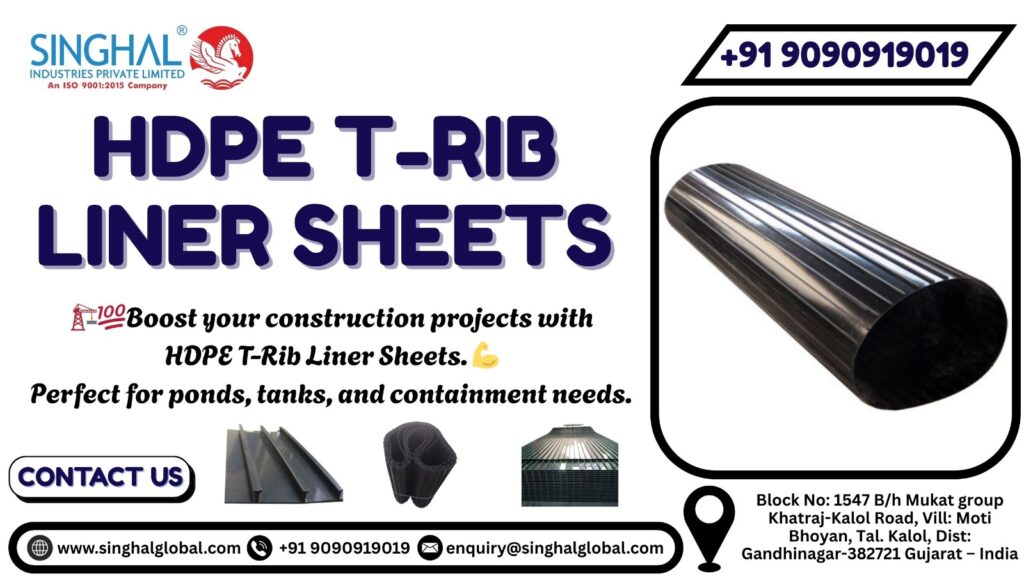
In simple terms, HDPE T Rib Liners are high-density polyethylene sheets specially made with T-style ribs (or anchors) on one side. These “T” formed ribs are combined with the concrete which allows the connection to be safe, the liner to be steadily deeply fixed while the flat side is the impermeable barrier protecting from water.
Just like human skin, their purpose is to protect the wear and tear of the material beneath, in this case, concrete. Besides the fact that they are elastic and long-lasting, they are not prone to leakage, immune to the impact of chemical and corrosion agents. So, after the installation, water infiltration through walls or floors is practically impossible.
These liners are composed of High-Density Polyethylene (HDPE), a material that is dependable, easy to work with, and that has a very long life span. Also, HDPE is very resistant to most acids, bases, and salts, and thus is an excellent material for the industry and infrastructure.
Why The Use Of HDPE T Rib Liners Will Be Revolutionary?
One of the reasons for their mounting popularity among construction professionals, waterproofing contractors from various countries is hidden in advantages. What makes them such a long-lasting solution is a bunch of benefits they provide. Let’s take a look at them:
Superior Waterproofing Performance
The normal waterproofing of the concrete relies on the use of a coating, membranes, or chemical additives. However, these sorts of interventions slowly decay or get injured under pressure. On the other hand, an HDPE T Rib Liner encloses the structure in a unified, uninterrupted shield that is not affected by the usual problems of aging and damage such as peeling, cracking, or leaking. Soon after putting it there, it is no longer a separate waterproofing layer but an integral part of the structure itself. In this way, there is a guarantee of safety against water penetration for a long time — in some cases, even up to several decades.
Chemical and Abrasion Resistance
The concrete in such industries as a wastewater treatment plant, mining, and tunnels is subjected to aggressive chemicals and materials. Fortunately, HDPE remains highly resistant to chemical reactions and even in difficult situations, it retains its properties. So, the avoidance of corrosion, scaling, and high repair costs follows logically.
Strong Bonding with Concrete
“T” ribs are, in fact, the main components that operate the most. When concrete gets poured over the liner, these ribs embed themselves in it, hence, the mechanical bond formed. As a result, the possibility of water flowing between the liner and concrete finding the way out is quite minuscule.
Durability and Longevity
If your new construction has a lifespan of 50 years plus, I’m sure you wouldn’t want to change its waterproofing every few years, right? The life span of HDPE T Rib Liners is one of their outstanding features. They have a high resistance to UV rays, stress cracks, and mechanical wear.
Cost-Effective in the Long Run
Even though the initial cost of installation can be more than that of the traditional waterproof films or coatings, the HDPE T Rib Liners prove to be an economical solution in the long run due to lessened maintenance and repair requirements as well as extended service life.
The Role of Exporters and Manufacturers
The market for this tech has literally gone through the roof in the last few years. While the demand for infrastructure projects keeps on going up across the world, HDPE T Rib Liners Exporters are consequently upgrading their facilities to meet global quality standards. India, notably, is already on its way to becoming one of the major export hubs for such products directed towards Africa, the Middle East, and Southeast Asia.
Almost all excellent producers abide by global standards such as ASTM D638 or IS 10837 for aspects of tensile strength and mechanical abilities. Consumers are now shifted towards suppliers who can provide them with not only the product but the whole package – including technical support and the on-site assistance.
Installation: Easier Than You Think
One of the most frequent wrong ideas is that the installation of HDPE liners is highly complicated and takes a long time. The truth is that it is an incredibly simple operation after the procedure is grasped.
- The panels are placed on the work surface prior to the concrete pouring.
- Welders connect the panels through thermal fusion, thus, making it a non-stop joint.
- The concrete poured envelops the ribs, thus, establishing the locking effect.
- After the process of curing, the liner is considered as part of the structure. It can’t be simpler than that – though welding needs to be done accurately hence, trained installers are the best option.
Conclusion
Without a doubt, waterproofing might be called the first necessity of every infrastructure project but, also, the most unsung. These HDPE T Rib Liners, from the tiniest retention tank to the giant public water works, are there, quietly ushering in a new era of waterproofing. The aim goes far beyond simply stopping leaks, i.e., it is to come up with a world where structures are resistant to time, weather, and chemicals, a world that is safer and more sustainable.
If quality means everything to you in the case of a HDPE T Rib Liners manufacturer, then it should be a deciding factor in choosing one. A good manufacturer will guarantee material uniformity, exact rib spacing, and standardization of welding compatibility. These tiny elements are important because the bad quality of the liners can lead to poor bonding or even crack formation in the course of time.
Thus, if you are one of those three – a civil engineer, a builder, or an investor, keep in mind this – waterproofing isn’t always there to see, but its effect certainly is. Opting for the right measure today is what will make your project last for the generations to come.
Frequently Asked Questions (FAQs)
Q1. Can they be customized?
Yes, definitely. It is possible to tailor HDPE T Rib Liners in aspects such as thickness, width, color, and rib spacing to meet the requirements of a given project. In large projects, it is a common practice for manufacturers to personalize dimensions in order to facilitate installation and minimize waste.
Q2. Can T Rib Liners be used with concrete?
Yes, this is exactly how they are intended to be used. The T ribs get firmly embedded into the concrete, thus, ensuring a strong mechanical bond. Such a bond is responsible for the prevention of the ingress of water and chemicals via joints.
Q3. Can they withstand high pressure?
Yes, for sure. The HDPE material is capable of enduring a quite high hydrostatic pressure. This is the reason why it is considered to be a suitable material in areas such as tunnels, tanks, and deep foundations – places that are subjected to constant pressure by water or soil.
Q4. Are they suitable for tunnels and canals?
Yes, they are the perfect choice for tunnels, canals, and similar constructions. With the prevention of water ingestion, they also serve as a protection of the internal concrete surface from erosion, thereby prolonging the lifespan of the structure. A lot of big infrastructure projects have already successfully employed this technique.
Q5. Who is the largest manufacturer of HDPE T Rib Liners?
There are plenty of companies that globally produce these kinds of liners, but the major manufacturers are usually region-dependent. To mention a few, SIPL and other such Indian companies that are known for manufacturing and global exporting of high-quality HDPE T Rib Liners. It is always good to take a manufacturer who is certified for international standards and experienced with large-scale projects.




One Response
hello testing