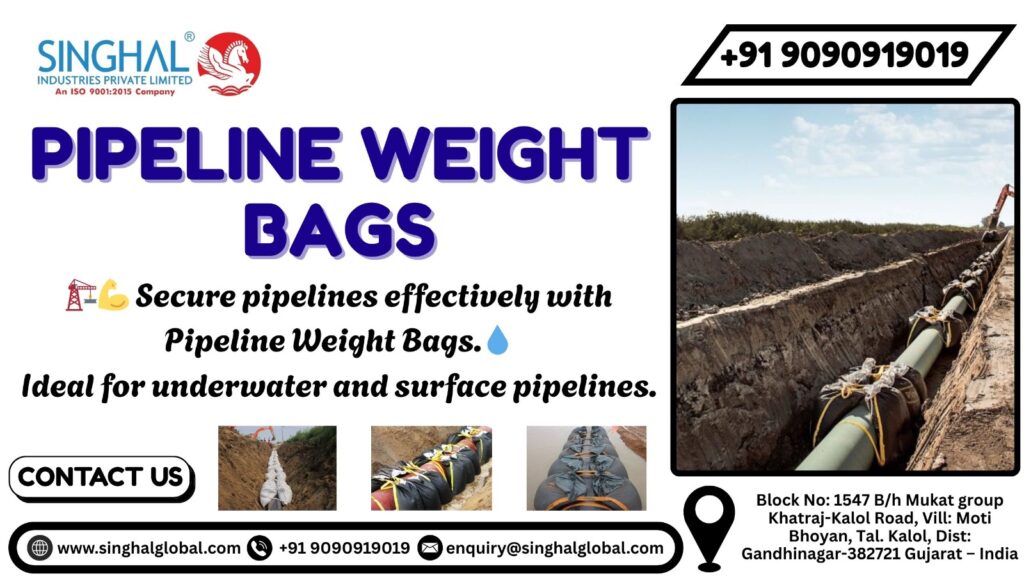
Every time a new pipeline needs to be installed, be it underwater, underground, or across open fields, the question of how to keep the pipeline stable and in place is what immediately comes to mind. Usually, heavy concrete weights were used to solve this problem. But now the situations are different; engineers, contractors, and field teams have been gradually phasing out the use of concrete weights in favor of Pipeline weight bags, and with good reasons.
Their innovative, flexible geotextile pipeline bag weights have done a lot to revive the morale of construction, oil and gas, and water management projects. The reason is that they can be mounted without much effort, their transportation is less expensive, and they are much more resistant to difficult conditions than most people think.
Now, let’s find out what features give pipeline weight bags an edge over their rivals and why they are slowly but surely gaining preference rather than conventional concrete weights.
The Problem with Concrete Weights
For many years, concrete was the backup for the “need to secure the pipelines” question. It is heavy, dependable, and slow to decay. However, the properties it has that once made it a good choice are now the very properties that are causing problems in many modern projects.
Firstly, being large and hard, concrete weights can fracture due to overloading, cause uneven pressure on a pipe, and even wear off the protective coatings. Imagine being in a far-off or marshy place and trying to put down and position some concrete blocks without a machine—you are sure to get very tired, and it is not safe. Also, the transportation of these weights is not without its impediments. Transport costs and fuel consumption go up because of their sheer bulk.
As if that is not enough, in areas where nature is very delicate, concrete can wreak havoc on ecosystems during installation. Further, it becomes almost impossible to remove or change later after it has been placed. Hence, rectifying costs are high when mistakes (which happen) come in the form of errors that are costly.
A Smarter Alternative: Pipeline Weight Bags
Here come pipeline weight bags to save the day. These bags are not packed with concrete, but in open areas, sand, or other aggregates are used for filling them. They are produced from strong geotextile fabric—an elastic, durable material that can repel nature’s elements even if it is handled roughly. Besides, a typical Geotextile pipeline bag weight molds itself around the pipe’s shape, thereby preventing damage to the line from the coating being abraded and strengthening the fixing without the risk of slips.
However, the main reason that makes them indispensable is the fact that they are so simple to operate. They can be easily located, loaded, hoisted, and mounted by workers with minimal assistance and without the use of heavy machinery to increase the number of workers if required. These benefits alone account for the savings of time, the costs of fuel, and labor—all these while the environment is being protected from pollution.
There was a time—and only a professional who knows the scene can attest to it—when an operator could breathe a sigh of relief because of the simplicity of the task. Pipeline weight bags are indeed that kind of breakthrough.
Key Benefits of Pipeline Weight Bags
First of all, let’s leave aside the concrete weights and cabin the pipeline weight bags as the victors of the game. We might not be so far off the mark with the guess that concrete weights are being pushed out of the market by pipeline weight bags.
Lightweight, Flexible, and Easy to Install
Pipeline weight bags are unlike concrete blocks in that they are less rigid and are sent empty and filled locally. Thus, the great flexibility achieved makes the transport much cheaper. You are transporting fabric bags instead of solid concrete pieces. It is a big cost saver no matter if you are covering 50 or 500 miles of distance.
Less Damage to Pipeline Coating
Damage to coating is definitely the engineers’ nightmare—costly and time-consuming. The concrete weights can cause scratching or crushing of the protective coatings, and in the long run, it can result in corrosion or leaks. Contrarily, the flexible construction of the pipeline weight bags helps the weight to be distributed evenly, and the pipe is cushioned, thus kept safe for a long time.
Eco-Friendly and Reusable
Concrete fabrication contributes a great deal to global carbon emissions. Compared to that, the weight bags normally use local material for filling, thereby cutting down the transportation and pollution caused as a result of that. If the areas are environmentally sensitive, such as wetlands, riverbeds, or agricultural zones, then this factor will matter greatly.
Lower Total Project Cost
Usually, contractors get concerned about the price of pipeline weight bags and think they must be quite pricey as they are ‘new tech’. However, the truth is that the overall project cost mostly turns out to be lower. The savings are made from transport (light before filling), machinery (less lifting equipment), and labor (faster setup).
Safer for Workers
Concrete weights are not only hard and unmerciful but also dangerous to workers’ health—a slip is enough to cause serious injuries. The weight bags’ soft and more manageable design approach helps to solve this issue. Workers can operate with smaller tools and fewer heavy lifts, thereby reducing the chances of injury on-site.
Perfect for Challenging Soils or Weather
Are you working on a marshy or unstable piece of land? Concrete blocks can crack, tilt, or sink. Without a doubt, weight bags remain stable even in swampy or coastal soils as they distribute pressure evenly. The geotextile fabric is protected from UV rays and can keep up with temperature changes, thus, it is always ready for long-term use.
Industry Insight: Cost and Longevity
An often-raised question is Pipeline weight bags price. While prices are different depending on the size and material, the majority of suppliers have very competitive prices—especially if you take into account the transport and labor savings.
Moreover, the pipeline bag weights made of geotextile are durable. They are resistant to abrasion, moisture, and chemical attack much more than the general perception is. Over time, though, concrete might be getting weaker, especially if it is placed in salty or acidic soils; good quality geotextile materials will remain almost new for decades.
Maintenance costs are equally important to remember. Once you have put concrete in place, it is a hassle to change it or take it away. Unlike weight bags, they can be changed, taken off, or refilled without any trouble. Over time, this flexibility points to greater control and lower operational expenses.
Conclusion
The transition from concrete to pipeline weight bags is not only about technology—it’s about practical sense. It’s about acknowledging that what was suitable decades ago is not always compatible with today’s requirements.
Concrete has its place, but in a sector where the factors of efficiency, safety, and environmental care are of utmost importance, pipeline weight bags are evidently the better choice. They are strong yet flexible, cheap yet high-performing, and easy yet innovative.
The time you would need, the effort you would put in, and the money you would spend can be saved if you thought of it the next time you are in charge of a pipeline job and are deciding your options (pun intended). Because at times, innovation is not about creating a new wheel—it is simply about replacing the concrete.
Frequently Asked Questions (FAQs)
Q1. Are they available in different sizes?
Yes, pipeline weight bags can be found in various sizes that accommodate different pipe diameters and project requirements. If it is small water lines or large oil pipelines you are working with, producers will make sizes to match your requirements.
Q2. Can they handle harsh weather?
Yes, these are made from a strong geotextile material that is designed to resist solar radiation, freezing temperatures, and even heavy rain.
Q3. Do they work in swampy soil?
Yes, this is one of their main features. In contrast to heavy concrete blocks that usually sink, pipeline weight bags apply the pressure evenly. This stability makes them great for swamp, marsh, and other moisture-rich soils.
Q4. Is there any maintenance required for pipeline weight bags?
Almost none. When they are properly installed, they do not require much attention. It is nice to look at them from time to time, but they are made to stay strong for years without wear or losing their performance.
Q5. Who is the largest manufacture of Pipeline Weight Bags?
Several big manufacturers offer these products worldwide. However, one of the most prominent names in areas like North America and Asia is SIPL, which is famous for providing durable, affordable, and international standard-compliant geotextile pipeline bag weights.