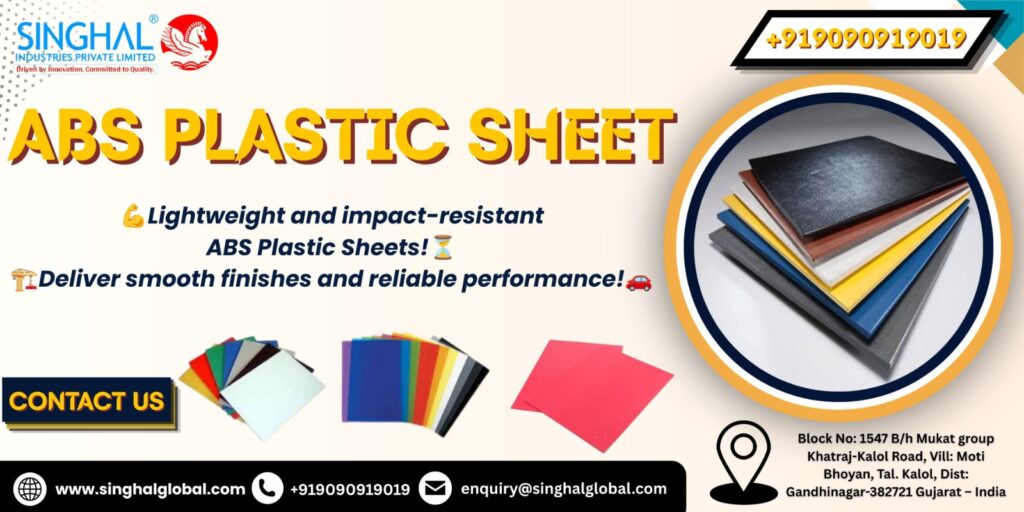
ABS sheets are used extensively in the construction and automotive industries due to their strength, lightweight, and simple to cut into various pieces and panels. ABS plastic sheets assist manufacturers to reduce weight, increase the durability of their products, and provide smooth surfaces in everything from automobile interiors to construction components.
What Are ABS Plastic Sheets?
ABS (Acrylonitrile Butadiene Styrene) is an engineered thermoplastic that is known for its strength, durability as well as its impact resistance and high-quality surface finish. ABS plastic sheets are produced by extruding the polymer into flat panels with various sizes, thicknesses, and colors to meet the requirements of various needs in both buildings and vehicles.
They combine three important characteristics into one product consisting of strength from acrylonitrile toughness from butadiene and the glossy appearance and stiffness of styrene. Due to this balance, ABS sheets are easier to cut, machine and drill as well as thermoform than other rigid plastics, yet providing enough rigidity for semi- and structural uses.
Why ABS Sheets Are Popular in Automotive
In the auto industry, every gram of weight saved can be used to improve fuel efficiency, performance, and emissions control. Sheets of ABS are an ideal choice because they provide excellent impact resistance and are lightweight compared to other metals.
- Panels, trims, and interior trims (dashboards, doors, door panels, consoles, pillar covers).
- Backseats and luggage compartment panels and trunk liner.
- External parts such as mirror housings and wheel arch liner, along with certain body claddings.
Manufacturers choose ABS because it is simple to form by vacuum or thermoform into complex shapes. They then paint or texture it, or even laminate it to give a high-end look. In contrast to brittle plastics, constructed ABS components can withstand everyday knocks, temperature fluctuations, and vibration without cracking rapidly. This is why a lot of ABS sheet producers offer automotive-grade sheets that have specific shades, textures, as well as UV-stabilized grades that are suitable for this type of use.
Use of ABS Sheets in Construction
Construction needs materials that are resistant to impact wear, environmental exposure, but remain cost-effective and easy to set up. ABS plastic sheets satisfy the majority of these requirements, especially in semi-exposed and indoor areas.
- Interior panels and wall claddings in hospitals, commercial buildings, as well as clean rooms.
- Coverings for protection, as well as partition boards and decorative panels.
- Guards for machines, housings with utility, and enclosure panels used in industrial structures.
Since ABS is available with different finishes (matte, shiny, glossy, embossed), engineers and architects can utilize it not just for its durability, but also for aesthetics. It is much easier to cut in place and fix with adhesives or screws and then replace damaged pieces as opposed to the more heavy materials. Certain ABS plastic sheets Suppliers by brands provide UV-resistant and fire-resistant ABS grades that are more suited to the rigors of construction environments.
Key Properties That Make ABS Ideal
Certain fundamental properties are the reason the reason abs sheets of plastic function very well in both automotive and construction
- High Impact Resistance They withstand shocks and abrasions without breaking easily. This is vital for guards, panels and covers.
- Good stiffness and the smallest weight: They keep their shape and rigidity, while being lighter than other metals or other plastics.
- Thermoformability: They are able to be heated to form complicated and curving pieces, which will then retain the shape when they cool.
- Surface that is smooth and paintable Surfaces is able to be painted, printed or laminated to help to achieve branding and aesthetic objectives.
- Stability of dimension: These maintain their size and shape in the normal range of temperatures for service.
This lets designers replace heavy multi-part assemblies by one ABS component which reduces assembly time and cost.
How ABS Sheets Compare to Other Plastic Sheets
ABS generally falls in the middle of efficiency and cost:
- In comparison against acrylics, ABS is typically stronger and less brittle even though acrylic is more clear and resistant to scratches.
- Comparatively with PVC, ABS usually has higher impact strength, and it is easier to paint or finish, in contrast, PVC might have superior fire and chemical resistance in certain formulas.
- In comparison to polycarbonate ABS is more affordable and easy to melt, whereas polycarbonate is more durable and heat-resistant.
This balance is one reason that the majority of ABS plastic sheet manufacturer companies maintain ABS as a primary material in which transparency is not required however toughness, formability and the finish are crucial.
Processing and Fabrication: Why Industry Loves ABS
From that point of perspective, ABS is easy to use. It could be:
- Cut using regular saws, routers, as well as CNC machines.
- Drilled and fastened without cracking when handled properly.
- Adhesive that is suitable for the glue or welded using plastic welding methods.
- Vacuum formed or thermoformed to deep-draw designs for construction and automotive components.
Applications Across Both Automotive and Construction
Certain applications can be a good fit between these two sectors:
- Guards for machines and covers to protect them in workshops that repair vehicles as well as in construction facilities.
- Control boxes, utility panels, enclosures, and control boxes that are used in both car plants as well as building services.
- Display boards, signage, and brand-name panels employed in service centers, showrooms, as well as construction sites.
Conclusion
ABS sheet manufacturers typically provide sheets in standard sizes such as 5×10 or 4×8 feet and in thicknesses of less than 1 mm to several millimeters, providing designers the ability to create their own designs. Texturing on the surface (like leather grains for interiors of cars or embossed designs on wall panels) is possible to incorporate into the sheet during production.
Since the same sheet stock and material can serve different industries, ABS sheet producers and distributors can serve an extensive clientele with a range of products that are fairly standard and can then customize the thickness, color, and even the finish if required.
Frequently Asked Questions (FAQs)
Q1. What’s the main difference in ABS or acrylic sheets?
ABS sheets are more durable and more resistant to impact, making them ideal for components that are likely to be struck or stretched, whereas acrylic sheets are more transparent and scratch-resistant. They are generally used when transparency and a glass-like appearance are essential. In short, ABS wins for strength and formability, while acrylic is a winner for its clarity and visual appeal.
Q2. What is the cost of ABS sheets of plastic from India?
The cost of sheets of ABS plastic in India differs widely based on the thickness, size color, grade and the brand, however generally speaking, the price is stated by kilograms or sheets and it is possible to vary from low-cost industrial grade to more expensive specialized sheets for fire-retardant or automotive use It is therefore recommended to inquire with local abs sheet suppliers or abs sheets makers for current, exact prices.
Q3. What are the benefits from ABS sheets?
Abs plastic sheets provide excellent impact strength, high stiffness and low weight, and easy thermoforming. They also provide an attractive and smooth appearance that may be printed or painted as well as a decent temperature and chemical resistance for everyday use as well as simple fabrication and machining. These makes them a flexible material for construction, automotive, and a variety of other industries.
Q4. Are ABS sheets suitable in vacuum-forming?
Absolutely, ABS sheets are widely utilized for vacuum-forming since they are able to soften when heated to low temperatures, and stretch easily into intricate moulds, they are then molded into rigid forms. Which are tough, and so many of the automotive interior parts such as equipment covers,, and construction panels are made using ABS.
Q5. Who is the largest manufacture of ABS Plastic Sheets?
There is Singhal Industries Private Limited is an widely accepted “largest” producer of ABS sheets as many international and regional companies manufacture sheets, and their rankings fluctuate depending on the time of year and the region So the best way to go is to search for reputable Plastic sheets manufacturer or ABS sheet Manufacturers with high capacity with quality certifications, as well as an export capabilities in your desired market.