Agriculture crates could be considered a minute detail in the whole farming and supply chain process, but those crates silently determine how much of the produce stays fresh till it reaches the market, how much space is utilized in the trucks, and even how much money is saved or wasted. For quite a number of farmers and traders, the change from traditional wooden or fixed plastic boxes to Foldable and collapsible crates seems almost like the transition from a simple phone to a smartphone – same function, but a huge difference in ease and efficiency.
Presented below is an in-depth, human-style blog on “Agriculture Crates: Foldable and Collapsible Uses & Benefits” incorporating the keywords and FAQs you requested.
Why Agriculture Needs Smarter Crates
In agriculture, the stakes are high, while the powers are thin. A single unfortunate shipment or a bunch of spoiled vegetables can cause the farmers to lose all their earnings from the past week. The farmers, traders, and wholesalers are continually battling against three invisible foes:
- Wasted space in trucks and warehouses
- Product damage during loading and transport
- Increasing logistics and packaging costs
On one hand, traditional wooden boxes, bamboo baskets, or rigid plastic crates were providing some help; however, on the other hand, they were also causing new problems. Those boxes occupied the same amount of space whether they were full or empty, were heavy and difficult to handle, and were often the cause of damage to the fruits and vegetables that were of a delicate nature. A lot of people saw this as “just the way things are” — until Foldable and collapsible crates came into widespread usage. Nowadays, when you enter a large mandi, a collection center, or a cold storage, you will be able to notice the organized piles of plastic crates, some are fully loaded with products, while others are folded flat like planks. That one simple folding feature is what changes the whole game.
What Are Foldable and Collapsible Agriculture Crates?
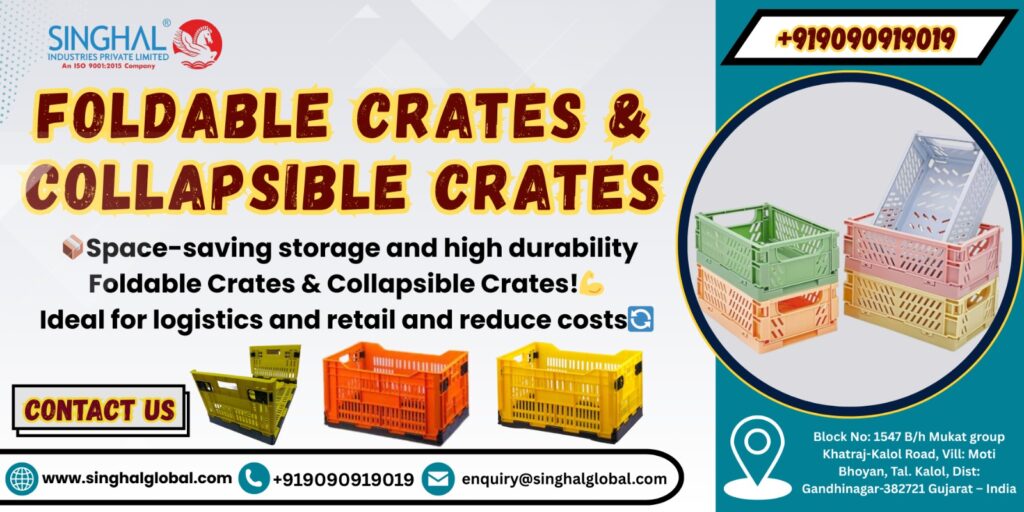
Foldable agriculture crates are plastic crates (most often made of durable polymers such as HDPE or PP) which have sidewalls that can fold inwards, thus enabling the crate to be converted into a flat or nearly flat form when the crate is empty. The same crate, of course, can be taken out and unfolded within a few seconds and then used again.
The characteristics of these crates normally consist of:
- A strong but light plastic body
- The side and bottom parts made of the crate are perforated to allow fresh air to come in and keep the stored products fresh
- Stacking the crates safely is ensured by the edges of the crates which can be connected to one another
- The crate’s walls can be folded or unfolded with the help of the hinges
On the one hand, these crates function as normal ones, and on the other hand, when they are out of use, they turn into slim pieces, which take up minimal space. Just for this reason alone, they are highly desirable in the agricultural sector where there is a sudden increase in the number of crates during the peak seasons, whereas there is a huge number of empty crates during the off-seasons.
Where Foldable Crates Shine in Agriculture
Farm to Market
Foldable crates are with the produce all the way from harvesting in the fields to loading in trucks and unloading at markets:
- Keep produce safe
- Allow easy stacking
- Foldable crates can be stacked one on top of the other more easily than baskets or jute bags as well as they help to conserve space, which is a critical factor of transportation and trading.
- Handle rough handling better than baskets or sacks
For fruits and vegetables like tomatoes, okra, cucumbers, grapes, mangoes, pomegranates, and leafy greens, these crates provide a far better alternative than jute bags or loose heaps.
Cold Chain and Storage
In cold rooms or controlled atmosphere storages:
- Consistent crate sizes help with better stacking and air circulation
- Foldable crates can be collapsed during off-season, freeing up precious space
- Standard-sized crates for onion, potato, apple, and other stored crops make inventory management and palletization more organized.
Retail Display and Back-End Logistics
Most of the modern retail stores get their fruits and vegetables transported by foldable crates. Usually, the stores:
- Display the produce in the same crate
- Collapse it once empty
- Send it back easily for reuse
This is a very big efficiency step for large retail chains, where the combined efficiency gain is huge.
Beyond Agriculture: Wider Uses
Although the main point of this article is agriculture, it is impossible to deny that these crates are now widely used in:
- Food processing units
- Dairy and bakery distribution
- Pharmaceutical and chemical logistics
- E-commerce and warehousing
- Automotive components and spare parts
This wider range of demand is precisely the reason why a large number of Foldable crate manufacturers in India are present, catering to both farm and non-farm sectors.
About Foldable Crate Manufacturers and Pricing in India
India has turned out to be a strong center for plastic logistics products, foldable crates inclusive. Foldable crate manufacturers in India vary from big industrial brands that supply FMCG, retail, and auto sectors, to more agriculture-oriented companies that target mandis, FPOs, and cooperatives.
Major Points of the Foldable Crate Price in India
- The pricing varies according to the size, design, plastic quality, and weight-bearing capacity of the crate.
- Bigger crates with higher weight capacity and better mechanisms are costlier.
- Bulk purchase (for FPOs, cooperatives, big traders) can reduce the per-unit price to a great extent.
- At the beginning, a lot of farmers share or rent crates, but after they experience the benefits, they buy crates of their own.
Conclusion
Agriculture is full of big problems: climate, prices, pests, water, and soil. A simple crate, in front of these, might seem insignificant. Still, when a farmer loses less produce in transit, saves a bit on transport, stores better, and keeps operations neater, that “small” change directly touches income and peace of mind.
Foldable and collapsible agriculture crates may not be perfect. They require a higher initial investment and a change of mindset. Yet, the majority of those who have switched consider them a silent revolution — not loud, not flashy, but very real. And sometimes, that is exactly the kind of progress that lasts.
Frequently Asked Questions (FAQ)
Q1. What kind of industries are known for the regular use of collapsible crates?
Firstly, the agricultural sector is the primary consumer of collapsible crates for the transport of fruits, vegetables, flowers, and plants from the nursery. After that, these crates have found extensive application in retail, food processing, warehousing, automotive parts, dairy, and the e-commerce back-end industry.
Q2. Are foldable crates stackable in a safe manner?
Absolutely, the majority of foldable crates have been designed with interlocks or ribs on their edges that stabilize the stacking of open and loaded crates. The stacks of good quality racks can be made high without the risk of falling, provided the weight limits and stacking heights allowed are observed. The security of the stack also depends on the equal distribution of the load and the ground being even.
Q3. Can the size of these crates be changed as per the customer’s needs?
Foldable Crate Manufacturers in India often provide standard sizes; however, for large orders they offer customized dimensions, colors, branding and even features such as barcodes or label holders to help lower costs. Standard sizes tend to be chosen for smaller orders to keep prices under control.
Q4. How many kilos can you put in a folding crate?
The maximum weight that a crate can hold should refer to the most extreme situation under which a crate will still be able to function without breaking. Thus, the limit is often set for the worst-case scenario when a collapsible crate is made of the thinnest material or is of the smallest size. The range of weight that a crate could carry varies between 20 and 200 kilos. Variations in the maximum supported weight depend on the size of the crate, the features of the materials used to make the crate and the application of the crates. Heavy-duty industrial crates usually can hold weight up to 25-40 kg or even more
Q5. Who is the largest manufacturer of foldable crates?
Singhal Industries Pvt ltd is one globally known company that dominates all regions. Different markets have their own local leaders. Their influence and market share can be different from one region and sector to another.