Container liners are among the things that people don’t think about, yet industries depend on them day after day. From food grains to minerals and chemicals, these liners safeguard products from contamination and help reduce costs associated with transportation. But many buyers are confused by the different types, applications, and something even as simple as the cost of a container liner, that can lead to making the wrong choice or paying too much. Here is a thorough blog-style, simple-to-read guide to “Container Liners for Food-Grade and Industrial Applications” that includes the necessary keywords, various sentence structures with a little informality and, yes, some natural contradictions and questions thrown into.
What are Container Liners?
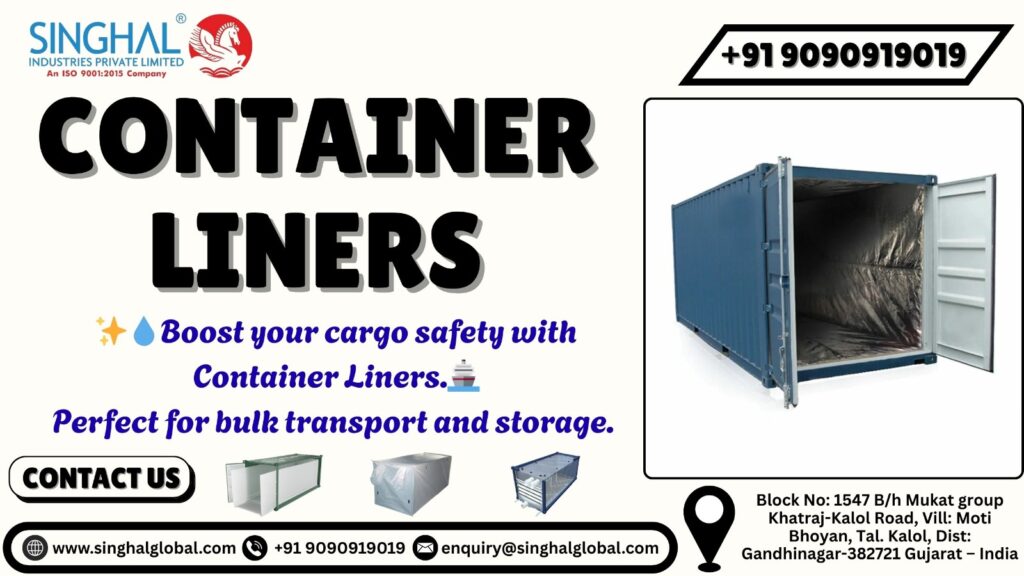
Container liners are big protective sleeves, also known as “bags,” that are used to line the interior of transport containers or rail wagons to carry large quantities of goods safely. They are used to create a temporary interior wall to ensure that the items do not touch directly the container surface, which prevents dust, moisture, and rust particles, as well as chemical residues from getting into the container and contaminating it.
Instead of utilizing hundreds of smaller drums or bags, one large liner can transform a whole container into a tidy bulk packaging system that is sealed, particularly when it is supplied by skilled Container liner manufacturers in India and elsewhere. This is precisely the reason why bulk importers and exporters seek out reputable container liner makers before even discussing freight costs.
Food-Grade Container Liners
Food-grade containers are designed to transport dry food items such as rice, wheat, and sugar, as well as pulses, coffee, cocoa, and similar items in a safe manner across large distances. They are typically produced from virgin, food-contact-approved polyethylene (PE) or polypropylene (PP) materials and follow strict hygiene and safety standards such as FDA or ISO-based food safety systems.
These liners protect food from sweat, condensation from the container, dust, and other pests, drastically reducing the chance of contamination when you take long journeys on the ocean or by road. But are they really perfect? Not necessarily. If you select the wrong style or do not follow correct sealing procedures, the most effective food-grade liner will still let moisture pockets or caking of the product. Therefore, buying container liners directly from manufacturers isn’t enough. Choosing the correct configuration is crucial.
Industrial-Grade Container Liners
Industrial applications usually involve minerals, chemicals, as well as fertilizers, resins, plastic granules, and dangerous or sensitive powders. To handle such loads, container liners are made with superior mechanical strength, often anti-static or conductive properties, as well as better resistance to abrasion, chemicals, and moisture.
They could be normal aluminum, safety-type, thermally or conductive, based on the type of cargo to be filled. For instance, conductive liners are utilized for transporting explosive powders or sugar dust, in which static sparks can be hazardous. Therefore, while food-grade liners are focused on purity and cleanliness, industrial-grade liners are focused equally upon safety, control, and the efficiency of handling.
Container Liners of Various Types
Different cargoes require different liners. Here are a few common kinds that Container liner manufacturers in India and around the world typically provide:
- The standard liners are for dry bulk granules as well as powders (plastic grains, pellets, sugar).
- Liners made of aluminum or metalized to provide better water and odor management, commonly used for hygroscopic and scent-sensitive products.
- Thermal liners to manage temperature fluctuations for products like beverages, wine, or temperature-sensitive food items.
- Heavy-duty or safety liners for hard, sharp, or high-density substances like scrap, minerals, or ores.
- Anti-static or conductive liners that are used in conjunction with explosive or flammable powders, chemical compounds, and fine sugar in situations where static discharge could be a risk.
It’s funny how buyers often over-specify. They might ask for premium thermal liners when a basic liner with a moisture barrier would be sufficient. However, some people under-specify, using thin mineral liners for rough loads, and then result in tears. This different way of doing things is not uncommon, but it occurs every day.
Manufacturers of Container Liners in India
India is now a major center for manufacturing liners due to its robust polymer and textile industries. Numerous Container liner manufacturers in India provide a variety of liner options that include food-grade, mineral, and chemical liners, as well as FIBC (jumbo) bags and flexible tanks.
Export-oriented manufacturers generally adhere to international standards, incorporate cleanroom-like production zones in food-contact liner production, and offer complete documentation to ensure tracking and compliance. When choosing manufacturers of container liners, it is advisable to request the test results, certificates, and references from other similar industries, rather than looking at brochures.
Understanding Container Liner Price
Discussing the Container liner price is difficult because there is no one “standard” price. It is contingent on:
- Fabrics or films (PE, aluminum-laminated, PP, etc.).
- The strength and thickness requirements for the particular product as well as the density.
- Special properties such as anti-static, thermal barrier, conductivity, and oxygen barrier.
- Dimensions and design: Containers of 20 or 40 feet filled with an open top, ending-fill, and without baffles.
- Quantity of orders and locations of the container liner manufacturer.
Due to these factors, buyers often see large prices and believe that lower quality is “low in quality.” It’s not always the case. Some suppliers offer the simplest liner, and another one has added premium materials or added features. The best way to do this is to examine liner specifications side by side and also the Container liner price instead of asking, “How much is it per piece?”
Where Do Container Liners Get Their Use?
Container liners have quietly escaped into virtually every bulk-handling industry:
- Agriculture: Seeds, grains, and animal feeds, fertilizers.
- Food & beverage: Sugar, cocoa, coffee beans, rice, flour, dried ingredients.
- Chemicals: Resins, pellets, powders, additives.
- Minerals & mining: Ores, concentrates, mineral sands, cement.
- Waste and recycling: Some bulk recyclable materials and non-hazardous garbage.
They are not only meant for large multinationals? Not at all. SME owners can also benefit from switching from small bags to liners, particularly when it comes to regular export shipments.
A Short Note About Sustainability
There’s a little contradiction in this. On one hand, container liners are made of plastic, which raises environmental issues. However, they can reduce packaging waste, as well as reduce the risk of spoilage for products and minimize food loss, which is a significant sustainable benefit. Many manufacturers of container liners are now offering recyclable materials, which are thinner but more durable films, as well as designs that create less waste after each use. There are even biodegradable and compostable solutions; however, these are developing and must satisfy security and performance standards first.
Conclusion
The flexible protective packaging could be almost unnoticed; however, for industrial and food-grade uses, containers are frequently the key to determining the difference between a clean and profitable package as opposed to a rejected, contaminated one. That’s why choosing the best design, the most appropriate manufacturer of container liners, and the most appropriate cost for the container liner isn’t an investment; it’s a method of achieving.
Frequently Asked Questions (FAQs)
Q1. What kind of container liners are available?
There are standard liners for dry bulk products, aluminum or metalized liners for high moisture or odor control, thermal liners for temperature-sensitive goods, safety or heavy-duty liners for sharp or dense cargo, and anti-static or conductive liners for explosive or sensitive powders. A few Container liner manufacturers in India also offer custom-designed forms, baffles, a variety of spills, and custom-designed discharge and filling systems to meet specific requirements.
Q2. Are containers suitable for food-grade items?
Yes, container liners are widely used for food-grade products like wheat, rice, pulses, sugar, coffee, and similar dry ingredients, provided they are made from certified, food-contact-approved materials and produced under hygiene-controlled conditions. Food-grade liners can help avoid contamination, minimize spoilage, and ensure compliance with food safety standards and regulations.
Q3. Can containers be branded or printed?
In most cases, there is a possibility. Based on the material as well as the manufacturing method, containers can have logos printed, instructions for handling, product identifiers, as well as branding elements. However, the use of heavy printing or dark inks might not be the best choice for applications that require strict food safety. It is therefore recommended to discuss your options with the Container liner manufacturers prior to making a decision.
Q4. How do container liners compare with bulk bags?
Container liners transform an entire container into one large, flexible container that is ideal for large loads that are uniform and efficient for loading and unloading. Bulk bags (FIBCs) split the load into smaller units. They may be easier to manage in isolation, but they may require greater packaging materials, more manual work, and, in some cases, the cost of logistics is higher. In reality, many businesses utilize both: liners for bulk deliveries over long distances and FIBCs to distribute smaller orders.
Q5. Who is the largest exporter of container liners?
The global market has a variety of important exporters from areas such as India, China, and parts of Europe, and one of them, the “largest” exporter, could fluctuate over time, based on demand and capacity. Numerous Container liner manufacturers in India are important exporters and supply liner containers for food, chemicals, and minerals around the world, which is why buyers usually begin their search for suppliers within the Indian market before comparing alternatives and Container liner price.