Container liners have become one of the major factors supporting the transformation of the agricultural world, without making much noise. They promote the safe and efficient transportation and storage of the products. No matter if you are a farmer shipping rice from Punjab, a trader transporting pulses from one state to another, or an exporter sending dry fruits to global markets, container liners are the silent helpers that can keep your products fresh, free from moisture, and hygienic. This article is our way of unraveling the structural and functional aspects of these liners, their importance, and the things that you must know before making a choice that suits your needs. Besides that, we will also talk about the practical experiences, the common doubts, and the latest trends in the industry.
What Are Container Liners?
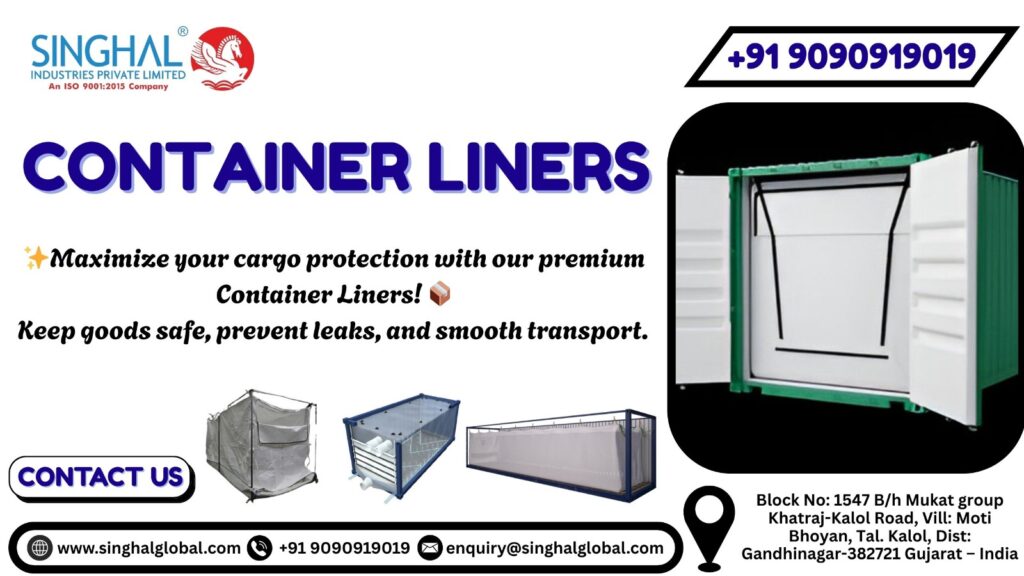
Container liners are the large elastic bags made of polyethylene (PE) or polypropylene (PP), which are placed inside the containers, trucks, or railcars. Their principal role is to create a protective layer between the cargo and the container walls, thus protecting the area from moisture, dust, pests, and any other type of contamination. In the farming industry, these sacks have become the carriers of a wide range of products that include grains, seeds, pulses, dry fruits, and even chemicals.
For instance, imagine that you are the one responsible for sending wheat from the farm in Haryana to the port in Mumbai. If the container is not equipped with a liner, the wheat is very likely to absorb moisture from the air, which will eventually lead to mold and rot. On the other hand, with a liner, the wheat will be kept dry and fresh, thus ensuring that it gets to the destination in the best possible condition. Such a simple solution has revolutionized the transport of agro-products, thus making it safer and more accessible to farmers and traders.
Why Container Liners Matter in Agriculture
Keeping Produce Fresh
Agriculture’s number one problem is to ensure that the products maintain their freshness when they are being transported over long distances. Container liners serve as moisture barriers, blocking water from entering the cargo and causing it to rot. This issue is particularly critical for grains and pulses, which are highly susceptible to mold and bacteria that thrive in moist conditions.
Just to illustrate, a rice farmer in Uttar Pradesh told us about how he kept losing large amounts of rice because of moisture that was causing the rice to spoil during the transport. After the introduction of container liners, he saw a great improvement in the quality of his shipments. The rice was transported to the market in good condition, without any moisture-induced mold, and as a result, he was able to get higher prices and have more customers satisfied.
Preventing Contamination
One of the problems that contaminate the agricultural supply chain is contamination. Contamination-causing particles like dust, pests, and that kind of pollutants can easily get into unsealed containers, thus lowering the quality of the products. In addition, containers that have liners are the perfect place to keep these unwanted elements away, thus the commodities remain clean and safe for delivery.
A trader from Gujarat, shared how his trade was declining due to losses caused by pests in pulse consignments and how it was very difficult for him to solve this problem until they put container liners. Accordingly, through the use of container liners, he found that pest-related losses had gone down to a great extent. Liners didn’t only keep pests out but also facilitated checking the containers between the shipments and cleaning them.
Enhancing Efficiency
Moreover, container liners very much facilitate the loading and unloading operations. Traditionally, it is usually done in a way that sacks or bags are stuffed into the containers, which is a slow and hard work process. Because of container liners, products can be brought in directly to the liner from the container, thus the whole operation of loading and unloading becomes less time-consuming and hardwork.
The head of logistics in the Indian state of Maharashtra recounted how container liners transformed his workflow. The time spent coordinating the loading of bags into containers was so great that he now uses only a fraction of that time to fill a container. This has resulted in reduced labor costs and improved produce safekeeping during handling.
Choosing the Right Container Liner
Size and Capacity
The question which is asked more than others is the way of choosing the right size container liner. In order to get a perfect fit, it is recommended to size the liner based on the container dimensions. Containers that are used for transportation by the sea have their standard lengths which are either 20 or 40 feet. So, the liners are made in different sizes to fit those containers.
Take a 20-foot container for instance, a liner of around 6 meters in length, 2.4 meters in width, and 2.4 meters in height would be enough to provide that container. On the other hand, a 40-foot container needs a liner of about 12 meters in length, 2.4 meters in width, and 2.4 meters in height. Make sure that you get the exact measurements of your container and then pick a liner that fits you perfectly so that there won’t be any parts that are not covered or the material doesn’t get wrinkled.
Material and Strength
What’s more, the factor determining the choice of the material for the liner is of utmost importance. Polyethylene (PE) liners are counted good as they are water-resistant and strong, while polypropylene (PP) liners are given credits for their firmness and stretching ability. Most of the time, the material used for the cargo will be the determining factor of the transport mode and the destination.
In a case where the cargo is made up of heavy items like grains or minerals, one should guarantee that the liner is of a high tensile strength so as to avoid tearing and puncturing. There are some Container liner manufacturers who go beyond and beyond in certain models by providing extra layers or webbing for complete consumer security. Such kinds of liners have a carrying capacity that reaches 21 tons, thus, they are meant for bulk products transportation.
Customization Options
Many Container liner manufacturers in India offer the opportunity to customize your liner. You can alter almost anything from thickness and color to the addition of features like discharge spouts or valves for easier unloading. Customized liners may also be designed to fit non-standard containers or to support specific loading and unloading systems.
For example, a company in Delhi needed a liner equipped with a discharge spout for their bulk chemical shipments. They searched for a container liner manufacturers in Delhi, approached him with a request, and he provided a custom solution that perfectly met their needs.
Container Liner Price in India
There are considerable variables that impact the Container liner price in India such as size, material, thickness, and customization availability. Typically, the price of the standard liners ranges between ₹1,600 and ₹4,000 while a reinforcement or a custom-made liner may cost more.
Weighing the case of a 21-ton dry bulk container liner at a price of around ₹1,950, and a heavy-duty with extra features at a starting price of ₹3,000, which one to go for is thus a question of decision. Also, before making a purchase, you should perform a vendor price and quality comparison as well as take into consideration the lifespan of the liner.
Factors Affecting Price
- Size and Capacity: The price for a 40-foot container liner will definitely be double that of a 20-foot one.
- Material and Thickness: The price of a PE or PP liner of good quality and considerable thickness will be higher but will offer better protection.
- Customization: Custom-made products, such as a discharge spout or stitched and reinforced seams, will cost more than the regular products.
- Quantity: Buying in large quantities often results in discounts, making it less expensive per unit.
Conclusion
Container liner is an excellent addition to the agricultural supply chain that can help farmers, traders, and logistics managers to keep their products fresh, safe, and free from contamination. By making the right decision as to the size, material, and vendor of the liner, you can be sure that your goods will be delivered in good condition, thus lessening the losses and increasing the customer satisfaction level. If you are dealing in the transport of grains, pulses, dry fruits, or chemicals, container liners will be a cost-effective and useful way to facilitate the growth of agriculture.
Frequently Asked Questions (FAQs)
Q1. How do I pick the right container liner size?
Picking the right container liner size is basically the key to a perfect fit and ultimate protection. First and foremost, you should measure the container accurately and get the liner that matches its measurements. There are pre-set sizes of liners for 20-foot and 40-foot containers but if your container is of an unusual size, you can get a custom size made.
Q2. Are container liners strong enough for heavy loads?
Yes, container liners are capable of carrying heavy weights and certain types of reinforced liners may hold up to 21 tons. Nevertheless, if you are transporting grain, minerals, or chemicals in bulk, it is necessary that you choose a liner with high tensile strength and that has extra reinforcement to prevent tearing or puncturing.
Q3. Do container liners pose any risk to food products?
Surely, container liners are an ideal solution for the hygienic transport of food products like grains, pulses, and nuts. Food-grade liners are made of materials that are safe for direct food contact and thus provide the prevention of contamination and food spoilage. Moreover, they are simple to clean and allow easy inspection, which are the reasons why they are widely used in the agricultural and food processing industries.
Q4. Is it possible to use container liners for chemicals?
Certainly, container liners are used as a means of transporting chemicals if such are manufactured from substances that can bear the specific chemicals to be shipped without any reaction. Chemical-grade liners come with resistance to chemical reactions and they also serve as equipment that prevents contamination thus ensuring that the cargo is safe and intact.
Q5. Who is the largest supplier of container liners?
With a wide reach in big industrial cities, Jet Tech Pvt. Ltd. is a distinguished name among container liner suppliers in India and it is known for quality and on-time service. Moreover, Singhal Industries Pvt. Ltd. and Bulk Packaging Liners Pvt. Ltd., are some of the other prominent suppliers of container liners.