In today’s fast-paced business world, packaging is often undervalued. But consider this: What is the protection offered by the products we use on a daily basis before they get to us? From the rice that you prepare in the kitchen to industrial chemicals kept in secure warehouses, packaging plays a hidden but significant function. There are a myriad of options to choose from; HDPE bags (High-Density Polyethylene bags) are quietly becoming the basis in modern solutions for packaging across all industries and countries.
When you get a hold of an HDPE bag, it is light but sturdy. It’s thin, but almost unbreakable. This is the appeal of the latest material science! This is precisely why companies, whether they are in agriculture, retail, manufacturing, logistics, or manufacturing, can rely on HDPE bags like a trusted friend that never disappoints and is durable, cost-effective, and simple to handle.
Understanding HDPE Bags
The Science of HDPE Bags: The Basic Facts Behind Their Power
Let’s begin with the fundamentals. It’s a member of the family known as polyethylene and is famous for its superior strength-to-density ratio. It is the primary ingredient behind the durable, water-resistant, and adaptable HDPE bags that we see in the present.
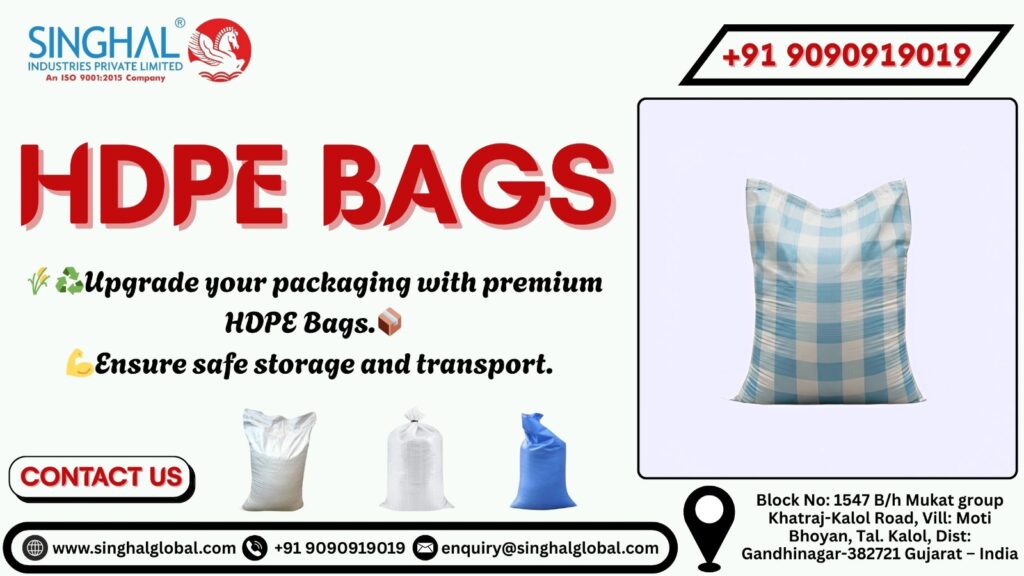
In contrast to the plastic alternatives that are thin and break under pressure, HDPE bags are constructed to last and also to safeguard. They are used extensively to store sugar, grains, fertilizers, industrial chemicals, grocery items, as well as construction materials. Their unique molecular structure provides the material rigidity but does not sacrifice flexibility – it’s a difficult balance to attain.
In simple terms, HDPE bags are lightweight and aces of the field. They are able to carry large loads, withstand harsh environments, and remain recyclable. Imagine how many businesses depend on something so simple and efficient!
The Reasons Why Businesses Across the Globe Trust HDPE Bags
Let’s make it more personal. Imagine that you run a small store for agricultural supplies in Hyderabad. You offer lentils and rice in large quantities. Would you be willing to put your products’ safety at risk just for the sake of saving a couple of dollars on plastic bags that are thin and cheap? Most likely no. Because if a packaging bag is damaged during transportation, there’s more than only the product that is damaged, but your brand’s reputation that gets damaged too. This is why the HDPE bag manufacturers in Hyderabad are already there to offer solutions to these problems through the provision of durable and affordable packaging that is secure.
That is why many contemporary companies use HDPE bags throughout the world:
- Durability and strength: These bags can handle an appalling weight without rupturing or distending.
- protective against moisture: Perfectly suitable in products that have to stay dry – such as chemical powder to foodstuffs.
- Quality bags: HDPE bags are cheap and have a longer shelf life. The HDPE bags price of per kg is competitive and the bags are applicable to the large company as well as small business.
- Sustainability: Many of them can be recycled 100 percent. They are also reusable and hence, reduce the effect that they have in the environment under their responsible usage.
- Personalization: Companies are able to print their logos, branding details or managing instructions directly onto bags.
The Indian Contribute in Global Supply by Indian Manufacturers
India has proved to be a significant player in the production of HDPE bags. With the advancement of technology and better production control techniques, HDPE bags manufacturers in Hyderabad, Ahmedabad, and Kolkata are now exporting their products to several countries across Asia, Africa, and Europe.
Specifically, HDPE bags manufacturers in Hyderabad are finding acceptance in producing high-quality bags that are well-balanced concerning the aesthetics and the strength. The manufacturing plants in Hyderabad have state-of-the-art extruders, printer machines, and lamination machines that are internationally recognized when it comes to packing.
Environmental Impact
The Environmental Side: Are HDPE Bags Really Eco-Friendly?
The issue often causes controversy. However, let’s face it: the truth is much more complicated. In contrast to single-use plastic bags, HDPE bags are durable and can be reused. Many companies are now encouraging customers to recycle or reuse the bags.
It is not so good, but it is a giant step towards the right direction compared with the disposable variants which are thrown away like garbage after having been used once. It is a fact to say that HDPE bags are not as environmentally friendly as jute and cloth bags; in terms of life cycle and longevity, HDPE bags generate less waste in the end.
Innovations in Packaging: HDPE Bags for the Future
Technology isn’t slowing down, not even when it comes to packaging. Certain companies are now manufacturing hybrid HDPE bags containing organic ingredients to speed up the process of decomposition.
Companies can now display high-definition logos, designs, and images directly on HDPE surfaces without compromising the quality of the bag. This makes brands appear more professional and polished.
An Insight into the HDPE Bags Price and the Market Scope
The Hdpe bags price per kg is subject to change according to a number of variables in the economic side:
- Weight and thickness of material.
- Lamination and printing requirements.
- Minimum order quantities.
- Services and location demand on the market.
At present, the price in India generally ranges from around Rs 80-120 per kg, based on the quality. Prices fluctuate based on the cost of raw materials, but HDPE still offers a good performance-to-price ratio when compared with alternatives like jute, paper, or LDPE. This stability in price ensures HDPE packaging as the preferred option for a variety of growing industries, including food processing, construction, and textiles.
Conclusion
The HDPE bag, at the bottom of all the day’s work, symbolizes something more than packaging. They represent the trust between manufacturers and consumers, as well as between products and protection. In a culture that’s constantly looking for new innovations, sometimes the quiet, steady heroes such as HDPE bags merit the spotlight.
No matter if you’re a shopkeeper in India, an exporter based in Dubai, or a logistics supplier in Africa, there’s HDPE packaging that stands tall, reliable, cost-effective, and ready for the business world of today.
Frequently Asked Questions(FAQs)
Q1. What are the numbers of sizes that HDPE bags can be bought?
HDPE bags come with the choice of size, some as small carry bags that can be utilized in the store to massive mesh bags that are applicable in packing 50 kg as well as 100 kg of material. The sizes will increase or decrease according to the needs of the business.
Q2. Are HDPE bags suitable to be used in industrial packing?
Absolutely. HDPE bags apply in the industrial products of fertilizers, cement, salt and chemicals, and cement. The tensile strength and moisture resistance makes them ideal to use in heavy duty works.
Q3. Can HDPE bags also be printed?
Yes, they can. The HDPE bag manufacturers in the present day have multi-color printing that gives you a chance to print logos and brand names and deal with directions and other important details about the product. It is a highly favored alternative to market the brand.
Q4. What are the differences between HDPE bags and LDPE bags?
The primary difference is in strength and density. HDPE bags are much more durable, rigid, and less stretchy in comparison to LDPE (Low-Density Polyethylene) bags. Bags made of LDPE, in contrast, are soft and more flexible, making them ideal for lighter items or for smaller packaging requirements.
Q5. Who is the largest exporter of HDPE bags?
Singhal Industries Pvt Ltd is the top exporter of HDPE bags in the world, with Hyderabad, Gujarat, and Tamil Nadu being key production hubs. Indian manufacturers provide high-quality products at cheap prices, as well as large capacity production that serves the world’s markets.