As cities become underground, with increasing communications and power, HDPE duct spacers are gradually growing to become one of the key elements in modern-day cable management. They may appear like simple plastic frames; however, they play a significant part in the way cables are laid, as well as pulled and maintained within banks of ducts. It doesn’t matter if you’re involved in a metro project, a telecom corridor, or a large-scale power distribution trench; choosing the appropriate HDPE spacers for ducts can help cut down on time, decrease friction, and shield costly cables from damage. We’ll take a look at how these spacers function, what they do, and what to bear in mind when considering Duct spacer price, as well as suppliers, such as HDPE Duct Spacers Exporter in India.
What are HDPE Spacers for Ducts?
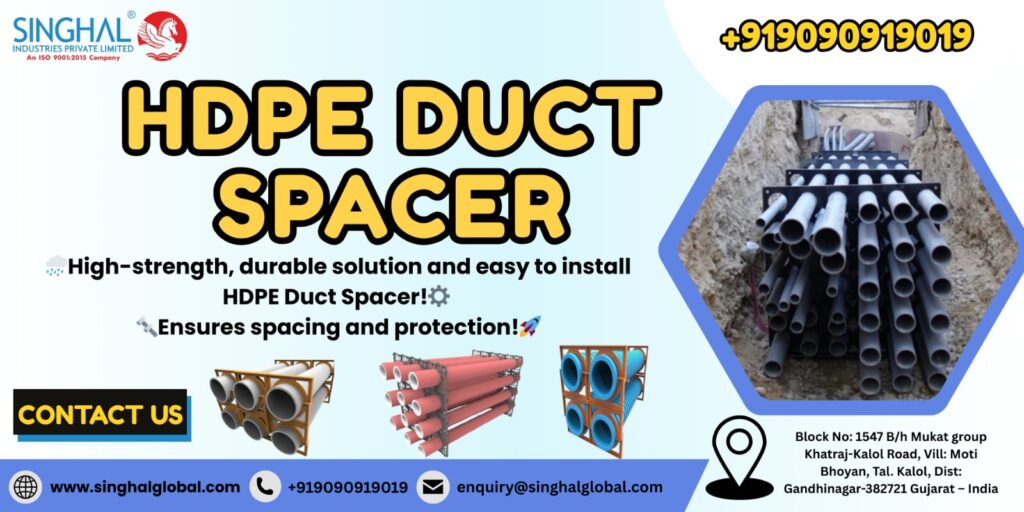
HDPE duct spacers weigh less than modular frames constructed from HDPE, a high-density polyethylene (HDPE) that is placed between ducts or underground conduits in trenches. Their primary function is to ensure that ducts remain perfectly spaced and aligned in a duct bank, so that each duct has a distinct path to pull cables and for future maintenance. These are generally:
- Non-conductive (safe for telecom and electrical use).
- Chemical and corrosion-resistant (ideal for soils and water).
- Lightweight and easy to move at work.
Since HDPE doesn’t rust or break down quickly, spacers can remain in the ground for many years without losing form or strength. That is why they are chosen over concrete or metal in numerous contemporary projects.
Why are Duct Spacers Required in Pipelines?
The simple answer is to keep ducts well-organized, separate, stable, and secure under the backfill and traffic load. If several ducts have been laid down in a trench with no spacers, they may press against one another and cause deformation or even crushing. Ducts may shift during backfilling, making cable pulling difficult. The heat generated by nearby power cables could transfer to ducts that are adjacent in the event that they come into contact. By using HDPE duct spacers, engineers ensure:
- Consistent spacing between conduits.
- Improved load distribution across the banks of the conduit.
- Access to the individual ducts for repairs or upgrades.
What is the reason duct spacers are necessary in pipelines? They must ensure appropriate duct alignment, stop deformation, and make installation of cables and subsequent maintenance more secure and predictable.
Can They Lessen Friction When Pulling?
Yes. Among the minor but equally significant benefits of HDPE spacers in ducts, one should mention the fact that it may be used to reduce the amount of friction during cable pulling. Provided that ducts are held firmly in place by spacers, the ducts are not bent or twisted suddenly in the trench. The pulling path remains more in line and uniform. The possibility of cables being caught over edges of disaligned ducts or sharp bends is reduced. Some of these designs include smooth-surface guides or rollers that allow the cable to slide over the bank of ducts more smoothly. This does not only increase the efficiency of pulling but it also reduces the chances of damaging the jacket of the cable as well as the duct itself.
The duct spacers made of HDPE are straight and stable, reducing bends and misalignment. This minimizes friction and the pulling of cables is easier and more stable.
Are Rollers Incorporated in Some Designs?
Yes. Many contemporary HDPE spacers are supplied with rollers in place, or roller-type guides, especially where long-pull or heavy-duty service is required. These rollers:
- Support the ducts in critical areas in the trench.
- Assist the equalization of the force of pulling over the whole duct bank.
Roller-spacers are used in:
- Telecom corridors are long distance.
- Large-capacity power duct banks.
- Efforts where routine cable drawing or additional upgrades are to occur.
Do some designs have rollers? Yes. Different duct spacers of HDPE designs have rollers or guides, which are roller-type to reduce friction and ease the cable laying process.
Duct HDPE Spacers- Life Expectancy?
HDPE is renowned for its longevity when used in sub-surface environments. The best HDPE duct spacers generally last for 25-50 years or even longer based on:
- Soil conditions (chemicals, moisture, pH).
- Load on the duct bank (traffic backfill, depth of the backfill).
- UV exposure (if stored above ground prior to installation).
HDPE means:
- Non-corrosive,
- Resistant to all chemical and water-based substances,
- Stable across a large temperature range.
The spacers don’t rust or crack, nor decay like concrete or metal alternatives. In order to answer the question: What is the duration that HDPE spacers in ducts last? Under normal conditions, they could last for decades, frequently surpassing or matching the design duration of the duct system itself.
Who is the Biggest Producer of HDPE Spacers for Ducts?
There isn’t a universally accepted “largest” manufacturer worldwide since different companies operate in different regions and ranges. In India, many companies are regarded as the top manufacturers and suppliers of HDPE duct spacers. Some of the more well-known names are:
- Singhal Industries / Singhal Global offers premium HDPE spacers for ducts to telecom and power ducts, with a particular focus on corrosion-free, UV-resistant products as well as supply for exports.
- Other Indian manufacturers of geosynthetics and plastics are also supplying HDPE spacers for ducts to both international and domestic markets, usually positioning themselves as HDPE exporters of duct spacers in India.
Which is the biggest HDPE Duct Spacers Exporter in India? There isn’t one worldwide “largest” brand; however, in India, companies such as Singhal Industries are among the most prominent exporters and producers of HDPE duct spacers used in underground cables and ducts.
HDPE Spacers for Duct Exporter in India: What to Look For
When sourcing an HDPE Duct Spacers Exporter in India, it is good to confirm things with a couple of things:
- Quality of material: It is important to note that the spacers are made of original HDPE (not recycled plastic and low-grade) to be more durable and strong.
- Dimensions and load rating: Order compressive strength and compatibility of duct-size and separation requirements to make sure the spacers to be used are compatible with your duct bank design.
- Test reports and certifications: Basic information on mechanical test or industry-standard standards is the most credible exporters tend to provide.
- Export experience: Determine whether the company has had previous experience dealing with similar projects in other places and whether the company is capable of dealing with the packaging, documentation, and logistical arrangements.
Spacer Prices for Duct: What Do You Think?
The Duct spacer prices differs considerably in relation to:
- Dimensions and the arrangement (number of pipes in the row).
- The load-bearing and thickness.
- In case the design is rollered or otherwise.
- Volume of order (bulk orders tend to have reduced unit cost).
In a variety of markets:
- No roller-resistant HDPE pipe spacers are inexpensive by the meter specifically when the cost of the spacing material is bought in bulk.
- Roller-type spacers or heavy-duty construction are costly, but they will offset their expenses in less labor expenses and easier cable pulls.
When you are comparing the cost of duct spacers, it is best to think about all project costs: Cheaper spacers that break or crack could lead to unbalanced ducts, difficult pulls, and even rework. Spacers that are slightly more expensive, but of superior quality, will save you time, cut down on the effort of pulling cables, and reduce maintenance costs over the long term.
How HDPE Duct Spacers Fit into Modern Cable Management
Underground cable management’s future is moving towards:
- Neater banks for ducts, with more organization.
- Faster, safer cable pulls.
- Long-life, low-maintenance systems.
HDPE spacers in ducts help with all three by:
- Separating and aligning ducts.
- Reducing friction and stress during installation.
- Lasting for decades, without rust or degrading.
Conclusion
For engineers, contractors, and project managers, selecting the appropriate HDPE duct spacers, sourced from an experienced HDPE Duct Spacers Exporter in India, is not only about purchasing a tiny plastic component. It’s about ensuring the safety of expensive cables, making installation easier, and making future upgrades much simpler.
Frequently Asked Questions (FAQs)
Q1. Why do duct spacers are required in pipelines?
Duct spacers are needed in pipelines to ensure that multiple ducts in a straight line and evenly spaced within trenches. In the absence of them, conduits may collide and deform or shift when backfilling, making pulling cables challenging and raises the chance of injury. They also assist in spreading load equally and make each conduit open for maintenance in the future.
Q2. Do they help reduce friction when pulling?
Yes, HDPE duct spacers help reduce friction during cable pulling. By keeping ducts in a straight, stable, and steady position and preventing unexpected bends or misalignment. As a result, cables can move more easily through the duct bank, and encounter less wear and resistance.
Q3. Are there rollers in certain designs?
Yes some HDPE duct spacer designs have roller-type guides that are built-in. The rollers help support the ducts and permit cables to move more smoothly particularly in long-distance or heavy-duty pulling which reduces effort and risk of damaging.
Q4. How long will HDPE spacers for ducts last?
HDPE spacers for ducts typically last between 25 and 50 years under normal underground conditions. HDPE is not corrosive, it’s resistant to moisture as well as most chemicals, and is stable over temperatures of all kinds and therefore, the spacers are robust and durable for many years.
Q5. Who is the largest manufacturer of HDPE spacers ducts?
There isn’t any one widely agreed-upon “largest” manufacturer in the world however in India companies like Singhal Industries (Singhal Global) are among the most prominent exporters and producers of HDPE duct spacers used in telecom and power duct systems.