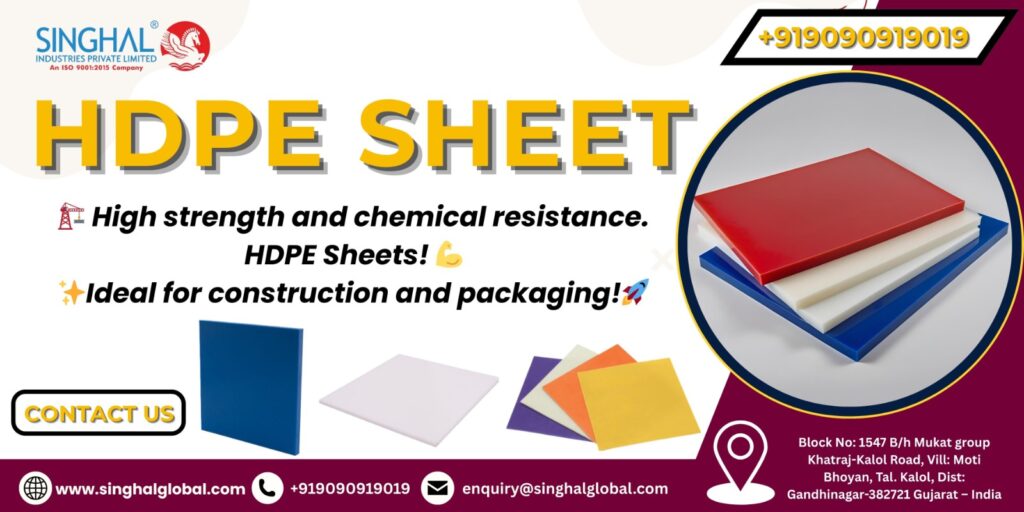
If you have ever been around a construction site, a chemical plant, or even a playground, you have most likely come across a product made of HDPE, High, Density Polyethylene without even realizing it. It is one of those materials that just silently supports the existence of the world. Actually, the role of HDPE plastic sheets is not at all small as they are used in almost everything that is the case of water tanks and pipelines, truck liners as well as marine docks. At first, they may seem like any other plastic sheet.
However, the real story starts with the properties that are hidden under the surface, the product that is made of a combination of strength, flexibility, and durability, resulting in a material that is strong enough for industrial use and still lightweight enough for easy handling. This is what makes HDPE so special.
A Brief Introduction to HDPE Sheets
HDPE (High, Density Polyethylene) is a thermoplastic polymer which comes from a petroleum source. It features a high strength to density ratio, that is, it is a lightweight material. However, it is capable of withstanding heavy loads, resisting chemicals, and surviving even the harshest of environments, whether the source of the trouble is dust from construction, corrosive liquids, or extreme weather. In a molten state, the material can be molded into a variety of shapes and sizes.
It’s a Paradox: Light, Yet Strong
A captivating feature of HDPE sheets is their ability to deliver high strength while retaining a lightweight structure. Such a fabric is so light that it can be lifted by any person without the need for a lifting device but strong to resist dents, rust, or UV radiation. This incredible mixture of strength and flexibility is what makes the HDPE sheet for construction projects so widely used.
For example, in civil construction, especially in bridge and road construction, HDPE sheets are used as protective liners or barriers most of the time. They will not break, chip, or corrode in the same manner as concrete, based or metal, based materials. I had an opportunity to talk with the administrator of a flood control project in Bihar who told me with a smile, “If steel has brute strength, HDPE has the brains.” He elaborated that HDPE, lined embankments remained intact in heavy rains, while standard concrete barriers cracked or were destroyed by water. This is the sort of testimony that discloses something about the worth of this material.
HDPE Sheets in Action
HDPE Sheets in Action HDPE sheets have a wide range of applications in the most diverse areas. Here is a list of some fields in which the brand excels:
- Civil and civil engineering: While being very useful to waterproof foundations, landfills, and drainage systems.
- Agriculture: As linings for tanks, irrigation canals, or water storage tanks.
- The marine industry: With use in floating docks, pontoons, or wave barriers.
- Industrial applications: Like chemical storage, cutting boards, and noise barriers.
- Furniture for household use: Room partitions and play equipment. Moreover, HDPE is recyclable, which is another reason to be positive about it along with its other remarkable properties.
After its lifespan, the product can be reused and recycled, thus it makes a very notable contribution to environmental sustainability.
A Closer View: HDPE in Construction
If there’s a single area in which HDPE has really made its mark, it’s in construction. Engineers love how simple it is to manufacture and cut. When you use HDPE sheets to construct, you can weld, cut, or bend them without compromising their strength and structural integrity. For example, in an ongoing site development project in Gujarat, the contractor substituted traditional steel formwork with HDPE sheets. The result? Reduced maintenance costs, simpler handling, and quicker assembly. He even said that the lightness of HDPE formwork reduced maintenance costs, made it easier to handle, and also sped up assembly. HDPE formwork helped reduce fatigue among workers, which is a benefit that you don’t think about when you are planning logistics for your material.
Comparative Study with Traditional Materials
When compared to wood, metals, or PVC, HDPE is a clear winner for several reasons:
- Resistance to corrosion: HDPE is not affected by moisture or chemicals.
- Low maintenance: The elimination of the rust, prevention layer and frequent painting is required.
- Flexible: Easy to build and install.
- Cost-effectiveness: While the initial price may appear like PVC, its longevity and lower maintenance make it much more affordable over the long term.
PVC is a popular material but tends to become brittle with time and releases harmful substances when degraded or burned. HDPE, in contrast, remains chemically stable and environmentally friendly, making it the preferred choice for safety-conscious industries. Many industrial customers have made the switch to HDPE following years of dissatisfaction with the limitations of PVC. One HDPE sheet manufacturer correctly stated at a trade show, “PVC will retire before HDPE even begins to age.” This statement, even though it’s a bit humorous, demonstrates the strength that comes with HDPE perfectly.
Economic Edge and Availability
India’s manufacturing sector has undergone a radical transformation over the past ten years. Leading to the birth of the new wave of polymer products has been a proliferation of innovations in the plastic industry. Aside from serving the local market, many Indian companies have grown to become top, ranking HDPE sheet Suppliers with a significant international presence. The extraordinary industrial plastic parks of Gujarat, full of major players, and the specialist manufacturers from Delhi NCR and Tamil Nadu, have together reached the production capacity that pretty much guarantees the continued affordability and availability of HDPE. India has thus positioned itself not only as a massive consumer of HDPE plastic sheets but also as a significant exporter of these products. Looking at everything, one thing stands out: HDPE is not just another plastic. It is a resource invested in a material that pays off over time.
Conclusion
In the field of construction and engineering, the aim is straightforward: build stronger, last longer, be more durable, and reduce maintenance. HDPE provides all that in a compact, eco-friendly, and cost-effective package. From architects and builders to industrial designers and farmers, everybody is starting to understand how reliable HDPE plastic sheets really are. They are the future of material innovations that combine performance with practicality, and sustainability doesn’t become just a secondary consideration. When you next find the sleek, glossy plastic sheets that are scattered at work sites, do not dismiss them as simply plastic. Have a closer look—you could be witnessing the underlying structure of future infrastructure.
Frequently Asked Questions (FAQs)
Q1. What is the lifespan of HDPE sheets?
Depending on the usage and the environment, HDPE sheets have a lifespan of 30 to 50 years. In many cases, they can be installed and maintained properly, and they will remain stable for longer periods than the structures they are supporting. Their stability to chemicals is one of the main reasons for such a long time performance even under very demanding conditions in the open air.
Q2. How do HDPE sheets compare to PVC sheets?
Both are extensively utilized, however HDPE sheets have superior qualities over PVC sheets in terms of the strength, chemical resistance and flexibility. Furthermore in contrast to PVC, HDPE does not decay or emit harmful gasses. Therefore, it is the most durable and safe option, especially for construction and industrial applications.
Q3. Are HDPE sheets lightweight?
One of the major advantages of this is that HDPE plastic sheets are strong and light. They bear heavy loads and very powerful impacts. This is the very reason they are easy to transport and set up since expensive lifting apparatus would not be required.
Q4. Can HDPE sheets be welded?
Yes, HDPE sheets can be joined with one simple heat-based process. It enables fabricators to join several sheets without visible joints, thus making this material perfect for producing large waterproof linings or structural elements.
Q5. Who is the largest supplier of HDPE sheets?
In India, several prominent HDPE sheet manufacturer are operating in states such as Gujarat, Maharashtra, and Tamil Nadu. like Singhal Industries Pvt Ltd The market is extremely competitive, and some of the top manufacturers export to countries in Asia, the Middle East, and Africa, making India an important global supplier.