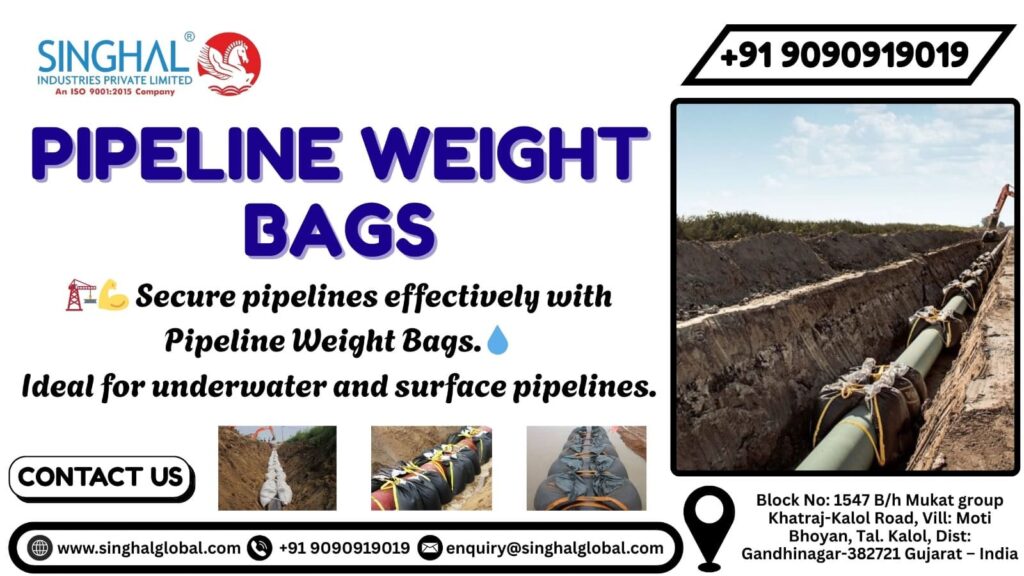
When installing pipelines over the wetlands, rivers, or marshes on the ground, one of the most difficult challenges for engineers is the control of buoyancy. Pipelines that are empty or not filled tend to sink, particularly when they are crossing the bottom of a trench that is filled with water or has a weak foundation. This is the point where Pipeline weight bags step in. These geotextile-based products are popular for permanent and temporary weighting. They offer the flexibility, affordability, and frequently more environmentally friendly option to concrete weights and rigid systems.
What Are Pipeline Weight Bags?
Pipeline bags that weigh weight, often called Geotextile pipeline bag weights as well as pipeline saddle bags, are specially designed containers of textile made from polypropylene with high-strength or similar geotextile fabrics. The bags can be filled with local aggregate such as sand, gravel, or crushed stone, and placed on or around the pipeline to create upward force and to prevent uplift. In contrast to solid concrete weights, these bags are flexible and easy to empty and are able to be easily transported to distant locations. After being filled, the bags form to the shape of the pipe as well as the trench, which decreases pressure on the coating and enhances stability.
Permanent vs. Temporary Weighting Applications
Pipeline weight bags are used for both permanent and temporary situations, based on the design, the material’s quality, and the project’s requirements. The use of temporary weights is typical during commissioning or construction when pipelines are completely empty or not fully filled and more susceptible to floating. Bags are positioned over the pipe in order to hold it in place until backfilling is complete, or until the system has been pressurized. Permanent weighting is employed in wetlands, rivers, and marshes, as well as lakes in areas where long-term buoyancy control is crucial. In these situations, manufacturers typically offer UV-stabilized, higher-gsm geotextiles that last for years underwater. Because they’re non-biodegradable and can be used in the event of need, pipeline weight bags are an alternative to “middle surface” between throw-away ballasts and concrete weights fixed.
What Are the Reasons They Are Used to Build Pipelines?
Engineers select pipeline weight bags for a variety of practical reasons.
- Control of buoyancy: These offer an unreliable buoyancy effect, which keeps the pipeline at the trench’s bottom in saturated or water-laden soil.
- Protection for coatings: The textured, flexible exterior of the bag decreases points of loading and abrasion, which protects the anti-corrosion coating of steel pipes.
- Logistics and cost: Bags are generally less expensive to manufacture and set up as compared to concrete weights, particularly when local fill materials are utilized. Bags also need less trench length and dewatering, which reduces the cost of excavation.
- Environment-friendly: Geotextile pipeline bags affect environmental conditions less than concrete structures. They can also be removed in the event that the pipe is ever removed or changed.
All of which makes them a great choice for gas, oil, or water. They can also be used for pipelines made of fiberglass or plastic crossing challenging or difficult terrain.
Geotextile Pipebag Weight: Material and Design
The typical geotextile pipeline bag is made from woven, non-coated polypropylene material, which is chosen due to its strength, tensile strength, and chemical resistance, as well as very low moisture absorption. The cloth is typically checked as per ASTM standards and is accompanied with the particular GSM (grams per square meter) to ensure the durability. The majority of the designs are based on a saddle bag design, whereby each end of the pipe has two chambers or lobes and is connected with straps that go around the pipe completely. This reduces the center of gravity and distributes the load uniformly improving the stability and traction of the bottom of the trench. There are also some systems that are fitted with legs or flaps that are open during placing and lifting, which are easier and more secure to install.
Pipeline Weight Bags Cost: What Is the Impact on Cost?
In the Pipeline weight bags Price when customers enquire, this is a number of factors that come into play:
- Fabric quality and gsm: The increased gsm, UV stabilized and ASTM tested fabrics are more expensive but with longer life especially when it comes to permanent submersible applications.
- Dimensions and weight capacities: Bags are between 100 kg and many tonnes after being filled. The bigger or heavier models cost more.
- Fill material: Fill material made of locally-sourced aggregates or sand is important to ensure that the overall construction cost is minimized due to reduced transportation of the ballast.
- Personalization and quantity: Bulk orders tend to be cheaper per unit though, tailor-made shapes, colors or certifications which are individualized can increase the cost.
Are They Waterproof?
They are made of UV-resistant, high-gsm polypropylene, which is resistant to degradation by sunlight, water, and other common chemicals used in groundwater and soil. The majority of these systems are constructed to last for decades in riverbeds, wetlands, and coastal zones, so long as the fabric isn’t physically damaged during the installation. Since the bags are not biodegradable and can be inspected and taken away if necessary, they are therefore often preferred over stone or concrete ballasts in areas that are environmentally sensitive.
Who Is the Largest Producer of Pipe Weight Bags?
There isn’t a single, universally accepted “largest” maker, however many regional and global companies dominate the pipeline weight-bag market.
- Singhal Industries Private Limited (India) is a major manufacturer of pipe weight bags as well as saddle-bag weights. They supply high-gsm polypropylene bags to pipeline projects across the globe.
- Other noteworthy brands include Pipe Sak Geotextile pipe weights and Rock Guard Pipe Weights which concentrate on permeable, breathable geotextile bags to control buoyancy.
When deciding on a supplier, buyers should check the fabric’s gsm, ASTM test reports, UV resistance and experience for similar projects instead of just relying on the brand names.
Conclusion
If you’re considering an oil pipeline project that will cross zones of water or has unstable soil, pipeline weight bags—particularly geotextile bags for pipelines—can be a cost-effective, efficient solution for temporary as well as permanent weighting. With the proper design and quality of the material, they can provide long-lasting durability, protection for coatings, and can be more efficient than traditional ballasting techniques.
Frequently Asked Questions (FAQs)
Q1. Are different weight capacities available?
Yes. Pipeline weight bags are available in various sizes and designs, which allow weights filled from about 100 kg to several tonnes, based on the bag’s volume and fill materials. The engineers can make sure that the ballast is precisely matched to the requirements of buoyancy for the pipeline.
Q2. What are pipeline weight bags?
Pipeline bags for weight are constructed of high-strength polypropylene woven fabric. They are filled with sand or gravel and placed on or around pipelines to reduce buoyancy and offer stability. They’re also referred to as geotextile pipeline saddle bags, Geotextile pipeline bag weight, or pipeline saddle bags.
Q3. What is the reason they are employed to build pipelines?
They’re used to avoid the flotation of pipelines in water-filled trenches and wetlands, rivers, and marshes, as well as protecting the coating of the pipe and reducing costs for installation. Their flexibility, convenience of transport, and compatibility with fill materials local to the area are attractive for use in permanent or temporary weighting.
Q4. Are they waterproof?
Yes, the best geotextile pipeline bags are specifically designed for long-term use in the water with UV-resistant high-gsm polypropylene, which will endure for a long time in lakes, rivers, and wetlands. They are not biodegradable and are usually checked or removed when needed.
Q5. Who is the largest manufacturer of Pipeline Weight Bags?
There isn’t a single widely acknowledged “largest” producer; however, significant players include Singhal Industries Private Limited (India) as well as several brands from around the world including PipeSak, ECOBAG, and RockGuard PipeWeights. Buyers must consider the quality of fabric tests, certifications for testing, and project references prior to deciding the supplier.