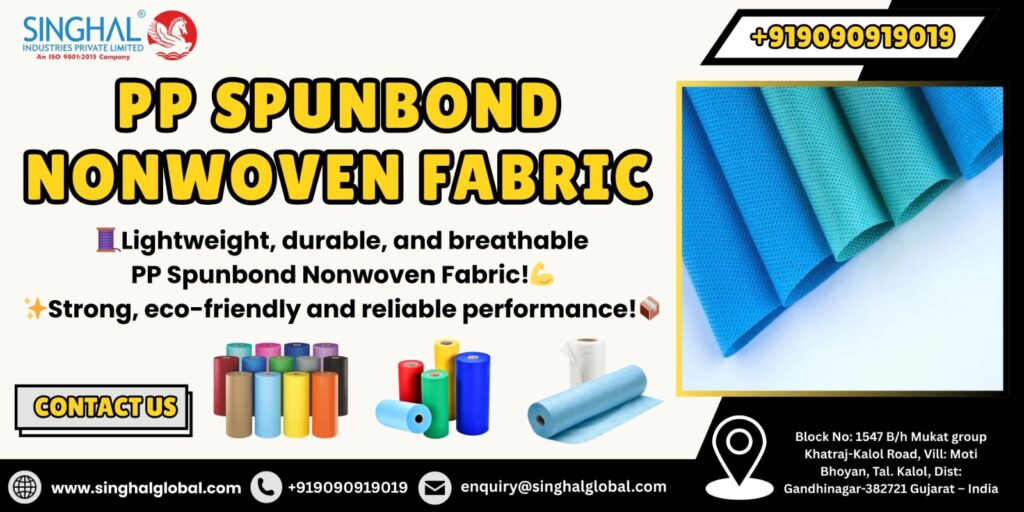
PP spunbond fabric is now an essential backbone for contemporary hygiene as well as sanitary items, because of its breathability, softness, as well as its high-performance barrier characteristics. From diapers for babies and sanitary napkins to scrubs and medical dressing gowns, the lightweight polypropylene-based fabric is revolutionizing the way brands create safe, comfortable, and economical products. Here we will look at the reasons PP spunbond fabric is widely used in hygiene, what it means for you, how Indian manufacturing and supply chains are integrated into this global chain, and what buyers need to know prior to making a purchase.
What is PP Spunbond Nonwoven Fabric?
PP nonwoven spunbond is fabricated of 100 percent polypropylene (PP) resin, which melts down, is molded into continuous filaments and then woven into webs and bonded by applying pressure and heat. It is an outcome of a robust light sheet that is good in tear strength, good in dimensional stability and enormous in skin comfort. Contrary to other types of textiles, the spunbond fabric is created by a single step that keeps the cost of production low and the output extremely consistent. This is one reason why it’s used so extensively in the production of hygiene products like diapers, sanitary pads, and disposable medical clothing.
What Makes PP Spunbond the Best for Hygiene Products
One of the primary factors behind why PP spunbond is widely used in sanitary and hygiene products is that it achieves a sensible equilibrium between comfort, protection, and sustainability. It’s naturally hydrophobic enough to create the necessary moisture barrier while being air-tight enough to prevent the amount of clamminess that can be found in disposable diapers as well as adult incontinence pads. For medical use, this fabric is utilized for disposable coversalls, gowns, caps, masks for faces, and sheets for beds because it has strong strength, is lightweight, and causes minimal irritation on the skin. In the field of feminine hygiene and infant care, it is often used as a backing sheet (outer sheet) in addition to a soft top sheet for diapers and sanitary napkins. Numerous manufacturers offer treated hydrophilic or antibacterial grades, so that the fundamental PP spunbond technique could be used for wipes, underpads, as well as products for incontinence that require improved absorbency and skin-friendly performance.
The Role of the Indian Manufacturer and Supplier
India has built a solid foundation of polypropylene-spunbond fabric manufacturers who support local brands as well as global hygiene product manufacturers. A reputable Polypropylene spunbond nonwoven fabric manufacturer India typically operates continuous lines with high speeds, which ensure constant GSM (grams per square meter) control and dimensional precision for roll goods that are used in high-speed pad and diaper machines. A reliable nonwoven spunbond fabric supplier from India acknowledges that hygiene-grade fabrics require higher levels of cleanliness, more stringent defect control, as well as custom formulations (for instance, hydrophilic finishing and UV-resistant coatings). They frequently work with their clients to adjust their weight range, color width, dimensions, and roll packaging to ensure that the material flows easily onto converting machines with no breaks or jams. However, companies that are called out often point out their position as a “polypropylene spunbond, nonwoven textile producer in India” to indicate that they don’t just manufacture locally, but also export. This helps those who are looking for a combination of competitive prices and cleaner, more reliable supplies rather than directly importing from China.
Export-Focused Firms and Global Demand
For international hygiene brands, locating an authentic Spunbond nonwoven fabric supplier India is crucial to diversifying the sources of supply, reducing logistics costs, and speeding up lead times. A lot of Indian exporters are already shipping their products to Southeast Asia, the Middle East, Africa, and portions of Europe and South America, aligning their products to international hygiene standards. Hygiene-grade PP spunbond rolls exported from India often carry additional documentation: mill test reports, certificates for non-toxicity, and—increasingly—documents related to environmental compliance. This is crucial when you import into countries where the requirements are for proof of the material’s safety when it is used in medical environments. In the world, China remains home to the top exporters and producers of PP spunbond fabric. However, many of the companies there are specialized exclusively as exporters with no direct involvement with conversion lines. India’s expanding “Spunbond nonwoven fabric exporter India” ecosystem provides buyers the option of a different route if they need closer technical collaboration and a more flexible service.
How to Select the Best Service Provider
When selecting a spunbond polypropylene nonwoven fabric supplier in India or a spinbond nonwoven fabric supplier in India, buyers shouldn’t solely focus on price. Important indicators include:
- Consistent GSM and dimensional stability for many thousands of meters.
- The availability of specific grades for hygiene (hydrophilic embossed, soft-feeling, antibacterial, or UV finishes).
- The track record of the company that supplies converter lines for sanitary pads, diapers, and medical disposables.
It’s also recommended to ask for a few trial rolls prior to placing orders for full containers to ensure that the product can be evaluated for lamination performance, runnability, as well as the comfort of the user in the finished product.
Conclusion
PP spunbond nonwoven fabric has been indispensable in modern sanitary and hygiene products, offering brands an established platform for building comfortable, breathable, and useful products. For companies looking for more regional support, selecting a trusted Polypropylene spunbond nonwoven fabric manufacturer India and a spunbond nonwoven material provider in India could mean faster delivery, more efficient service, and simpler customization. As the demand for safer, more sustainable hygiene products grows, you can anticipate further advancements in PP spunbond, such as lighter weights, better fluid-management finishes, and compostable or recyclable options, all with clearer and more detailed documents from Indian nonwoven suppliers and exporters.
Frequently Asked Questions (FAQ)
Q1. Are custom-designed widths made?
Yes, most reputable manufacturers are able to produce custom widths, usually ranging from smaller rolls (around 50-80 cm for the specialty line of sanitary products) all the way to full-converting widths of around 320-340 centimeters for high-speed pad and diaper machines. Custom widths are typically considered during the order-planning phase together with GSM, coating requirements, and roll-core sizes, so that the fabric can be inserted right into the converter’s equipment without trimming.
Q2. Are export grades available?
Yes, the hygiene grade PP spunbond is usually shipped with export quality, which means more precise tolerances on GSM and fewer flaws, and carefully controlled end of the roll and care with regards to packing (moisture-proof wrapping, solid cores, and pallet wrap). Export-grade fabrics are typically covered with comparative specifications to allow international buyers to compare their scores against others or alternative materials without having to re-engineer their production lines.
Q3. Do you have quality certifications?
The top manufacturers and leading suppliers in India frequently issue quality certifications and mill test results, which cover GSM, tensile strength, elongation, and often the claims of permeability or antibacterial when appropriate. For medical-related applications, the certificates can refer to general international standards (like ISO or EN indicators in the documentation) or internal laboratory test records. Buyers should verify the requirements for documentation and request samples of reports prior to mass ordering.
Q4. Does it find its way into hygiene products?
Absolutely. PP spunbond fabrics are extensively employed in sanitary and hygiene products, such as diapers for babies and sanitary napkins, as well as adult-care products, incontinence pads, bed protectors, bed covers, and medical disposable gowns. It is used as an upper sheet (soft skin-touch layer) or a backing sheet (moisture-barrier layer) or a part in composite structures (SMS/SSSS) used in masks and medical gowns, depending on the GSM as well as the finish and lamination type selected.
Q.5 Who is the largest exporter of PP spunbond fabric?
Globally, the top exporters of PP spunbond fabric are mostly large-scale manufacturers located in China, where several companies have the largest share of production and export shipments. Within India, the various “Polypropylene spunbond nonwoven fabric manufacturer India” and “spinbond textile exporter India” companies like Singhal Industries Pvt Ltd are smaller in terms of volume but are increasing their market share by focusing on medical and hygiene-grade fabrics and streamlined customer service.