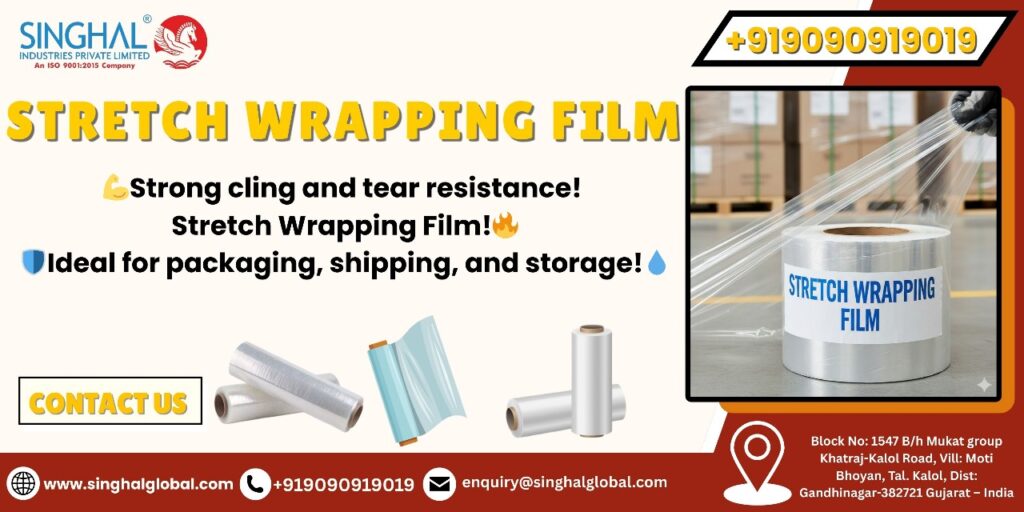
The warehouse world is full of tumultuous events where goods are stacked and moved in and out at a high rate of speed. Amidst such hectic circumstances, it is sometimes difficult to ensure the safety of the operation as well as carry out the task of checking and managing the inventory efficiently. Stretch film acts as a savior to these warehouses, which is a seemingly insignificant glory, yet has changed the way warehouses work today in a fantastic way. Besides that wrap plastic, it is indispensable in the storage area; it is the means to make things safe, orderly, and more straightforward, and at the same time being very economical.
What is Stretch Film and Why Does It Matter?
Stretch film is a stretchable or flexible material of a certain type, normally polyethylene, the purpose of which is to wrap goods presented on pallets or even separate commodities tightly. Actually, it has a small surface, but it is very strong and steady at the same time. In effect, the ability to lock different products on the same package ensures all goods are impassable shifts that are the root of falling or even hurting problems during transfer or storing. Besides that, the translucence allows the fast access of the products under the film without it being a saver in fast-paced warehouse environments.
Usually, the cost of stretch film is figured out by its weight, with the term “Stretch film price per kg” used for this matter, while different lengths or widths of films appear as rolls. In the meantime, the price of a roll of stretch film per kg can be altered owing to differences in quality and supplier, but it is mostly kept at a reasonable level in contrast with other types of packaging. This combination of low cost and productivity made it a vital element in warehouse operations across the globe.
Stretch Film and Warehouse Safety
Visualize a warehouse that has stacked pallets without any type of wrapping in an untidy manner. In this scenario, pallets are bound to move during transit, boxes will fall and get damaged, and workers will find it difficult to work under the conditions of the unsafe stacks. The use of stretch film gets rid of such problems.
For instance, a local distribution center only changes product damage scenarios to postpone load stability to blame, hard times they have faced! By wrapping their pallets with stretch film, they solved the problem, which resulted in fewer accidents due to falling boxes and a decrease in damaged goods reports. Their products were kept safe, and so were their employees from being hurt in the process — a perfect harmony. The film can almost be likened to a safety net that presses close to hold the contents tightly and makes them less prone to getting shaken.
How Does Stretch Film Help Inventory Management?
Inventory management is definitely much more than just having the knowledge of the stock. It also includes the aspect of making items readily available, trackable, and capable of being handled. Stretch film roll is also very effective in this respect. By packing like products together or alternatively using printed or colored stretch films on pallets, warehouses can ultra-quickly pick orders and, at the same time, reduce mistakes. For example, a warehouse could decide to utilize red-colored stretch film in the case of fragile goods and blue for electronic products so that all handlers could immediately understand what to do with each load and how to take care of it properly.
Besides that, workers can easily unveil barcodes or labels under the stretch film and scan or check them without the need for taking off each wrapping, thereby saving time as well as cutting down on the handling of goods which is unnecessary. Stretch film’s asset in the reliable and visual execution of stock makes the running of warehouses simple.
Balancing Cost and Quality in Stretch Film
The price per kg is one of the main factors when deciding to purchase stretch film, but it is not advisable to compromise quality. An inexpensive film might result in a money saving initially, but due to the fact it can tear easily and not provide sufficient stretching, ultimately product damage and consequently higher losses will occur. Whereas, by spending just a little more on a strong stretch film roll, you get better protection and less trouble.
By and large, it is more cost-effective to purchase stretch film in rolls than in smaller parts, and being aware of the Stretch film roll price per kg will be of assistance to you in budget planning. One is able to perform such calculations by thickness and length of the film and also by source material i.e. virgin or recycled polyethylene.
Conclusion
Minimalism can be called a characteristic of stretch film which can be cited as an example of a tool that helps warehouse safety silently, it makes stock-taking easier and the company saves on the packaging budget. Its different applications in various industries are a proof of its flexibility. It does not matter whether you are wrapping the monstrous shape of an item or securing a towering pallet load, stretch film is a smart, cheap way out.
On top of that, if you are in warehousing or logistics, a thoughtful and serious stretch film use consideration amount, type, and manner of use might be the factor that works your operation turning point. Needless to say, safety and efficiency are not only objectives; they are the fundamentals of success.
Frequently Asked Questions
Q1. How do I properly wrap pallets with stretch film?
The best way to do it is to tie the film at the bottom of the pallet. After that, wrap the pallet horizontally, making sure that each side overlaps one another. Then, with your hand, move the film vertically and wrap from the top down to the base for extra support. Make sure the wraps are not too tight to avoid damaging the product but tight enough to keep it firm. Using a stretch film dispenser or a machine can make the process smoother and more consistent.
Q2. What industries commonly use stretch film?
Almost every industry that involves processes which need packaging uses stretch film; these are manufacturing, food and beverage, pharmaceuticals, electronics, retail, and logistics. All these sectors benefit from the protective qualities which the film has and also from its low price. For instance, a fresh produce packer uses it to make the crates safe and keep the moisture out, while an electronics company depends on stretch film for protection against dust and static.
Q3. Can stretch film reduce packaging costs?
Certainly. In comparison to large and heavy boxes, tapes, and straps, stretch film is a lot lighter and less expensive. Just think of the time and material saved, which is equal to labor and shipping costs. Several companies have reported that their total packaging costs have dropped after they switched to stretch film, while still making sure their products are safe and intact.
Q4. Are colored or printed stretch films available?
There are no restrictions on colored or printed stretch films; anyone can have access to these types of films. These products are used for color identification of goods in warehouses, for packaging branding, or for theft deterrence by hiding the contents. Black, red, blue, and yellow are the most common colors, and office prints with company logos or handling instructions can be inserted to make it look professional. It provides both functional and advertisement advantages.3
Q5. Who is the largest supplier of stretch film?
Globally, to name a few, Tilak Polypack is one of the big players in manufacturing and supplying high-quality stretch films with a long international network of customers. In India, companies such as Singhal indutries Pvt Ltd and Stretch N Wrap International are significant entities producing thousands of metric tons to meet the needs of the market growing at a fast pace.